
Italian company supplies filters to Formula 1: a little-known story of technology made in Italy
UFI of Nogarole Rocca (VR) makes customised filtration systems for all single-seaters, developing solutions that are also used for road vehicles
by Danilo Loda
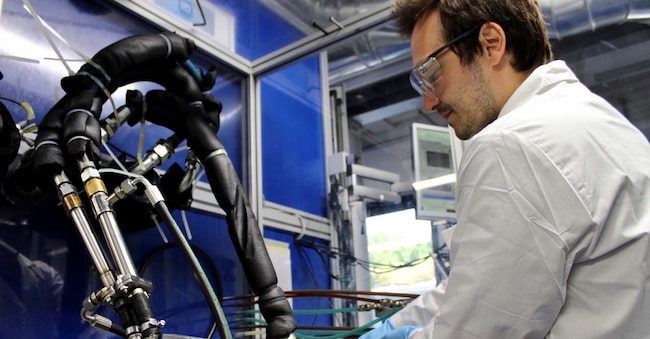
The world of Italian companies, if you probe it with a little attention, always holds some nice surprises. Let us take the case of UFI: it produces filters for cars and trucks, but also for helicopters and space probes, between Nogarole Rocca and Marcaria (headquarters of the Advanced Applications Division), in the lands that unite the provinces of Verona and Mantua. And it also does so in another twenty or so plants, seven of which are in China, with a total of 4,300 employees, three research centres (in Italia, China and India) and a turnover of around EUR 600 million. One of the big names in the filtration sector, therefore, also present in other fields (thermal management of electric vehicles, hydrogen), original equipment supplier to 95% of car brands and to a number of manufacturers that accounts for half of heavy vehicle production. A creature of Giorgio Girondi, an entrepreneur also known in the world of finance who, having taken the reins of the company founded by his father in 1971, has led it to the conquest of the world, landing as early as the early Eighties with the first plants in China, at that time a planet still half-unknown to the great managers of the automotive industry.
But, and herein lies the biggest surprise, UFI is now also a company capable of supplying filters to all eleven Formula 1 teams competing in the 2026 World Championship. How it arrived at this milestone almost by chance is a story worth telling. One day in the second half of the 1970s, in fact, two Ferrari technicians, passing on the motorway near Nogarole Rocca, saw the signs of a filter company. Concerned as they were about the high pressures developed on the circuits of Maranello's 12-cylinder F1 boxers, they crossed the threshold of that small factory to discuss the possible supply of components. Niki Lauda was the first to test them at Fiorano, to his satisfaction; Carlos Reutemann, on the other hand, had the opportunity to be the first to win a Grand Prix (the 1978 British Grand Prix) with a 312 T3 fitted with UFI filters.
Customised Components
Thus was born a relationship with Ferrari that has lasted to the present day, in which UFI supplies more than 6,000 filters a year to all Formula 1 teams, in a variable number of up to 15 for each single-seater, distributed between the engine area (main and secondary filters for the oil, high-pressure circuit and air) and the chassis area (filters for the cooling circuit of the engine and its hybrid component and hydraulic filters for the brakes, power steering and wings). All filters are made on the basis of the specifications of each team, in the imaginable confidentiality, in a constant dialogue with the teams' designers, who communicate their requirements when defining the single-seater for the following season. When the championship is underway, changes may then be requested to be made as quickly as possible, dictated by the developments of the cars, but also analyses of the filters used, which turn into warning lights of possible problems with the propulsion systems.
Even such an apparently banal component as a filter, on the other hand, has now reached a high degree of sophistication, both in terms of weight containment - which has gone from a hefty kilo in the 1970s for petrol filters to just over 60 grams today, thanks to the use of materials such as titanium, carbon, ergal and stainless steel - and in terms of filtration performance, and new types of oils has in fact imposed technological solutions for the realisation of filter media that are capable of warding off possible adverse chemical reactions, employing for this purpose raw materials such as glass fibre, polymeric fibres and novel polymer mixes. For the bonding of the filter elements, on the other hand, adhesives are used that are usually destined for aeronautical applications.

