
Italian craftsmanship explores digital culture
Confartigianato: Ai used by a fifth of the realities but difficulties in skills and governance weigh heavily

3' min read
3' min read
In Guardavalle, a village in Ionian Calabria, there is a designer who has returned to her homeland to recover those fabrics linked to the community's history. Among these is broom fibre. "It is resistant and we transform it into textile fibre," says Flavia Amato, 35, who ten years ago opened Malìa, a laboratory connected with the world. To date there is no industrial processing to extract the broom yarn, but with researchers from the University of Calabria we have tried to digitise the process. A strategic alliance that accelerates digital transformation. Flavia is in good company. In a historic company in Lurago d'Erba, six thousand souls in the Como area, generative artificial intelligence exploits information from all company documents to accompany the entry of new recruits. Thus Bonacina 1889, now in its third generation and leader in the production of reed and wicker furniture exported at 90%, secures the transfer of skills.
Craft Skills
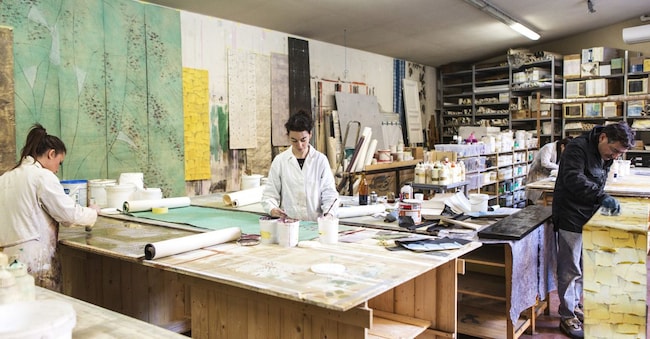
.In Milan, immersive digital spaces become a guide to the creation of hand-painted wallpapers. The Fabscarte workshop hosts some fifteen designers working with New York, Paris, Munich, London, Tangier. "We have taken a direction against closure and are open to contamination, but there has to be a common feeling," says Luigi Scarabelli, co-founder of Fabscarte. Hands, certainly. But it is clear that the revolution in craftsmanship comes from the head, that is, from the awareness that new profiles and technologies can hack craftsmanship. Today there are 1.25 million active handicraft enterprises in Italy for a global handicraft market value of around USD 1,100 billion and a projection of over USD 2,300 billion by 2032. Products and services are being rethought, market boundaries are expanding, possibilities are multiplying, and waste is being reduced. The transformation is multi-level: internal processes, shared design, smart labs, quality control with sensors. But above all people. So the shop comes alive by learning to graft new tools, evolved skills, transversal alliances. 'If we are too protective, then we block progress,' Carolina Roux wrote in the Financial Times.
Declining investments
.Meanwhile, the Confartigianato study centre took a snapshot of the adoption of artificial intelligence. While overall digital investments have slowed down from 70.8% to 66.8%, Ia is becoming a driver for digitisation. As of today, almost two out of 10 (19.3%) have experimented with Ia applications, a higher share than the general business average (11.4%). The difficulty lies in introducing the technology, finding skills, and allocating investments. "Ia is a means governed by the craft intelligence of entrepreneurs to enhance their talent. For example, digital twins make it possible to visualise and refine projects before they are physically realised, and Ia is used to obtain information on market trends, customer preferences and optimisation of production processes,' says Bruno Panieri, Director of Economic Policies at Confartigianato, which has launched Gate4Innovation, a hub that offers companies assessment of their level of digital maturity and proposes actions to access financing tools. But the brake remains skills: 7 out of 10 professionals do not know how to introduce Ia.
Micelli: digital to dialogue with niches
."Artisan enterprises need digital technology to dialogue with niche consumers in search of uniqueness. There is a growing demand that is curious and willing to recognise the value of quality proposals that are authentically linked to their territories of reference," says economist Stefano Micelli, professor of international management at the Venice School of Management of Ca' Foscari University in Venice and president of Upskill 4.0. Thus was born the first edition of Artigiani 4.0, a digital and managerial acceleration programme promoted by the Lombardy Region and implemented by Upskill 4.0, which accompanied nine excellent Lombardy artisans in the development of innovative solutions to become more competitive on the market. "Evolved craftsmanship promotes tailor-made products and services that set in motion more durable and sustainable consumption. Quality craft products are an alternative to fast consumption in many sectors. But beware: the condition is to embrace the digital culture,' Micelli concludes.

