
Italian football must become a cultural industry
The challenges facing the new federation president, Giovanni Malagò, as he grapples with the decline of Italian football

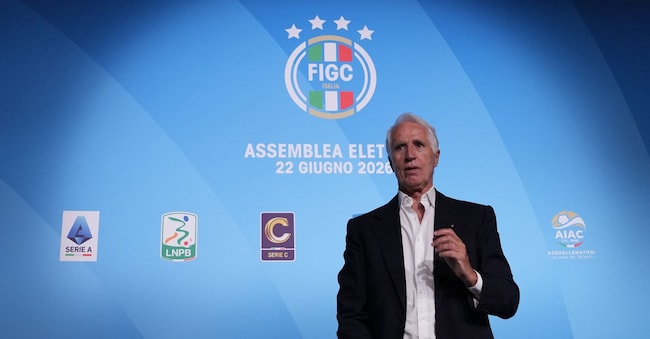
The winners go to the World Cup. The losers re-elect the federation president. For far too long, Italian football has been going round in circles, fixated on this paraphrase of a maxim coined by Julio Velasco, the most successful coach in the history of volleyball. Yet there is a fundamental misunderstanding that has accompanied the debate on the crisis in Italian football for years: the health of the system continues to be gauged on the basis of sporting results (which are certainly not flattering), without addressing its structural weaknesses. The national team’s defeats, the struggles in European competitions, and the widening gap with the Premier League – and other more agile models such as La Liga – are merely the visible manifestation of a deeper deficit, one that relates to the economy, facilities and governance.
It is against this backdrop that Giovanni Malagò takes up his new role as president of the Italian Football Federation, having just completed a long tenure at the helm of CONI. He is, therefore, a figure who understands the complexities of Italian sport but who is now called upon to tackle a sector which, rather than merely a sporting sector, is – or should be – a cultural and financial industry. With all that this entails in terms of legislative support.
The first issue is the economic one. The Italian model remains overly dependent on domestic TV rights (and will continue to be so after the forthcoming renewals), with a limited capacity to generate alternative revenue streams. Sponsorships, merchandising and, above all, the internationalisation of the brand are levers that remain underutilised. Against a backdrop of stagnant revenue, costs – particularly wages and commissions – have remained rigid, squeezing margins and leading to constant losses that are weighing down the balance sheets with over 5 billion in debt, thereby reducing investment capacity. The challenge for Malagò will be to promote the transition to genuinely sustainable models. The second front is infrastructure. Stadiums represent Italy’s most glaring anomaly: obsolete facilities, widespread public ownership and cumbersome authorisation procedures. In a sports economy increasingly geared towards experiences and entertainment, a stadium should be an asset capable of generating revenue all year round. Without a significant improvement in this regard, the system will continue to lose competitiveness. Although the FIGC has no direct powers, it can play a role in exerting pressure and coordinating efforts. Thanks to his network of contacts and institutional clout, Malagò can act as a facilitator for a dialogue – which has so far been ineffective – between clubs, local authorities and the government. Then there is the issue of governance, historically the weakest point in Italian football. The fragmentation between leagues, the federation and institutions has resulted in a slow decision-making process, often paralysed by conflicting interests. League reforms, a fairer distribution of resources and the very definition of business strategies all come up against short-term thinking. The real change that Malagò is called upon to bring about concerns precisely this: transforming the FIGC from a place of mediation into a centre for strategic direction.
Alongside the systemic reforms, a number of operational decisions of great symbolic significance have been taken, starting with the appointment of the new head coach and the idea of introducing a liaison figure between the federation and the national team: a technical director with strong credibility, capable of liaising with the new head coach and guiding sporting decisions. The names being mentioned, such as Paolo Maldini, point to a clear direction: strengthening sporting expertise within the federation’s structure.
On a political level, the priorities outlined by Malagò are reasonable and, all things considered, widely supported: extending the ‘ius soli’ principle in sport, reintroducing a mechanism similar to the ‘Decreto Crescita’ to attract international talent, reviewing the ban on betting-related advertising, and allocating a share of betting revenue to the football system. The real challenge will be to channel these resources towards supporting youth sectors and basic infrastructure, such as sports centres and high-quality academies for the all-round development of young talent. And it is precisely the issue of talent that represents the most strategic factor in the medium to long term. Italia has lost its leading role in the development of footballers, whilst other countries have built integrated models combining academies, scouting and training methodologies. The result is greater dependence on foreign talent (partly due to more favourable regulations) and a decline in the average quality of squads. Taking action here means rethinking the entire supply chain: from coaches to facilities, right through to incentive mechanisms for clubs. Ultimately, all these strands converge on a broader issue: the culture of the system. Global football is now an entertainment industry, in which organisational models compete even before teams do. Italia is lagging behind in adapting to this transformation, remaining anchored to twentieth-century ways of thinking. Malagò’s mandate will ultimately hinge on this very issue: guiding Italian football through an industrial revolution from which it has been sidelined for far too long.


