
Robotics: an Italian-German partnership to revitalise Europe
Neura Robotics and Arezzo-based Seco have announced an agreement for the production of computing modules that will be used in the German company’s robots

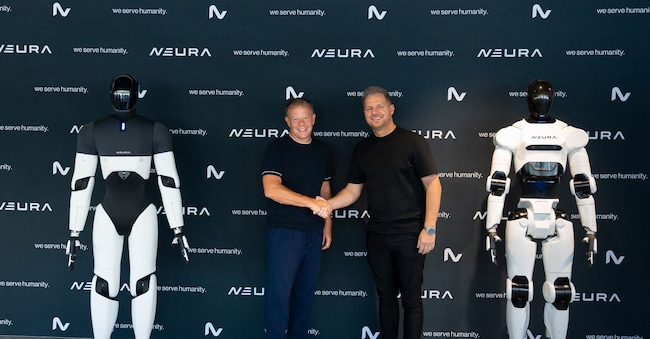
An Italian-German partnership to counter the Chinese advance in the world of humanoid robots. This is the agreement signed between Neura Robotics and Seco, who have announced a deal to produce the computing modules that will be fitted into the German company’s cognitive robots, including the 4NE1 humanoid. Seco, based in Arezzo, will be responsible for the design, engineering and production of the circuit boards, which are built around Qualcomm Dragonwing processors. The market reacted positively to the agreement straight away, with Seco’s share price rising by more than 7 per cent on the Milan Stock Exchange.
The financial context surrounding this deal is particularly interesting. Neura, founded in 2019 in Metzingen (in the German region of Baden-Württemberg), has become the biggest European investment in the robotics sector. Shortly before the summer, in June, it closed a Series C funding round worth around $1.4 billion with leading investors (Tether, Qualcomm, Amazon, Nvidia, Bosch, Schaeffler and the European Investment Bank). This round valued the company at around 7 billion. The company reports an order book worth one billion euros and aims to produce five million robots by 2030. There are, of course, some doubts surrounding this latter figure, but it is a statement of intent that captures the spirit of the German firm very well. It is interesting, in the context of Neura, to note the absence of the Californian giant Qualcomm, which is both an investor and a supplier of semiconductor chips. This is now a common arrangement in this market, one which makes the role of each party less neutral.
In Italia, however, Seco’s story is quite different. Listed on the Milan Stock Exchange since 2021, with revenues of around two hundred million, the Arezzo-based company operates in various areas of the IT sector. It is currently a small-cap company. Now, undeniably, a supply contract for a humanoid robot – which is ultimately funded by companies such as Tether and Nvidia – changes certain perspectives. Although the actual impact of this partnership on the profit and loss account has not been clarified.
In the official statement, the two companies are already discussing the next stages. For example, a Neura Gym in Italia – the group’s first training centre in southern Europe – and the joint collection of real-world data in factories, with a stated application to the production of semiconductors and electronics. The idea is that European industrial processes will serve as raw material for training the machines, and that the expertise gained in this way can be reused elsewhere.
“Physical AI will not be built by a single company. It requires an ecosystem encompassing sensing, computing, the cloud and industrialisation,” said David Reger, Founder and CEO of Neura Robotics - “Through our collaboration with Qualcomm Technologies, we are advancing the computing that underpins our Brain + Nervous System and Smart Limb architecture, whilst SECO brings further European expertise in engineering and manufacturing to help us scale it up. Together, we will use real-world industrial processes to generate data and develop Physical AI solutions for semiconductor manufacturing that can ultimately be deployed anywhere in the world. This is exactly how I believe Europe should approach Physical AI: by combining our industrial expertise, building together and scaling it up globally.”

