
Italian table grapes, booming exports threaten the primacy of apples
Sales abroad increased by 13% in value supported by the 30% price increase. Declining quantities, also affected by the switch to seedless varieties
3' min read
3' min read
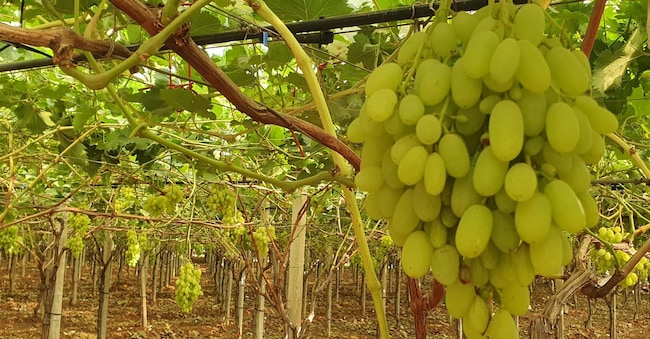
The export of Italian table grapes is booming: between 2022 and 2023 it grew by 12.8%, reaching almost 821 million euros, Ismea estimates, despite the fact that exported quantities decreased by 13.5%, stopping at 384 thousand tons. Supporting the value of exports was, therefore,the 30.4% annual increase in prices, which reached an average of 2.14 euro/kg. A sign that grapes made in Italy are succeeding in gaining recognition and value on foreign markets, where 43% of national production ends up. More than is eaten in Italy, since the domestic consumer market absorbs 'only' 38% of total annual production, while another 15% is sold to processors to obtain juice.
Italy is the world's third largest exporter of table grapes, behind Peru and the Netherlands, and grapes are the second largest fruit, after apples, in terms of turnover generated by exports. But overtaking seems close. "In a short time the grape is destined to exceed 1.2 billion euro in exports, because it is appreciated and sells well in many markets," explained Mario Schiano Lo Moriello of Ismea during the Regina di Puglia event organised by the Municipality of Noicàttaro, leader of the Terre dell'Uva network that involves seven municipalities in the south-east of Bari, Italy's largest production basin (24% of national volumes) - The good production potential and the prolonged commercial availability of the product will increase the quantities available and, at stable prices, bring a greater return to producers and open up new markets, which are necessary to support exports,' he said.
That Italian table grapes appeal to foreign consumers is a fact and the multi-year growth trend in exports confirms this. There are important and established markets, such as France, Germany and Switzerland, that continue to appreciate historical varieties (such as uva Italia or Vittoria). But global preferences go towards seedless grapes, which from Great Britain to Scandinavia continue to gain market share.
Italian growers are able to satisfy both of these needs, thanks also to a decisive varietal renewal that has introduced new types of seedless grapes, especially in Apulia, where 57% of national production is concentrated and where in just a few years about half of the historical plants have been uprooted to introduce the new seedless varieties. Almost all of these are grapes developed by big international breeders but there is also an all-Apulian one: it is the Maula, a new native, early and black berry variety, obtained from a breeding project financed by the Apulia Region and carried out by Crea (Council for Research in Agriculture and Analysis of the Agricultural Economy) and the Nuvaut Producers' Consortium.
The transition phase to seedless grapes is negatively affecting yield per hectare and total production (884,000 tonnes in 2023, i.e. 14% less than in 2018), but is increasing the quality level and, therefore, the price recognised by the market. And it is opening up new markets, particularly in Arab countries and South America. But, paradoxically, in the global scenario dominated by competition for seedless grapes, new spaces are also opening up for the traditional grape with seeds, as a typical Italian product, 'non-homologised' and non-globalised. This is happening in Canada, a market that has reopened to Italian table grapes after a long phytosanitary blockade, where the seedless market is dominated by the fresh product from nearby California but where there is an interesting demand for traditional Italian grapes, and Apulia in particular.

