
Italy and SpaceX: Agreement for experiments on Mars with Starship
Italy collaborates with SpaceX on Mars experiments via Starship. Challenges and opportunities in interplanetary space.

3' min read
3' min read
Italy books a ticket to Mars, and does so with the agreement signed in these days between our space agency, Asi, and SpaceX, Elon Musk's space company, best known for its Starlink system for transmitting Internet from space to Earth.
On the first Martian missions of the giant Starship rocket, planned for the near future, Italian experiments will also be mounted: at the moment there is talk of a plant growth experiment, a weather monitoring station and a radiation sensor.
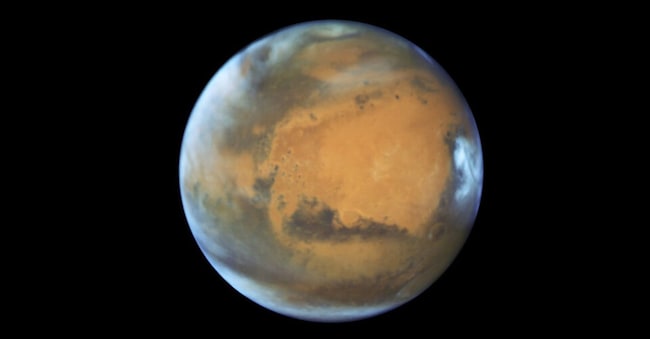
Mate is an outer planet, it is further away from the sun than we are and therefore the distance between Earth and the Red Planet varies a lot, 200 million kilometres at the maximum and 50 at the minimum, a position it reaches every two years. Thinking therefore of going there so as to have the best situation between the two planets, the race still takes six months.
It is, however, not as safe as going to the Moon, because you leave the protective, and invisible, mantle of the Earth's magnetic field and enter a region of space where elementary particles from the Sun and galactic cosmic rays rule. How much harm both can do to astronauts and plants, which are needed for food, is still a major question mark to be answered, the experiment on plant growth in the space environment will meanwhile be crucial in testing the basis for autonomous agriculture on Mars. A radiation sensor will meanwhile provide indications during the voyage as to how many and what dangers await the astronauts with regard to their health and physical safety.
On Martian soil, then, the problems remain, both because, unlike the Earth, Mars has a very thin atmosphere and therefore very little protection, and also because it has no magnetic field that could deflect dangerous particles. So no protective atmosphere and no natural magnetic shield, Mars has a few places in its crust that produce a weak, local magnetic field, but it does not appear to have a metallic inner core, as we do, that would create an important dynamo effect with rotation. To understand how the Martian atmosphere works in detail, however rarefied, we will need the third instrument a meteorological monitoring station.


