
Hydrogen bike with Chinese technology arrives in Italy
Imported by Remoove, the bike has a range of 50-60 kilometres and does not have lithium batteries
3' min read
Key points
3' min read
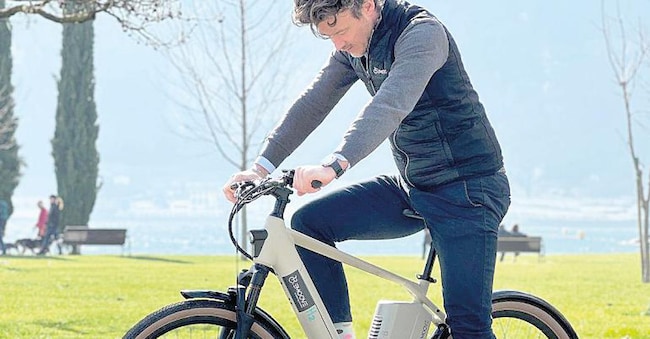
A pedal-assisted bicycle that is even more sustainable than the electric one, which recharges with not even half a litre of water, broken down by hydrolysis into hydrogen for the fuel cell motor and oxygen released into the air. This is the innovation proposed by Remoove, a Riva del Garda operator specialising in inclusive mobility, focusing on the disabled and the elderly, which is now launching itself into the new frontier of the hydrogen bicycle. A 'full tank' guarantees an autonomy of 50-60 kilometres, eliminating lithium batteries, replaced by fuel cells fed by a water bottle filled with low-pressure gas, which in turn transmits energy to a 180 W motor positioned in the rear hub of the two-wheeler.
Four models in China
.The technology comes from China. The manufacturer is Youon, a group specialising in fuel cell technology that is also working on development in the automotive field and has launched a series of four bicycle models - one for urban mobility, a more sporty one, a folding one and one specifically for sharing - already in circulation in Chinese metropolises. The Hyryd Sport Bike 1.0, the entry-level model, is the one Remoove is focusing on for the debut in Italy (and Europe) of the hydrogen-powered two-wheelers, which will be officially presented in Bergamo at BikeUp, the electric mobility festival scheduled to take place from 11 to 13 April.
Half litre of refill water
.The bike (€4,800 price) comes with a recharge kit consisting of a home hydrolyser, about the size of a microwave oven, which uses 400 ml of tap water to produce 40 grams of green hydrogen over five hours and fill the recharge 'flask' that slips inside the frame, releasing oxygen to purify the air in the home. The gas is stored in the container at ten atmospheres, a much lower level than the 150 of hydrogen for industrial use, eliminating the risk of explosion, which is thus less than a normal lithium battery. Youon itself is working with Toyota, exploiting its automotive experience for a domestic electrical energy storage system with a capacity of up to 5 kWh.
More sustainable than the ebike
."The target we are aiming at is individuals, early adopters devoted to sustainability, but also companies that could include these vehicles in their fleets instead of electric bikes: in this case the recharging station could be useful,' explains Andrea Tomasoni, president and CEO of Remoove, emphasising that it is a much more sustainable vehicle than the ebike, both in terms of materials and efficiency in energy generation: 'It is a revolutionary vehicle, ready for the market and with a composition that eliminates all those raw materials, starting with lithium, making it the sustainable vehicle par excellence. The problem remains the timing of deliveries from China, which have become much longer in recent years, as hydrogen-powered bicycles also risk becoming entangled in the climate of trade tensions and cross-duties that is making global supply chains increasingly nervous.
For corporate users there is also the provision of an off-grid charging station, powered by photovoltaic panels to recharge the tanks: the cyclist takes a refill with a full water bottle and leaves his empty one, thus eliminating recharging time. It is natural that the spread of hydrogen-powered two-wheelers is helped by the development of the fuel network. Today there is only one recharging station in Italy, in Bolzano, but the NRP envisages the creation of some thirty 'hydrogen valleys', areas dedicated to the development of green hydrogen on the basis of cogeneration and powering other projects, which could give rise to refill points for bicycles.


