
Italy at the forefront of drone airspace control technology
The start-up StradaAi has signed an agreement with the Port of Rotterdam and should be certified by Enac by the end of the year
4' min read
Key points
4' min read
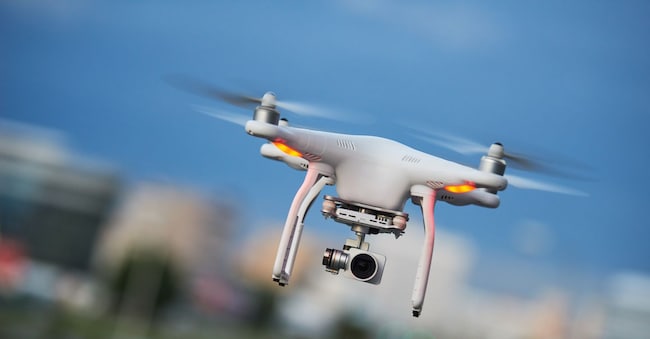
An Italian company is in the front row to accelerate the safe use of unmanned drones (UAS - Unmanned aerial systems) in real operating environments, i.e. urban, mountain, logistics, industrial and, in particular, port contexts. StradaAi (this is the name of the start-up) has, in fact, already signed a strategic partnership with Droneport Rotterdam, the European hub for testing, validation and practical application of autonomous aerial systems. And while the Dutch airport also works closely with the port of Antwerp-Bruges and the Hamburg Port Authority, other countries, Switzerland and Sweden, are already preparing to welcome the Italian company, which is in the final stages of certification with Enac (the Italian Civil Aviation Authority) as a U-space service provider.
"Our startup," explains Giulio Segurini, the company's CEO, "was born in February 2023, immediately after the entry into force (26 January of that year), of European regulation 664 on the digitisation of low-altitude airspace, that which ranges from 0 to 120 metres in height, in which drones operate. The regulation was conceived with the aim of regulating these airspaces so that they could be used for flight beyond the pilot's or operator's line of sight, the so-called Bvolos (beyond visual line of sight), and allow the drone to fly safely while the operator is in the control room, 100, 1,000 or even 2,000 kilometres away. The story is a bit like that of the chicken and the egg: airspaces cannot be opened up until there are companies that can offer the digital services for the spaces themselves'.
Investment of 2.1 million and planned operation from 2026
StradaAi, he continues, 'was founded by people who were already working in the world of drones and started with two initial rounds of investment raising, with which we obtained EUR 2.1 million. There are currently six of us in the company, with a number of external collaborators and the support of our advisory board. We are actively working to certify our digital platform and Eurocontrol, the body that manages European airspace, describes us as the first private European company - then there are two American ones - that is certifying itself to offer these services. Private means that it is not linked to the regulated market, that of the air navigation service providers (ANSP), such as Enav or Enaire (its Spanish equivalent, ndr), which had obviously started earlier. We are the only ones in the EU who have almost completed the certification. We will start providing services by the end of 2025 and, next year, the airspaces where we will be able to offer these services will begin to open up'.
Digitalised airspace, obligatory to offer four services
.To clearly explain what the company is preparing to do, Segurini clarifies that, in order to operate in the digitalised airspace, it is necessary to offer four fundamental and compulsory services: the first is called Network identification, whereby every drone that enters this space must be equipped with a digital plate and send us its position, altitude, speed, the identity of the operator, and the purpose of the mission, which, moreover, must have been pre-authorised. The second service is called Geo awareness; it concerns the maps that have to be provided, in agreement between Enac and Enav, for Italy, delimiting where you can fly, at what altitude, the rules of the spaces available, including who can fly there'.
Then, he adds, 'there is Flight authorisation, where we check the flight plan and whether, operator and drone, they have all the necessary qualifications to move in a given space. The fourth service is Traffic information: we aggregate data to make what is called e-conspicuity, which would be the digital point: we take all the signals that helicopters, airliners, and drones send, put them together, and give a picture of the traffic. So if a civil protection, carabinieri or private helicopter arrives in that airspace, we have to dynamically reconfigure the space and land, or move, the drones so that the helicopter can enter and leave that area safely.


