Energy

Nuclear power in Italy: costs, timing and model of the Enel-Ansaldo-Leonardo newco

The path will not be easy, let alone have immediate tangible effects
by Laura Serafini

Un esempio di small modular reactor (smr). (Ansa)

6' min read

6' min read

Interest is growing in the country in reintroducing nuclear generation as a source of electricity production. Although various initiatives are taking shape, including the government's appointment of an expert to assess the viability of the process and the announcement of a forthcoming enabling act to regulate the sector, the path will not be straightforward, let alone have immediate tangible effects.

On the one hand, it is necessary to convince the public that it is possible to overcome the obstacles - especially in terms of safety - that led Italians to vote no twice in the referendum on nuclear power. On the other, it is necessary to focus on the fact that, in any case, even the most advanced technology will not be able to come into operation before 2030. This means waiting at least another six years.

Loading...

It is for this reason that it will be crucial to continue the development of renewable energy sources in the meantime: especially in Italy, where the dependence of electricity pricing on gas pricing remains very high, and for this reason the cost of electricity is much higher than the European average.

A situation that is no longer sustainable for citizens, but especially for businesses exposed to competition, which in some cases find themselves having the energy component weighing more than 30 per cent of production costs. And it is precisely businesses that are the main user to whom nuclear production will be directed, because it will have lower costs than gas and will be able to guarantee continuity of production without the intermittency problems that renewables have.

Mini Reactors (SMRs) only available from 2030

It is on the basis of these considerations that a number of companies in which the state has a stake, and which are in any case active in the sector, have begun negotiations to set up a company to carry out all the assessments necessary to adopt nuclear technology. This company will not produce reactors, it will only carry out evaluations and will have to identify the conditions necessary to create a production chain in Italy that will build these plants on an industrial scale.

Among the companies involved is Enel, the Italian electricity group that has a great deal of know-how in the sector because it manages and has built plants: it has inherited some in Spain and Latin America through the acquisition of Endesa, and in Slovakia where, through a minority shareholding company, it has completed the construction and started operation of a nuclear power plant. This is traditional nuclear power, i.e. plants so large that they have to be built on site with costs in the order of tens of billions of euros. Other partners of Enel are the Ansaldo group, which is active in the nuclear sector on various fronts, and Leonardo.

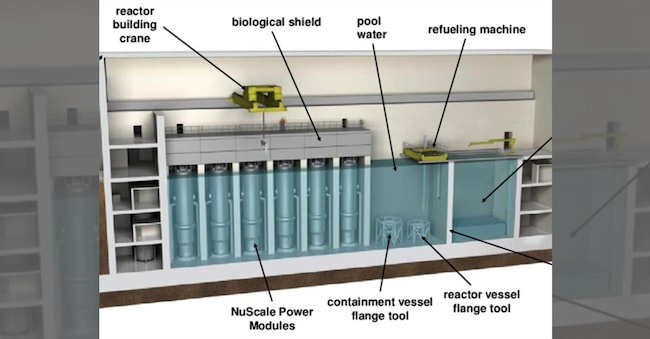
The focus today, actually not only in Italy but a little all over the world, is on mini modular nuclear reactors (SMRs), which make use of third-generation technologies: they are much smaller than traditional plants (less than half the size of a football pitch) and are considered safer, because they have automatic systems for cooling the reactor - which continues to produce heat even after shutdown - using water and without the need for an operator to intervene. Their smaller size means that these modules can be built in industrial sheds and then transported and assembled at locations where a plant is to be installed.

So a supply chain can be created that produces these module models and then sells them in Italy or exports them abroad. Preparing in time to set up a supply chain means making sure, for example, that the raw materials needed are available to make the product competitive in terms of price when it has to be sold. In short, avoiding what happened with photovoltaic panels, whose production is delocalised to China and producing in Europe is now too expensive.

Investing in the production and construction of the mini-reactors, once the technology to be used has been chosen (which can be used under licence from the company that developed it) will be various players: utilities or the business districts themselves. Globally, there are about 80 different projects under consideration. The French are developing their own technology (Nuward) and aim for commercialisation in 2030.

In England, Rolls-Royce is at work. Among the major developers of SMR technology is the United States. Three operators are working on different projects: GE Hitachi, NuScale Power and Westinghouse. The technology developed by the latter could attract Italian interest, due to its advanced stage and more competitive costs; however, it will be up to the new Enel-led company to make all the necessary investigations to establish which technology will be used to build the plants that will eventually be constructed in Italy.

The Chinese are of course also at work, with the ACP100 technology, to date the most advanced design and in experimental operation. Meanwhile, work is also being done on the development of AMRs, which have a lead cooling system. They take about 15 years to reach commercialisation, but have the advantage of using fuels other than uranium and plutonium and of drastically reducing the volume and duration of waste, as they can burn spent fuel in other plants. The basic idea is to start with the first available technology and gradually adopt newer, more efficient ones.

Up to 40 SMRs expected in Italy: investments of 40 billion

The interest is mainly related to the large quantities of electricity that would be produced at costs considered competitive. An electric utility must be supplied for 8,760 hours per year: SMRs guarantee a constant supply, like gas on the other hand. Photovoltaics today can provide power for 1,500 hours. Once the production model is standardised, the SMR will cost 3.5 million per megawatt (5.5 million is the estimated cost of the prototype).

Utility-scale photovoltaic systems cost 1.2 million per megawatt, a cost which, however, when compared to the lower number of hours they can feed in, makes the investment twice as expensive, relative to the return, as for SMRs. They can therefore guarantee a lower selling price for electricity. An average SMR has a capacity of around 300 megawatts, so the investment should be around EUR 1 billion each. According to some assumptions, which are not, however, to be connected with the work of the new company, which has yet to be established, Italy could need 30-40 mini nuclear reactors.

According to these numbers, nuclear power would guarantee an installed capacity of between 12 and 16 gigawatts, which is about one-tenth of the current generation capacity in Italy of 130 gigawatts. Therefore, the limited size of these reactors means that they cannot cover the needs of large cities and that they must be used for energy-intensive production activities, such as businesses or the data centres that will be needed for the development of artificial intelligence.

Enel: 40 expressions of interest from Big Tech for data centres

Speaking of data centres, in the last three to four months Enel has received about 40 letters of interest from international operators from all over the world who would like to build data centres in Italy, so much so that the company has set up a special team to work on this new branch of business. Among these operators are Big Tech, including Google and Amazon, but also real estate development companies such as Starcom.

The electricity group manages the grid to which these centres are to be connected, but also has potentially interesting sites because they are very interconnected to the grid and often close to the sea. For example, those of the coal-fired power stations being closed in Civitavecchia, Brindisi, Venice and Sardinia. And that is not all: other sites could be the areas around railway stations. Big Tech has started to make agreements for nuclear energy supplies, as Google has done with Westinghouse. It is clear that they are aiming for a constant and consistent type of power supply, such as SMRs, combined with battery systems and renewable plants.

The interest, in any case, is mainly in northern Italy. Enel, however, has diversified its focus on all technologies: it has signed an agreement with Newcleo, which is working on AMRs. But there is more than just fission: the recent news is the agreement to study fusion projects other than the Iter mega-project in France, in which the world's major powers, including Russia, are collaborating. The Italian electricity group is collaborating with the Californian start-up TAE, which together with Google is using artificial intelligence to accelerate the innovation of processes that can lead to fusion. Based on today's knowledge, fusion, which can generate large amounts of energy without producing waste, will not be available as a technology before 2050. Who knows whether artificial intelligence and the large private investments that Californian start-ups are able to catalyse will be able to accelerate the process.

Copyright reserved ©
Loading...

Brand connect

Loading...

Newsletter

Notizie e approfondimenti sugli avvenimenti politici, economici e finanziari.

Iscriviti