Use

Ius soli, Trump: 'We are the only country stupid enough to grant citizenship at birth'

US President: 'Citizenship by birthright was for children of slaves, not for Chinese billionaires'

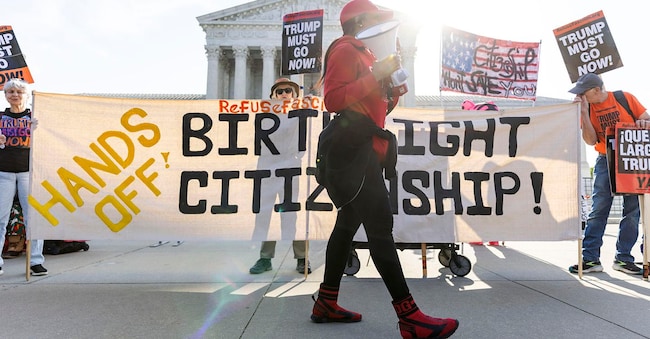
Manifestanti si radunano davanti alla Corte Suprema degli Stati Uniti prima dell'udienza per la discussione orale nel caso Trump contro Barbara, a Washington, DC, USA, il 1° aprile 2026. Il caso di grande risonanza mette in discussione il diritto di cittadinanza per nascita, garantito dal 14° emendamento della Costituzione, che conferisce la cittadinanza a tutti i bambini nati negli Stati Uniti, indipendentemente dallo status giuridico dei genitori.  EPA/JIM LO SCALZO EPA

3' min read

Translated by AI
Versione italiana

3' min read

Translated by AI
Versione italiana

Donald Trump attended the Supreme Court hearing in person on the case involving citizenship by birth. No sitting president had ever attended the Court's oral arguments before, much less in a dispute directly involving one of his own acts. After leaving the hearing, Trump stated in a post on Truth: 'We are the only country in the world so stupid as to allow citizenship by birthright'.

The Supreme Court has seen much scepticism towards Trump's executive order to limit Ius soli. According to the New York Times, several conservative justices have sharply challenged the administration's interpretation of the history and precedents related to the 14th Amendment of the Constitution.

Loading...

The case

The case stems from the executive order signed on 20 January, with which Trump sought to restrict automatic citizenship for children born in the United States to parents without permanent legal status or present on temporary visas. Immediately, the measure was blocked by several federal courts, which suspended its nationwide application, deeming it contrary to the Constitution. This opened an initial judicial phase that took the matter all the way to the Supreme Court.

The judges, in particular, intervened on the use of the so-called "universal injunctions", i.e. the nationwide blocks ordered by the federal courts. In a decision with a conservative majority (6-3), the Court restricted the lower courts' ability to apply this instrument extensively, without, however, entering into the question of citizenship. The litigation was thus reopened and the case brought back before the Court, this time on the substantive issue.

The central issue is the interpretation of the citizenship clause of the 14th Amendment, ratified in 1868. It states that 'all persons born or naturalised in the United States and subject to the jurisdiction thereof shall be citizens'. For over a century, these words were read in a broad sense, including almost everyone born on US soil. The decisive precedent remains the 1898 ruling in the Wong Kim Ark case, which granted citizenship to a man born in the United States to non-citizen foreign parents and continues to be regarded as the mainstay of the expansive reading of American ius soli.

The positions

It is precisely this interpretation that the Trump administration questions. The prevailing reading, for the president, would have gone beyond the original intentions of the constituents: the clause would have been designed to grant rights to former slaves and not to automatically include the children of irregular migrants or temporary aliens. The technical point, specifically, is the formula 'subject to jurisdiction', which is reinterpreted in a restrictive sense, excluding those who would not have a stable legal link with the state.

Beyond Trump, conservative doctrine has begun to question the extension of the Wong Kim Ark precedent in recent years, but it is a minority position compared to the established legal consensus, which continues to consider citizenship by birth a structural principle of the American constitutional order.

For their part, the plaintiffs (including families and civil rights organisations) argue that the executive order is unconstitutional both in substance and method. A president, they say, cannot restrict the scope of a constitutional provision through a unilateral act. And any intervention by Congress would also raise strong doubts of legitimacy, because it would affect a principle that requires formal constitutional review to be changed.

The possible consequences

About 250,000 children born each year in the United States to parents without legal status may not automatically obtain citizenship. The executive order would apply to future births, but the effects would also affect civil registration, issuance of documents, and access to services and legal status for families.

The debate is not only legal, but also and above all cultural. The American Civil Liberties Union (Aclu) has launched a public campaign on the case using 'Born in the U.S.A.', after Bruce Springsteen authorised the use of the song for a video released by the organisation. For the ACLU, the defence of citizenship by birth is closely linked to an idea of American belonging rooted in the Constitution, and its restriction could affect millions of children in the coming years.

The decision is expected by the end of the Court's session, between June and early July 2026.

Copyright reserved ©
Loading...

Brand connect

Loading...

Newsletter

Notizie e approfondimenti sugli avvenimenti politici, economici e finanziari.

Iscriviti