Exhibitions

James McNeill Whistler, a refined interpreter of beauty

Tate Britain is staging the artist’s largest retrospective in over thirty years, with more than 150 works on display until 27 September

3' min read

Translated by AI
Versione italiana

3' min read

Translated by AI
Versione italiana

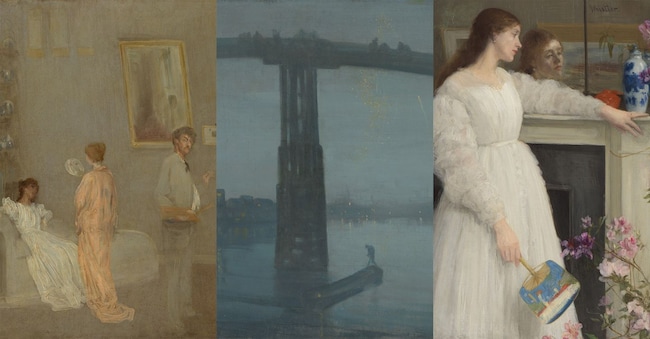
James McNeill Whistler, like Charles Baudelaire, sought to redefine the concept of beauty and challenged the conventions of his time. Tate Britain is now dedicating the largest retrospective to him in over thirty years, featuring more than 150 works – including some never seen before – to revisit the artist we know, but also to uncover lesser-known aspects of his life and artistic output.

Whistler’s itinerant life and personality are inextricably linked to his art: having grown up in St Petersburg, where his father was building the first railway line for Tsar Nicholas I, he had already announced at the age of 14 that he wanted to be an artist. Sent to the United States Military Academy at West Point, he was expelled because he had no concept of discipline and his sole interest was drawing, as demonstrated by his sketchbooks containing hundreds of sketches, on display for the first time.

Loading...

At the age of 21, he had moved to Paris, immersing himself in the city’s bohemian atmosphere, and had subsequently settled in London whilst continuing to divide his time between the two sides of the Channel. His artistic journey took him across four continents, and his boundless curiosity led him to constantly experiment with different themes and techniques.

Le sinfonie su tela di Whistler alla Tate

Photogallery13 foto

The exhibition begins with a reconstruction of Whistler’s studio near the Thames in Chelsea, where, in 1871, he painted the famous portrait of his mother – a study in grey, white and black – and the night-time views of the river that made him famous. Even before Monet, Whistler had sought to capture the smog, the fog and the unique atmosphere of the Thames with his brush in paintings that foreshadowed abstract art.

The exhibition brings together the largest collection ever seen of the artist’s famous atmospheric *Nocturnes*, from his first painting in Valparaíso, Chile, to his last, created in Venice, and also includes a painting that once belonged to President John F. Kennedy – an exceptional loan from the White House Collection.

Loading...

Always going against the grain, the artist detested the opulence of the Victorian style of the time; his studio and home, like his paintings, were instead simple and minimalist, inspired by Far Eastern art. His private collection included hundreds of pieces of Chinese porcelain, as well as Japanese screens, fans, tapestries and textiles.

From wealth to financial ruin

Having achieved fame through his portraits, landscapes and engravings, the restless artist went from wealth to financial ruin after falling out with everyone, from critics to patrons. One room in the exhibition recreates the spectacular ‘Peacock Room’, created by Whistler for Frederick Leyland – at the time England’s foremost patron of the arts – to house his paintings and his collection of Chinese porcelain. When Leyland, dissatisfied, refused to pay the artist, Whistler had the last word, painting a large fresco in the room depicting a fierce battle between two peacocks – one rich and one poor.

During the last twenty years of his life, he led a nomadic existence, travelling about and constantly drawing and painting in an increasingly experimental style. Painting, he wrote, must be light and transparent, ‘like the breath that mists up a window’.

Whistler was convinced that there was nothing intrinsically beautiful in nature and that it was up to the artist to interpret and invent it by creating harmonies of line and colour with his brush. In a lecture he gave at a theatre in Piccadilly and later published – also re-enacted by an actor for the exhibition – Whistler compares the artist’s crucial role to that of a pianist: the keys of a piano are utterly useless without the fingers of someone who knows how to play it. He was himself a talented musician and used musical terms such as ‘compositions’, ‘arrangements’ and ‘symphonies’ for the titles of his paintings. ‘Music is the poetry of sound,’ he wrote, ‘painting is the poetry of sight.’

James McNeill Whistler, until 27 September 2026, Tate Britain, London

Copyright reserved ©
Loading...

Brand connect

Loading...

Newsletter

Notizie e approfondimenti sugli avvenimenti politici, economici e finanziari.

Iscriviti