Samples

Jannik Sinner triumphs at Wimbledon: he is the first Italian tennis player to win

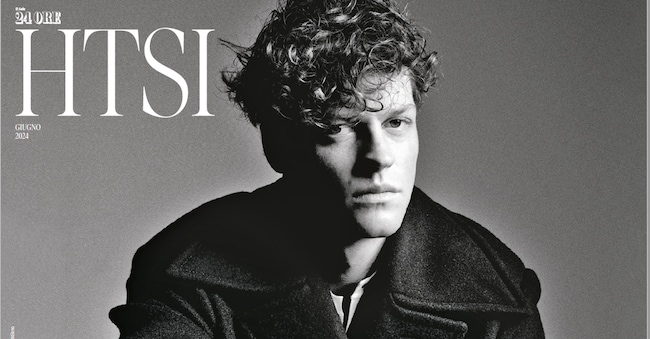
The world number one, when featured on the cover of HTSI and in the fashion photo shoot, had already said this. "Carlos Alcaraz and I give everything on the court, we have a great relationship and we try to entertain the public."

by Raphael Abraham
8' min read

8' min read

Jannik Sinner is the first Italian to win Wimbledon. We republish here the interview we conducted exactly one year ago, when the champion was the protagonist of HTSI's fashion shoot and cover story. So much has changed in just one year, but the spirit of the tennis number one has remained the same on court. He proved this even in his final match against his friend and rival Carlos Alcaraz, who had won the first set 6.4 and whom he beat three sets to one in a comeback. "The important thing is to stay calm and never get demoralised".
The last time an Italian had won a Grand Slam, ABBA dominated the charts, theaters were showing the terrifying The Omen and Jimmy Carter was campaigning. That 48-year dry spell came to an end last January when Jannik Sinner lifted the Australian Open trophy, leaving defeated finalist Daniil Medvedev behind. But the most surprising thing was the way the 22-year-old from South Tyrol did it: it had to do with his trademark powerful forehands and topspin backhands, but above all with his mental strength and unwavering confidence. Despite finding himself down two sets to nil, Sinner never gave the impression of considering the possibility of defeat.

Loading...

"Res

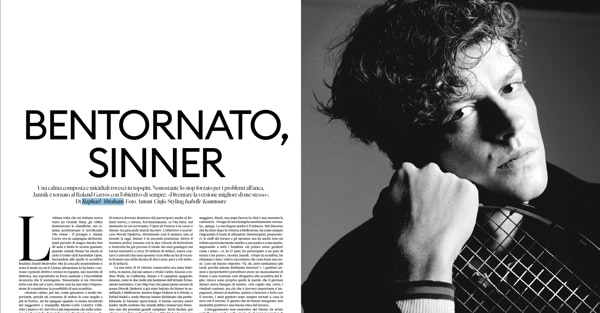
'Staying calm, for me as a player, is very important, because it allows me to see things better and faster,' he explained when we met in the atmospheric and quiet Monte-Carlo Country Club. At 6'2" tall, he is more imposing in person than on screen, but the tangle of red curls is just as vibrant. "If you get demoralised, it's like when you're driving a car and going fast: you can't see what's around." He orders a macchiato, 'decaf, please'. Nothing about Sinner tastes of caffeine. In person, his affable calm mirrors the composure he maintains when he is on the pitch.

The champion managed to retain that serene, cautious optimism even when a hip problem forced him to withdraw from the Atp Masters 1000 in Madrid at the beginning of May, and then to forego the Internazionali d'Italia. It was feared that he would have to desist from participating in Roland Garros as well, but instead, fortunately, he made it: at the time of writing, the French Open is underway and Sinner is playing decisive matches. The goal is to overtake Novak Djokovic, thus becoming world number one (as of today, Sinner is in second position, behind the Serbian tennis player). Meanwhile, with his two victories in Rotterdam and Australia, he has already brought his total tournament earnings to around $20 million, not counting his sponsor contracts (he recently signed a ten-year contract with Nike for $158 million).

His streak of 19 consecutive victories was broken in March by his friend and rival Carlos Alcaraz in Indian Wells, California. Sinner and the Spanish champion, together, are the two brightest stars in the current tennis firmament. With the Big Four slowly leaving the scene (Novak Djokovic has already been beaten by Sinner in the semifinals in Melbourne, while Roger Federer has retired, and Rafael Nadal and Andy Murray have stated that they are likely to do so this year), tennis was looking for new leaders. Many believe that Jannik has the numbers to become one of the next great champions. Boris Becker, to name but one. The three-time Wimbledon winner has known him for many years: 'Maybe the red hair and fair skin help, we certainly get along, there is sympathy between us,' he explains over the phone. "I think anything is possible," Becker continues about the athlete's potential. "He and Carlos Alcaraz seem to be better than the others for various reasons. Many things can happen. But I don't see why Jannik should stop excelling."

Sinner was born in San Candido, Trentino-Alto Adige, 43 kilometres from the Austrian border. He has an older brother, Mark, his dad was a chef and his mum a waitress. 'I come from a completely normal family,' he explains. His mother tongue is German. In his speech after his victory in Melbourne, he thanked, as always, the team of coaches, physiotherapists, trainers, tournament staff and sponsors, but also paid a particularly heartfelt tribute to his father and mother, wishing all children 'to be able to have parents like mine'. "When I was 16-17, I played in a couple of tournaments and lost," Jannik recalls. "After the defeat, I called my parents, I wanted to tell them what had happened. They replied: 'Yes, OK, but let's talk later, because we have to work now'". Anxious and overprotective parents might wince at such a hasty reaction to their son's defeat, but those were precisely the words young Sinner needed to hear. "I realised that, sure, results matter, but what's really important is to put in the effort, get up in the morning, go to work and do it with a smile. My parents always came home at night with a smile. That's what they taught me: a positive mindset and a good work ethic'.

The Sinners' non-obsessive attitude also had an influence on the story of Jannik's tennis beginnings. Instead of concentrating on one sport, he was encouraged to play several. He excelled in football and especially in skiing, so much so that he won the Italian slalom championship at the age of eight. 'I was really good at skiing, better than I was at tennis,' he admits. But then, as a teenager, the turning point. "At the age of 12, 13 I took on my first downhill race. It's about jumping 30 or 40 metres: when you're small it's scary, or at least, it was scary for me. That was the moment when I asked myself if I was perhaps too scared to continue skiing. So I chose tennis: it's a healthier competition'. And he adds a pure competitive joke: 'Even if there is no direct contact with your opponent, you can still hurt him'. Djokovic, whose style is often compared to Sinner's, was also a pro-skier as a child. One of the characteristics the two players have in common is impeccable balance in lateral movements, a quality, according to Jannik, developed through skiing, but not only: "The mental component helped me a lot: when you ski and make a mistake, you can't win. If you fall, you're out".

The gruelling commitment that the tennis tournament tour requires is legendary. The season is very long, the periods in which one does not play are short, often stopping only a few weeks in December. Last Christmas, Sinner managed to break away and went skiing in the Dolomites. Two days only, but sacred. "These are important moments for me, the most special, because they make me feel like when I was younger. I go on a slope, I ski, I have fun with friends. It's like going back to the old days, it really does me good". Today, however, he is not trying to set records in the downhill, he cannot risk injury. A player's physique is invaluable (and the recovery course for hip problems proved this). 'In recent times I have spent more time in the gym than on the tennis courts,' he explains. In the first two decades of the 2000s, tennis players aimed to develop large muscle mass, but suffered more injuries. Recently, they have become slim again, and many are as tall and agile as Jannik. "Every body is different," he points out. "I, for example, need to feel strong and stable. I think that having grown physically has contributed to me winning, for example, the Grand Slam. In my twenties I still couldn't rely on the body of a 20-year-old, and when that's the case you have to accept it."

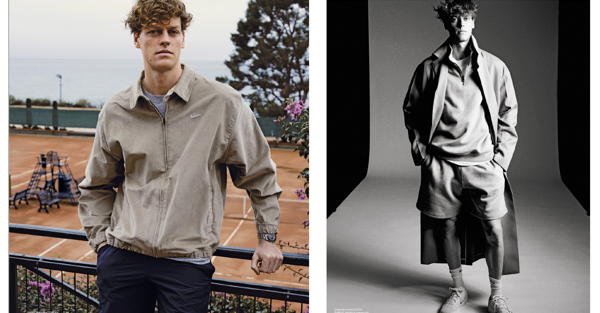
Jannik lives in Monte Carlo, a place traditionally associated with social life, boat parties and young drivers, but it is clear that he does not belong here. He is a Formula One fan, but he has no garage here and only owns one car, an Audi. He is also very strict about his private life. At the opening match at Roland Garros, his Russian colleague Anna Kalinskaya was spotted in the stands, albeit in a sidelined position. Jannik responded sincerely, confirming the story, but with these words: 'You know, I don't like to talk much about my private life. Yes, I'm with Anna, but we keep everything very private. That's all I'm saying. Even during the shoot on these pages, he patiently endured the changes of clothes, of light, of positions, for more than three hours, and now wears a slate-grey mackintosh, which perfectly matches today's sky, but his mood couldn't be sunnier. Calm, smiling, focused. Just like on the field.

"Today's athletes have to develop a type of strength that is mainly related to endurance," Becker explains. "Tennis is not like running 100 metres, but 800 or 1,500, sometimes a bit more. And you have to be resilient enough to be on the court the next day, the day after that and the day after that'. For this reason, he was impressed not only by the talent, but by the discipline. Sinner's mentality and work ethic touched him deeply. "Most teenagers have a lot of distractions on their minds. First a girlfriend, then the car. Jannik has always been very determined, he has a calm confidence that leads him to say, 'I know what I have to do and I have only one goal, to become the best possible version of myself'".

Tennis also thrives on dyads and rivalries, and the Sinner-Alcaraz rivalry is perhaps the most interesting that exists in the sport today, so much so that it has inspired the neologism 'Sincaraz'. Alcaraz is two years younger than Jannik, at the time of writing they have met eight times and won four matches apiece. Even Jannik is a fan of Carlos. 'It's amazing that a young athlete achieves those results,' he comments. "The sport needs that. Carlos and I have a very good relationship both on and off the court, we give everything and try to entertain the public, maybe him more because he throws spectacular shots. I really enjoy watching him play."

Sinner is already a superstar everywhere in the world, and his fame continues to grow rapidly. He, however, lives it lightly. "If I walk into a shop and someone asks to take a picture with me, I accept," he explains. "I'm pleased, especially when someone very young asks me: I remember that I was a kid myself and, sometimes, I was too shy to ask a champion for a photo together."

"Jannik is simply unbelievable," comments Sabato De Sarno, who, having noticed Sinner's potential, wanted him as a Gucci brand ambassador back in 2022 (last year at Wimbledon, he caused a sensation when he walked onto the court sporting a special Gucci duffel bag, which had required the approval of the strict All England Lawn Tennis & Croquet Club). "He is a champion not only for his talent, but also for the attitude, discipline and kindness he shows every day. Watching him play, match after match, has been an inspiration".

The celebrations following sporting victories have also changed: today there is much more sobriety than in the past. Gone are the days when players went wild at parties after a triumph. At the Australian Open in 2012, Djokovic, winner in a final against Nadal that lasted almost six hours, rewarded himself by indulging in a single chocolate square. In 2023, Sinner is said to have celebrated Italy's victory over Australia in the Davis Cup final in an even more morose way: by eating an apple. 'No, he didn't,' he laughs. 'It was a hamburger. I have this ritual: after a good week, I eat one." Since he has collected so many victories, in different cities around the world, I ask him where he eats the best burger. "If I have to be honest, the one in Australia was excellent. Even in America there are places where they are good, at Firebirds in Cincinnati, for example'. I point out to him that he still hasn't won in Cincinnati: busted! That he has dropped the mask of Sinner's bluntness? He smiles: 'True, but during the Cincinnati Open it was my birthday!'

Meanwhile, his appetite for success grows. "I certainly feel more motivated now. I am in a partially different position than last year, because I feel more aware of the challenges. I have always believed in them, but it's different when you become fully aware of your abilities and your limits. His lips stretch into a broad smile again. 'It is indeed an exciting feeling.

Copyright reserved ©
Loading...
Loading...

Newsletter

Notizie e approfondimenti sugli avvenimenti politici, economici e finanziari.

Iscriviti