Art

Jenny Saville and the anatomy of bodies in Venice

The artist's major exhibition at Ca' Pesaro, in the year of the Biennale Arte, opens the Venetian exhibition season
by Silva Menetto

3' min read

Translated by AI
Versione italiana

3' min read

Translated by AI
Versione italiana

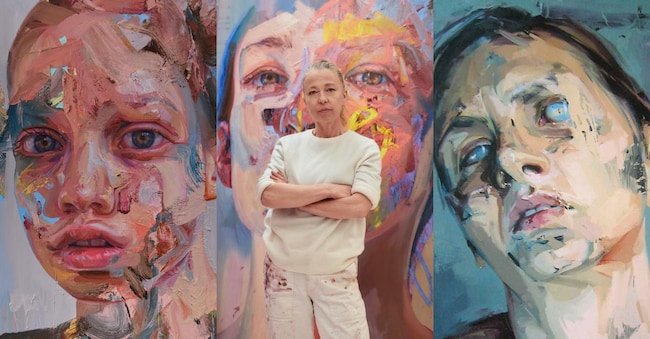
No filter, no indulgence, just the expressive power of human nature that is body, flesh, blood, skin, and colour that in some cases thickens into material spatulae and in others drips from the canvas, transforms, mixes. Only the eyes are the only anatomical element painted with photographic perfection: eyes that observe, that scrutinise, that challenge the public gaze, even though they may not see, in a sort of divination, as in the case of "Rosetta II" (2005-06) the young Neapolitan woman portrayed as a blind Homer or an ancient seer.

Jenny Saville in mostra a Venezia

Photogallery10 foto

Jenny Saville calls herself with a singular alliteration 'a painter'. Ever since she was very young, in the years when figurative painting had given way to other forms of artistic experimentation, she has always felt a strong call to paint faces and people, to bring out from canvas or paper the three-dimensionality of the human figure in all its poses, even in compositions of bodies.

Loading...

In his studio in Oxford, lists of names hang on the wall: Titian, Michelangelo, Rubens, Rembrandt are his ideal references, but also Picasso, Basquiat, De Kooning, Freud. They are the teammates, the artists he likes to think about when he works.

Young British Artists

Jenny Saville was born in 1970 in Cambridge and belongs to the generation of Young British Artists, who wrote a decidedly new chapter of art in the UK in the late 1980s and early 1990s.

To her, the Galleria Internazionale di Ca' Pesaro, in Venice, dedicates an extensive exhibition in the year marked in the lagoon by the Biennale Arte.

It is an acknowledgement of one of the most important contemporary painters, but also Saville's return to a city to which she is deeply attached. This is demonstrated by the two new works - 'Danae' and 'Venus and Adonis' - that Saville has created specifically for the exhibition, as a tribute to Venice, its history and the masters of its Renaissance.

The dialogue with the greats of the past is inherent in all his canvases, but without direct quotations: rather, they are suggestions, as in the case of 'Byzantium', a 'mater dolorosa' standing out against a gold background (a reference to the mosaics of St. Mark's), with a face with ancient features.

Past and present, painting and commitment, a manifesto that the visitor can see room after room, in the thirty works on display at Ca' Pesaro until 22 November, including monumental canvases and smaller format paintings: a sylloge of masterpieces that have marked the artist's production in recent decades.

Over all stands the construction of the pictorial flesh, with the density of colour and the image's capacity to hold time, as it did for Titian, Rubens and Schiele. There is no complacency in Jenny Saville's aesthetics, nor any concession to stereotyped beauty: the human body is portrayed in all its imperfection, in its overflowing physicality - emblematically "Propped", her debut canvas - and in all its profound, shared humanity.

It is also the case when Saville's eye shifts from the individual body to a collective dimension linked to the news, with the most recent series inspired by images of war and humanitarian crises, such as Aleppo or the various Pietas. Here, Saville's painting truly measures itself against the present. He does not seek consolation or distance, but insists on the body as a place of conflict, exposure, vulnerability. And of reflection.

Copyright reserved ©

Brand connect

Loading...

Newsletter

Notizie e approfondimenti sugli avvenimenti politici, economici e finanziari.

Iscriviti