
Nvidia: Jensen Huang has stepped down; CFO Kress takes over on an interim basis
Resignation with immediate effect. He is stepping down from the helm of the company he co-founded 33 years ago

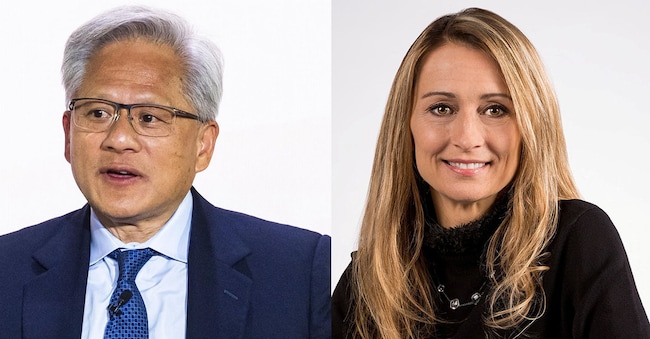
“The Board of Directors announces that Jensen Huang has resigned from his positions as Chairman, Chief Executive Officer and member of the Board of Directors, with immediate effect.” These were the terse opening words of the statement published today by Nvidia, in which CFO Colette Kress was also appointed as interim CEO. Thus ends, after 33 years, the era of the man in the black leather jackets who transformed a company that produced parallel microprocessors (Graphics Processing Units, GPUs) for video games into the global artificial intelligence (AI) giant that everyone knows.
Huang has stepped down from the company he founded – in which he holds a 3.6 per cent stake – due to the now well-known scandals in which he has been implicated. First and foremost, his affair with Alice Huang, a former executive at Megaspeed, a Singapore-based company specialising in the procurement of Nvidia chips. A woman who, according to US intelligence, is believed to have been recruited by the Chinese secret services. The affair has, of course, raised questions about national security and the possible circumvention of US restrictions on the export of semiconductors. Huang admitted to the affair, whilst Nvidia immediately launched an internal investigation, stating that it had no evidence that its trade secrets had been compromised. But evidently, the explanations provided were not enough. Not least because – although less significant – just yesterday the New York Times revealed another alleged romantic relationship. This time with Kimberly Powell, vice-president of Nvidia’s healthcare division and his direct subordinate.
It must be said straight away that – setting aside moral considerations – Huang’s departure was certainly not due to any issue of infidelity. The central issue, of course, is that of national security. The former CEO of Nvidia has, in fact, always advocated the need to keep the Chinese market open to US semiconductors, in the belief that restrictions favour the development of local competitors. This stance was at the heart of a dispute with the White House: in August 2025, the US administration had agreed with Nvidia to allow the resumption of exports of H20 chips to Beijing, in return for a payment to the US government of 15 per cent of the revenue generated by those sales.
That is not all. We must also bear in mind Washington’s investigations into the possible channelling of advanced semiconductors via countries such as Singapore, Malaysia and Thailand, used to circumvent export bans on the former ‘Middle Kingdom’. In May 2026, the Department of Commerce also took action regarding supplies to Chinese companies via foreign subsidiaries. It is against this backdrop – already marked by trade tensions and fears of technology transfer – that the alleged links with Chinese intelligence take on a significance far greater than Huang’s private affairs.
In such a scenario – even against the backdrop of a political landscape that has shifted following the Democrats’ landslide victory in the mid-term elections – the efforts of Donald Trump and Elon Musk himself to come to his aid proved to no avail.


