The book by Germano Maifreda

Jewish 'restitutions' as restorative measures

by David Bidussa

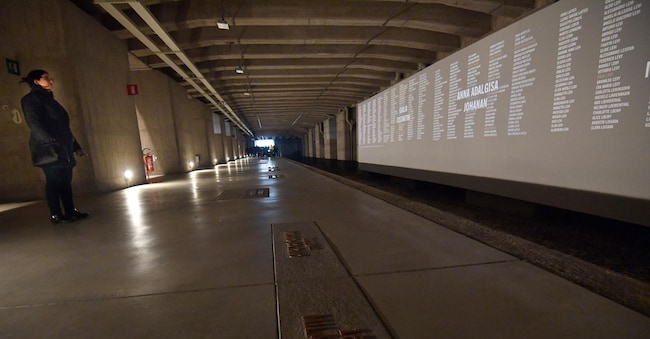
Il Memoriale della Shoah di Milano. (Ansa)

4' min read

Translated by AI
Versione italiana

4' min read

Translated by AI
Versione italiana

Since the 1990s, the subject of assets taken from Jews during the Holocaust has re-emerged, producing court actions, usually in the form of class actions, against banks, companies and insurance companies, mainly European, accused of wrongdoing dating back to the period of anti-Jewish persecution. Those stories opened a strand of study, aimed at the reconstruction of specific events or court cases. At the same time, they have also prompted reflection on a long history of the economic action and economic presence of Jews in the societies in which they found themselves living during their long exile.

This is another reason why the reconstruction that Germano Maifreda proposes in the first part of this book is interesting, because it allows us to reflect not only and not so much on the specific case and on the forms of persecution between the 1930s and 1940s, but points to some structural issues: the concept of the "interpersonal market", the analysis of demographic behaviour in advance of the demographic turning points of the 20th century, the poles of Jewish presence in Italy. The conviction, he writes, is that "we would not understand the economic physiognomy and professional choices of Italian Jews in contemporary times without knowing their previous history and the past of Jewish-Christian relations in the peninsula and, more generally, in the world of the diaspora".

Loading...

At the same time, in order to pose the problem of the transformations induced by racial legislation, it is important to consider the quantitative reconstruction of the presence of Jews in the world of business and more generally in the economy that is the focus of this research. It is interesting to evaluate the census data conducted in the 1930s: the reality of the beginning of the century offers the opportunity to grasp the dynamics of hitherto almost completely unknown processes.

This reconstruction is particularly relevant both on a comparative level (with reference to the processes of discrimination and the measures adopted in particular in the France of the Vichy regime, between 1940 and 1944, in Nazi Germany, in Hungary), from which it draws the characteristic radicality of the discriminatory legal corpus, but also and above all in the concluding reference to the 'after', where, it emphasises, 'the restitution of property turned out to be a long and complex process' and the 'restitutions', rather than a return of the stolen, take on the figure of reparatory measures.

In this sense, the final reference to the text General Report (2001), produced by the Commission for the reconstruction of the events that characterised in Italy the acquisition of Jewish citizens' property by public and private bodies, better known as the Anselmi Commission, set up in 1998, and especially the silence that accompanied that lengthy text, testifies to two aspects that it is good to retain.

More precisely: on the one hand, 'the pervasiveness of the economic persecution carried out by fascism, whose discriminatory measures were applied by a bureaucratic machine that was on the whole diligent and at times zealous'; on the other hand, the difficulties in taking the measure especially of the lasting effects of racist legislation in republican Italy. It is in addressing this second aspect that I notice the most reticence and resistance. This is why I believe it is appropriate to propose a reflection.

There are two most significant moments in the juridical vicissitudes of the Jews in Italy in the modern-contemporary age: on the one hand, there is essentially the start of the first emancipation that can be placed between the end of the 18th century and the middle of the 19th century; on the other, there is the advent of the Republic in the aftermath of the Second World War. In order to make the overall historical event proposed in the volume clear, it is important to focus on this second date in particular. Which is particularly significant because it is illustrative of the slowness of the journey that allowed for the progressive annulment of that inequality of individuals that underlies the racial legislation that in Italy began to be constituted in the second half of the 1930s, was legally defined in November 1938, and then showed its effects on the persecution of lives between 1943 and 1945. Progressive annulment that has a slow realisation time, in any case not immediate.

Three phases have been identified. The first is between the liberation of Rome (4 June 1944) and the launch of the Republican Constitution (1 January 1948); the second coincides with the first part of the second Republican legislature (1948-1955); the third covers the period between 1955 and the early 1970s. The essential provisions of the first phase concern the reinstatement of rights, compensation and indemnities in respect of the pecuniary damage suffered; the second phase corresponds mainly to the rules on reinstatement; the third is mainly concerned with the reconstruction of careers for pension purposes. Thus, a legal path in which the last provisions date back to the mid-1980s, i.e. forty years after the fall of the racial legislative system ratified since 1938.

On the whole, these are regulations aimed at repairing or compensating damage to individuals or communities, entities or associations. This is not an exception and does not represent a particular path. For example, the same delayed, slow and basically non-reintegration-oriented treatment occurs with military veterans. The return and reintegration of veterans does not take place immediately with the end of hostilities. It is significant that the repatriation of prisoners of war out of Italy occurs in the aftermath of the referendum vote transforming Italy from monarchy to republic. The basic choice of Parri and De Gasperi's governments was not to privilege veterans as a category, but to grant them the same assistance reserved for civilian victims of the conflict.

Copyright reserved ©
Loading...

Brand connect

Loading...

Newsletter

Notizie e approfondimenti sugli avvenimenti politici, economici e finanziari.

Iscriviti