Mind the Economy/Justice 120

John Harsanyi and the dream of mathematical justice

The question remains whether moral life can really be compressed into a calculation

by Vittorio Pelligra

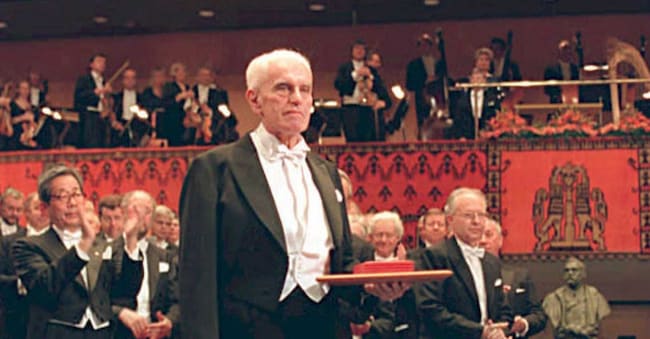
John C. Harsanyi. (Photo by JAN COLLSIOO / SCANPIX SWEDEN / AFP)

8' min read

Translated by AI
Versione italiana

8' min read

Translated by AI
Versione italiana

John C. Harsanyi was born in the rubble of history in 1920s Budapest and grew up in the restless climate of Europe of totalitarianism. Brilliant in his studies in 1944, he graduated in pharmacology. During the Nazi occupation, as a Jew, he was imprisoned in a concentration camp and forced labour. He managed to save himself thanks to a daring escape and the protection he found in a Jesuit community.

After the war, he was back in Budapest where he studied again and obtained a doctorate in philosophy and sociology. He converted to Catholicism, began studying theology and joined what was then called the Dominican Third Order. But in the institute of sociology at the University of Budapest where he had started working, the climate for him began to get tough because of his radically anti-Marxist ideas. The communist regime left little room for independent thinkers and Harsanyi was forced to resign. For years he worked in the family pharmacy, studied Kant and Mill at night, and meanwhile observed the disasters of authoritarianism on individuals and communities.

Loading...

In 1950 he decided to risk it all; with his wife Anne they crossed the Austrian border clandestinely, fleeing the regime. The two moved first to Australia where his wife had relatives and where Harsanyi worked in a factory during the day and studied economics at night. He is truly brilliant and even before graduation starts publishing his essays in the most important academic journals in the field. Thanks to a scholarship, he manages to leave for the United States. At Stanford he meets the future Nobel Prize winner, Kenneth Arrow, a year younger than him but already a superstar in mathematical economics. Arrow takes him under his wing, Harsanyi studies and publishes and in 1959 he obtains a second doctorate. After a brief return to Australia, he was called to the University of California Berkeley in 1964, where he would spend the rest of his academic life.

Ethics as rational calculation

.

It is in this context of life and thought that he matures his deepest conviction: ethics cannot depend on fickle emotions or arbitrary authorities, but must have the strength of rational calculation, capable of withstanding the winds of history. If societies are to avoid the disasters of the 20th century, they must give themselves impartial rules, constructed as solidly as science constructs its laws. Justice is either rational or it is not justice. So he began to apply the mathematical techniques he had begun to develop in his youth - the theory of games with incomplete information - to the fundamental problems of social ethics. For a long time, traditional economics had rejected the idea that it was possible to compare the utilities of different individuals. Vilfredo Pareto, for example, argued that economic theory could only say whether a situation A was better than a certain situation B if it could be shown that moving from B to A would improve someone's welfare without, at the same time, reducing the welfare of anyone else. The problem is that this approach prevented any serious discussion of distributive justice: if I cannot say whether an improvement for a poor person is worth more or less than a loss for a rich person, I cannot rationally discuss equity, redistribution or welfare.

Interpersonal comparisons and the veil of ignorance

.

Harsanyi, on the other hand, argues that not only can we compare utilities between different individuals, but that we must do so if we are to take issues of distributive justice seriously. It is not absurd to say that the marginal benefit of a rich person - the pleasure of an extra holiday, the luxury of a new car - is worth less than the relief of a poor person who, thanks to a subsidy and free access to services, can take care of himself, send his children to school, live a decent life. In this perspective, redistributive policies no longer appear as a generic moral imperative, but as the result of a rational calculation: what is lost on the one hand weighs infinitely less than what is gained on the other.

A simple exercise is sufficient to justify this passage: we must try to reason behind the 'veil of ignorance'. The idea, which is usually traced back to John Rawls' Theory of Justice published in 1971, was actually introduced by Harsanyi in an essay published in 1953 in the Journal of Political Economy. To reason behind the 'veil of ignorance' is to reason about the rules of the game without knowing in advance what role we will play. The implication that Harsanyi develops is that in this condition of impartiality, everyone should operate to maximise the expected utility of the community, as if we were choosing an insurance policy against the risk of ending up in the most disadvantaged positions.

In more formal terms, society should organise itself by seeking rules capable of maximising a social utility function that targets the sum, or average, of individual utilities, all weighed equally. Harsanyi does not merely describe this intuition, but elaborates a formal demonstration - the so-called 'Harsanyi Theorem' - according to which, if we accept certain axioms of rationality and impartiality, the only consistent social utility function is the utilitarian one. An approach in which Adam Smith meets Immanuel Kant, Jeremy Bentham and John Stuart Mill.

From Impartial Spectator to Justice Algorithms

.

From Smith he takes the idea of the 'impartial spectator' that we originally found in The Theory of Moral Sentiments (1759). An ideal observer that each person carries within himself and to whom he turns his inner gaze when he has to judge his own actions. For Smith, this figure is first and foremost psychological and moral: it is what allows us to assess ourselves with a minimum of detachment, imagining how we would appear in the eyes of another who were to observe our actions from the outside. Harsanyi takes this cue but radically transforms it.

For him, the impartial observer is not so much the inner conscience as a theoretical construct that enables the foundation of social utility. While Smith aimed to explain the genesis of morality in interpersonal relationships, Harsanyi seeks to solve a problem of political philosophy: how to sum up different individual preferences in a complex society. The impartial observer, in his model, has to evaluate the alternatives as if he could be in any social condition, and thus becomes the guarantor of comparability between possible lives. This is a decisive step: the Smithian 'moral sentiment' becomes, in Harsanyi's hands, an algorithm of justice.

But Harsanyi's utilitarianism differs profoundly from that of the classics. Whereas Bentham, for example, spoke of maximising pleasure and minimising pain, almost as if they were natural quantities to be added up in an arithmetic calculation, Harsanyi abandons this common sense psychology and relies on 'revealed preferences'. We cannot get inside people's heads to measure their joys and sorrows, but we can certainly observe their choices. If faced with two alternatives A and B a subject chooses A, then he will be 'revealing' his preferences for A over B. He will be telling us that he expects to see his well-being increase after choosing A more than if he had chosen B. What matters, then, is what a person would choose if he were consistent and fully informed of all available options.

This brings us to another crucial distinction from classical utilitarianism. Harsanyi's utilitarianism, in fact, is to some extent 'kantimatised'. Whereas the version of the classics can be described as 'act utilitarianism' and stipulates that each individual action is judged by its immediate consequences, Harsanyi's version belongs to 'rule utilitarianism' and, in this case, what counts are the general rules, the rules that, if followed by all, guarantee the best collective results.

If lying to a friend today is to spare him unnecessary pain, then the lie may also be considered right. If evading a small tax allows me to cure a family member, the act may seem morally licit because it increases overall happiness at that moment. That of the utilitarianism of acts is a 'retail' ethics, which decides on a case-by-case basis.

Rule utilitarianism, on the other hand, shifts the perspective. It does not ask whether lying in this case brings more benefit than harm, but whether accepting lying as a general rule would not corrupt the general trust. And the same applies to taxes: an exception may seem harmless, but if everyone did the same - here is the Kantian dimension, the universalisability contained in the categorical imperative - the state would run out of resources for hospitals and schools. In other words, the utilitarianism of the act resembles a motorist who decides when to stop at a red light only according to the convenience of the moment. Rule utilitarianism, on the other hand, asks whether or not the existence of a rule prohibiting running red lights will lead to a safer society for all.

Just as a rational agent faced with an uncertain choice will opt to maximise his expected utility - the welfare derived from a certain event given the probability of that event occurring - similarly, as a society we should choose rules that maximise average welfare. Power, status, wealth do not matter: each individual weighs equally in the collective calculation. His tragic personal experience underpins this belief. Having seen the brutality of regimes that classified individuals into races, classes and categories to be annihilated, Harsanyi dreamed of an ethic that left no room for arbitrary hierarchies. The happiness of a poor man is worth as much as that of a rich man. And above all, the reduction of a rich man's wealth must be worth less than the liberation from misery of those who have nothing. In this sense, the redistribution of income is not a gesture of charity, but the result of a rational calculation aimed at maximising collective welfare.

Harsanyi's topicality and the challenge of algorithmic morality

Harsanyi's theoretical framework may not be known to most, but certainly its application is pervasive and affects the lives of all of us. During the Pandemic, for instance, in a situation where vaccine doses were still scarce and respirators were insufficient for all the sick, the question of who to treat first divided governments and citizens: to privilege the most fragile, as Rawls would have suggested, or who contributes most to the average wellbeing, as Harsanyi would have wanted? In many government regulations and directives, it was Harsanyi's position that prevailed. The same question applies to climate change: how much should we sacrifice in the present to ensure future benefits for our children? In all these cases, utilitarianism provides a language and algorithms for calculation, which are immediate and intuitive, though not without reductionism.

We will focus on the main criticisms of Harsanyi's thought in next week's Mind the Economy. Criticisms that cannot overshadow the contribution of the Hungarian philosopher who will win the Nobel Prize for Economics in 1994 together with John Nash and Reinard Selten.

In fact, his work is not just a refined technical contribution, but a veritable manifesto for rational ethics. An attempt to offer politics a shared language, capable of uniting philosophers, economists and public decision-makers. Its promise is bold: if we really want to be rational and impartial, we have no choice. We must accept utilitarianism as our compass. Ethics, argues Harsanyi, must have the same solidity as science, it must be based on rational rules capable of withstanding the winds of history. We cannot afford an ethic made up of emotions or dogmas: justice must have the force of rigorous calculation.

The question remains whether moral life can really be compressed into a calculation. In a world increasingly governed by algorithms that decide for us, Harsanyi's challenge is more relevant than ever. The risk, however, is that by reducing the complexity of human lives to numbers, we end up forgetting what those numbers cannot capture: the bonds, the stories, the irreducible dignity of each person. Harsanyi challenges us to look at ethics with the eyes of reason and the coldness of calculation, but the real test remains another: will we know how to measure justice, what we owe each other, without ever betraying that deep sense of humanity that it is supposed to guard?

Copyright reserved ©
Loading...

Brand connect

Loading...

Newsletter

Notizie e approfondimenti sugli avvenimenti politici, economici e finanziari.

Iscriviti