United States

Jon Ossoff: who is the Democrat who defeated Trump in Georgia and now has his sights set on 2028?

From his meeting with John Lewis to the war crimes investigations, right through to his victory over the candidate backed by the president. At the age of 39, the Democratic senator has secured a place amongst the potential frontrunners for the next presidential election

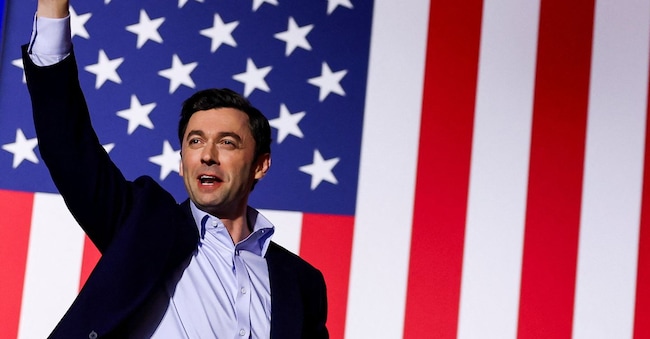
Il senatore statunitense Jon Ossoff (D-GA) saluta i sostenitori durante un comizio nella notte delle elezioni, dopo aver ottenuto la rielezione alle elezioni di medio termine negli Stati Uniti, ad Atlanta, in Georgia, il 3 novembre 2026. REUTERS/Carlos Barria REUTERS

10' min read

Translated by AI
Versione italiana

10' min read

Translated by AI
Versione italiana

Jon Ossoff was 17 when he wrote a letter to John Lewis, the Democratic MP who had marched alongside Martin Luther King in the 1960s for the civil rights of African Americans. He had read Lewis’s autobiography and wanted to work with him. Lewis offered him an internship in his congressional office.

More than twenty years on, that boy who grew up in Atlanta has become one of the best-known politicians of the new generation of Democrats. And in the mid-term elections on 3 November, he secured a victory that could propel him far beyond the borders of Georgia.

Loading...

At the age of 39, ‘the Accidental Senator’ (the ‘senator by chance’), as the magazine Puck dubbed him, highlighting his reserved nature, his lack of interest in Washington’s social rituals and a political career that began almost unexpectedly, has secured his second term in the United States Senate, defeating Mike Collins, a Republican MP backed by Donald Trump, to the cry of ‘the first light of dawn is on the horizon’. And he did so in Georgia, the state that in 2024 had pinned its hopes on the tycoon’s return to the White House and which, for years, has seen its elections decided by margins of just a few thousand votes.

A victory that is unlikely to go unnoticed in a Democratic Party still searching for a way back to the White House. Ossoff has managed to unite the traditional African-American base, moderate voters and a section of the independents, whilst in Washington he has carved out a leading role in the opposition to the President, attacking him over corruption and the cost of living.

His origins and his meeting with John Lewis

Thomas Jonathan Ossoff was born on 16 February 1987 in Atlanta, the city of Martin Luther King, into a family with a strong political tradition. His father, Richard, a descendant of Russian and Lithuanian Jewish immigrants, is an entrepreneur in the professional publishing sector. His mother, Heather Fenton, came from Australia and helped found NewPower PAC, an organisation that supports women standing for public office in Georgia.

Jon attends Paideia School, a private school in Atlanta, and developed an interest in international politics at an early age. Among the books that left a lasting impression on him was the autobiography of John Lewis, the Democratic MP who, in 1965, was beaten by the police on the Edmund Pettus Bridge in Selma, Alabama, whilst marching for African-American voting rights.

That encounter marked the beginning of a relationship that was to last for many years, until Lewis’s death in July 2020. The MP would live to support the Senate bid of that young man who, a few months later, would become the first Jewish person elected from Georgia to the upper house of Congress.

Meanwhile, Ossoff moved to Washington to study at Georgetown University , where he graduated in 2009. He then joined the staff of Democratic Congressman Hank Johnson and began working on defence, national security and foreign policy. From his desk, he witnessed military appropriations and all manner of legislative measures being passed. What struck him most was the influence of large corporations on congressional decisions. Years later, he would tell the Washington Post just how disillusioned that experience had left him. In 2013, he left Washington, completed a master’s degree at the London School of Economics and prepared to run a company producing investigative documentaries. He was 26 years old and, at least for the time being, politics could wait.

Investigative documentaries and the colleague murdered in Ghana

His path into investigative journalism began during a holiday in France. He was 16 when, at a family dinner, he met Ron McCullagh, a British documentary-maker and founder of Insight News Television. They discussed international politics and kept in touch even after he returned to the United States.

In 2008, whilst still studying at Georgetown, Ossoff spent a summer as an intern at the London-based company. Five years later, McCullagh offered him the chance to take over the reins. He was just 26 years old, with no specific training in journalism or film, butan inheritance from his grandfather, an entrepreneur in the tanning industry, which enabled him to invest $250,000 in the company. McCullagh put up a similar sum. The company, which was going through a period of financial difficulties, was relaunched under the name Insight TWI, an acronym for “The World Investigates”.

Loading...

Ossoff has never made a secret of the advantage of having grown up in a well-off family. In fact, he has said that his parents’ financial circumstances enabled him to complete his studies without incurring any debt and to choose a career based on his own interests.

In London, he finds himself running a company that produces investigations into corruption, organised crime and human rights abuses , working with international broadcasters such as the BBC and Al Jazeera English. His team investigates illegal trafficking, abuses of power and scandals involving governments and institutions. In 2015, the organisation also secured funding of $350,000 from the Omidyar Network, backed by eBay founder Pierre Omidyar, to train African investigative journalists.

Then, in January 2019, news came from Ghana. Ahmed Hussein-Suale Divela, a journalist who had worked on an investigation into corruption in African football, was shot dead by two men on a motorbike in Accra. The investigation he had been working on had documented the payment of bribes to football officials, sparking an international scandal. A few months before the murder, the Ghanaian MP Kennedy Agyapong had publicly revealed his identity during a television broadcast. The circumstances and those behind the murder remain to be clarified.

Ossoff flies to Ghana to attend his colleague’s funeral. Writing in the Washington Post, he highlights the risks faced by investigative journalists and calls for greater attention to be paid to their safety. Years later, he would tell the same newspaper that it was whilst working on these investigations that he had come to believe that in order to combat abuses of power, it was also necessary to intervene within institutions.

So, in September 2019, she announced her candidacy for the Senate. And that whole world – corruption, private interests and the accountability of those in power – became some of the recurring themes of her election campaigns. Meanwhile, that familiarity with the cameras, gained by following the work of the journalists and producers at Insight TWI, would prove useful a few years later, when videos of his speeches against Donald Trump began to circulate on social media far beyond the borders of Georgia.

The first defeat at the hands of the Republicans

Jon Ossoff first stood for election in 2017. Trump had just taken office in the White House and, in Georgia’s 6th constituency – amongst the affluent suburbs north of Atlanta – there was a seat up for grabs. It had been vacated by Tom Price, who had been appointed by the new president to head the Department of Health. It is a constituency that has voted Republican for decades, but Ossoff, barely thirty years old, decided to give it a go. The Democrats still had Hillary Clinton’s defeat fresh in their minds. And that race for the House of Representatives became one of the first litmus tests to gauge the popularity of the new occupant of the White House.

Ossoff is little known, but donations soon begin to pour in from across the US. John Lewis and Hank Johnson back him, whilst he tours the residential neighbourhoods on the outskirts of Atlanta, talking about waste and transparency. He also seeks votes amongst those Republicans who do not identify with Trump’s tone and manner. In the first round, he finishes ahead of everyone else, but fails to secure the 50 per cent needed to win. In the run-off in June 2017, he lost to the Republican Karen Handel. It was a costly defeat, at the end of one of the most expensive House campaigns in American history up to that point. Yet, in a constituency where the Democrats had not won the seat for decades, the margin narrowed. So much so that a year later, in 2018, the Democrat Lucy McBath managed to win there.

Ossoff will have to wait until 2020 for a second chance. This time, he is setting his sights on the Senate and taking on David Perdue, a former business executive and Republican close to Trump. The backdrop to the election campaign is a Georgia that is changing. Atlanta continues to attract new residents, the once staunchly conservative suburbs are becoming more competitive, and the mobilisation of African-American voters is helping to redraw the state’s political map.

In the November 2020 presidential election, something happened that had seemed unlikely just a few years earlier: Joe Biden won there, in Georgia, by a margin of just 11,779 votes. No Democrat had managed this since 1992. But to find out the fate of the state’s two Senate seats, we had to wait a little longer. On 5 January 2021, the state’s voters returned to the polls. Ossoff faced Perdue, whilst Raphael Warnock, pastor of Ebenezer Baptist Church in Atlanta – the very same church where Martin Luther King had preached – took on the Republican Kelly Loeffler. When the results came in, both Democrats won. Georgia elects its first African-American senator and its first Jewish senator. Ossoff is 33 years old and is the youngest member of the Senate.

But, above all, those two seats shift the balance of power in Washington. The Senate is split exactly down the middle, with 50 Democrats and their allied independents against 50 Republicans. It will be Vice-President Kamala Harris’s vote that gives the Democrats the majority, as she is called upon to break any tie. The following day, 6 January, whilst Congress was preparing to certify Biden’s victory, a crowd of Trump supporters stormed the Capitol.

Work in the Senate and the search for a bipartisan consensus

In the Senate, Ossoff is once again doing what he learnt during his years of making investigative documentaries: putting pressure on those in power. His investigations focus on federal prisons, where allegations of sexual violence against female prisoners have come to light, on the circumstances of military families, and on the protection of children. These are battles in which he manages to find allies even amongst Republicans, using the investigative powers of parliamentary committees to hold federal administrations to account for abuses and inefficiencies. In July 2024, one such battle led to the passing of the Federal Prison Oversight Act, a bipartisan law introducing independent oversight in federal prisons and establishing an official role to receive complaints from prisoners and prison staff.

But whilst he is building his reputation in Washington through investigations, in Georgia he must prove that he can deliver tangible results. He is securing federal funding for roads, hospitals, broadband connections and economic development. And he does not confine himself to Atlanta and its suburbs, but also visits rural counties, where Republicans continue to win by wide margins.

Foreign policy is a more sensitive issue. Ossoff supports Israel’s security and has condemned the Hamas attacks of 7 October 2023. However, as the war in Gaza has dragged on , he has criticised the conduct of Israeli military operations and the consequences for Palestinian civilians. On domestic issues, however, his positions are clearer-cut. He defends the right to abortion, access to healthcare and public investment. The issue of reproductive rights, in particular, has become a key concern in Georgia since the Supreme Court struck down federal constitutional protection for abortion in 2022, paving the way for stricter restrictions to be imposed in the state.

The issue also touches on Ossoff’s private life through the work of his wife, Alisha Kramer, a gynaecologist and obstetrician. The couple have known each other since they were teenagers; they are married and have two daughters. They live in Atlanta, far from the receptions and social events of the nation’s capital.

The 2026 campaign and the attack on Trump

When Donald Trump returns to the White House in January 2025, Jon Ossoff knows he will have a target on his back. He is the only Democratic senator facing a re-election challenge in 2026 in a state won by the Republican president in the last presidential election. For the tycoon, recapturing Georgia also means reclaiming one of the seats that had handed the Senate to the Democrats in 2021.

Ossoff decides to step up the rhetoric. He accuses Trump of using the White House to enrich his own family and his allies, denounces what he calls one of the most corrupt administrations in American history, and keeps coming back to one question: what has become of the promises to bring prices down? He talks about supermarket bills, utility bills, health insurance and taxes. He also attacks the President’s foreign policy decisions, including the war with Iran.

Then there are the videos. All it takes is a few seconds of one of his speeches, a pointed question or an accusation made in front of an audience for the clip to start circulating on social media . His staff select the most striking moments and share them in videos that reach millions of people. His popularity is growing and, alongside the view counts, the first speculations about 2028 are emerging. His name is beginning to appear amongst those of the Democrats who might run for the White House. Even though, in the meantime, he continues to focus primarily on Georgia.

The showdown with Mike Collins and the Trump factor

His opponent in the mid-term elections on 3 November is Mike Collins, a Republican MP and former transport entrepreneur. To reach the contest against Ossoff, he first had to win the primary within his own party, defeating Derek Dooley – a former football coach backed by the outgoing governor, Brian Kemp – in the run-off. Trump has thrown his weight behind Collins, siding with him in the contest between the various factions of the Republican Party in Georgia.

Collins attempts to portray his rival as a progressive out of place in a conservative state, more interested in preparing a bid for the White House than in representing his constituents. The Democratic senator responds by highlighting the funding he has secured for Georgia and by focusing on prices, healthcare and Trump’s economic promises. Money is also a key factor separating the two candidates. Ossoff has raised $126 million more than his opponent, whilst external groups are spending a further $18 million in support of Collins. The Democrat can afford a widespread advertising campaign and an electoral organisation that reaches voters well beyond Atlanta.

The result of the 3 November election proves Ossoff right. Georgia – which in 2020 had chosen Biden by a margin of just 11,779 votes and, four years later, had returned to Trump – has decided to re-elect a Democratic senator. And it has done so despite the President’s personal support for his opponent. Meanwhile, some are beginning to imagine that young man – who, at the age of 17, knocked on Congress’s door – in the White House. For now, he has secured another term in the Senate. But his next letter might be addressed to someone else.

Copyright reserved ©
Loading...

Brand connect

Loading...

Newsletter

Notizie e approfondimenti sugli avvenimenti politici, economici e finanziari.

Iscriviti