Raw materials

Journey into the future of mining after the OK for mining research projects

There are 14 research projects in the National General Mineral Exploration Programme approved by the Interministerial Committee for the Ecological Transition

by Davide Madeddu

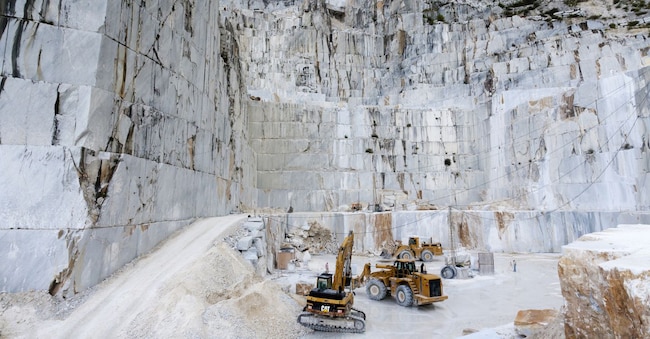
Toscana, Alpi Apuane, Cava di marmo, Bacino di Fantiscritti

4' min read

4' min read

It will still be some time before the mines reopen. But the race for critical materials, necessary for the ecological transition, does not stop and, indeed, is widening. Because next to the private initiatives, those in which some companies are applying for exploration permits in various parts of Italy, will be added the 14 projects contained in the national mineral exploration programme approved by the Interministerial Committee for Ecological Transition.

North Italy

.

In the North-East, Lombardy and Trentino-Alto Adige will be the focus of research for the presence of fluorspar and baryte, as well as rare earths located in the Southern Alps. In Piedmont, the focus will be on the Finero area, where the investigation will concern platinum group metals (PGM). In the same region, an attempt will also be made to assess the presence of Lithium. Also in Piedmont and Liguria, graphite deposits will be investigated, and copper and manganese deposits will also be explored.

Loading...

From Tuscany to Lazio for lithium

.

In Central Italy, particularly in Tuscany, Latium, Emilia-Romagna and Marche, the potential of lithium will be analysed, both in geothermal and sedimentary contexts. In Tuscany, moreover, the well-known antimony and magnesium deposits of the Colline Metallifere will be studied, while in Lazio activities will focus on fluorite, also in relation to its concentration in rare earths.

Campania, Calabria and Sardinia

In southern Italy, Campania will be involved in investigations of lithium, feldspars and other industrial minerals strategic to national industry, while in Calabria, the significant graphite deposits of Sila will be examined. In Sardinia, historically Italy's main mining region, exploration will focus on various materials: industrial minerals such as feldspars, zeolites, bentonites and kaolin in magmatic areas; fluorite, barite and rare earth mineralisations in the centre-south of the island; and the most important metalliferous deposits. In particular, work will be carried out in the Funtana Raminosa district, where tungsten, rare earths, copper and other sulphides will be investigated, and in the south-western sector of the island, where interest lies in copper and molybdenum, associated with tin, bismuth, arsenic and gold.

Start exploring

.

The starting point is exploration, a necessary procedure to assess the potential of the territories and then proceed with work programmes. For the time being, it has not yet been defined how this will be done. That is, whether to proceed with programme agreements or with the regions. Because at the centre of the projects are the mining sites with expired concessions and therefore returned to the availability of the State of the Regions. The evaluation 'will take place on a case-by-case basis'.

In addition to this new programme, however, there are also ongoing private initiatives with several companies in the field. From Energia Minerals, which is working in Gorno to reactivate the lead and zinc mine, to others that have applied for research permits for Lithium, Cobalt, Graphite, Copper.

Sardinia. In Silius, work is also underway to reactivate the Fluorite mine, a site where there could be rare earth potential. Its restart, as Ispra writes, 'will be one of the most important in Europe and will make a significant contribution to reducing China's dependence'.

The mines are still active

.

In the national panorama, according to the Ispra census, which stops at 2023, out of 94 mining concessions still in force, 76 are actually in production, mainly in Sardinia, Piedmont and Tuscany. Production is linked to the presence of mines of ceramic and industrial minerals (feldspar, kaolin, refractory clays, bentonite, bleaching earths), particularly widespread in the granite areas of Sardinia, and of cement marl, widespread along the Apennine ridge and in the Lombard-Venetian Pre-Alps. Rock salt is extracted from mines in the Volterra and Agrigento areas, while sea salt comes from the salt pans of southern Sardinia.

Metal mining is, however, still at a standstill. Neither the lead-zinc-silver mine at Gorno in the province of Bergamo nor the magnetite mine at Giacurru in the Nuoro area have been started yet. 'In 20 of the active mines, located in Piedmont, Tuscany, Calabria, Latium and Sardinia,' reads the national mining plan prepared by Ispra, 'feldspar is extracted, a mineral essential for the ceramic industry and of which Italy is the European leader. Its criticality is linked to the strong dependence on Turkey from which the EU imports more than 60% of its needs'..

Times and costs

.

As for the timescale for starting production, they are not exactly short. Fabio Granitzio, a mining geologist with national and international experience, outlines them. Specifically, it starts with the "application and obtaining of the exploration permit", which lasts between 1 and 3 years. "The exploration permit can be valid for between 3 and 5 years, renewable. From an operational point of view, this phase includes geophysical campaigns, core drilling, soundings and geological studies to estimate resources and feasibility. It requires specific authorisations for field work,' argues Granitzio. 'Of course, the types of deposits and the specific geological difficulties and characteristics of individual prospects also dictate the timing and budgets. Then there is the second phase, i.e. the mining licence application. 'The duration varies from two to five years,' he adds. 'If the resources are economically exploitable, the mining concession application is submitted. Then there is the construction and start-up phase, which lasts between 1 and 3 years. Then there are the times for cultivation (from 10 to more than 30) to closure and reclamation. "As a result of everything, the average time to open a mine in Italy (including authorisations)," Granitzio emphasises, "can be estimated at 8 to 15 years.

Copyright reserved ©
Loading...

Brand connect

Loading...

Newsletter

Notizie e approfondimenti sugli avvenimenti politici, economici e finanziari.

Iscriviti