
Journey Between the Sacred and the Profane in Contemporary Art
The art-religion relationship is investigated in the exhibition, open until 8 February, at the Künstlerhaus in Vienna

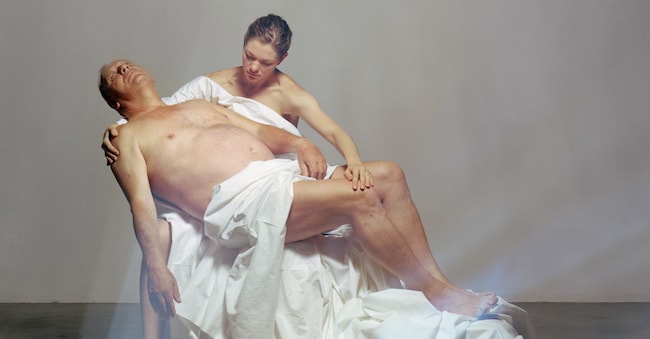
The art-religion relationship invests the very essence of art-making. This is demonstrated by the anthropological and historical-religious discovery of the ritual and liturgical matrix of the genesis of artistic practices. This is also proven by the history of aesthetic theory, which has been oriented since its beginnings towards the search for a joint definition of the notions of beauty, art and the "divine" - think of Plato, among others - as well as concrete artistic praxis, which for years has coexisted, sometimes in harmonious terms, in other cases in conflictual forms, with religious institutions. How, however, must we ask ourselves, does this original relationship find its declination in an age, such as the modern one, dominated by secularisation and the metamorphosis of the epiphanies of the sacred?
On closer inspection, this question can be reformulated prospectively by taking into account the radical shift that contemporary global society is experiencing. The exhibition project 'Du sollst dir ein Bild machen. Zeitgenössische Kunst und religiöses Erleben' ('You should make yourself a picture. Contemporary art and religious experience'), curated by Günther Oberhollenzer at the Künstlerhaus in Vienna.
Between contemporary art and religion
The exhibition, dedicated to the relationship between contemporary art and religion, with a particular focus on Christian iconography, proceeds from a metaphorical reformulation of the iconoclastic prohibition of the Book of Moses (the Second Commandment: "thou shalt not make thyself an idol or an image of any kind") to provocatively reflect on the iconophilic and demiurgic power inscribed in artistic images.
The curatorial project also starts from the assumption that contemporaneity is a phase of multiform transition. In fact, this season is inhabited by artists who are no longer modern, but post-modern; no longer secularised, but post-secular, on the way to rethinking the existential value of religion in the light of a renewed need for the sacred, also through the encounter, at the time of globalisation, with distant religious traditions (Islam, Hinduism, Buddhism, etc.) and new spiritual trajectories (the "New Age" universe and the New Religious Movements, etc.).) and new spiritual trajectories (the 'New Age' universe and the New Religious Movements); no longer 'disenchanted' but open to forms of hybridisation between western reason and holistic, symbolic, perspectival, de-centred paradigms.
In the rooms of the exhibition, more than forty artists, some historic and some emerging, who have been able to thematise the relationship between the aesthetic dimension and the religious sphere from a secular but philosophically committed point of view, meet in the exhibition rooms, subdivided by theme. Art, in short, returns to take the spiritual experience seriously. It does so in a stunning, at times chaotic and contradictory multiplicity of perspectives, ranging from respect to rediscovery, from satire to irony, passing through rhizomatic processes of deconstruction, eclecticism and cultural 'pastiche'. To say religion is in fact to allude to transcendence, to the power of the sacred, to the epiphany of meaning, but also to relations of power and oppression, to devices of control and forms of social construction. A dual perspective thus runs through the images evoked in the exhibition: the icon is proclaimed in its archaic sense of sacred image (eikon) but also within the dialectical play with the idea of "iconic" recognisability, the "pop" affirmation of a given model or lifestyle; the cross, an eminent symbol of the Christian faith, also stands out as a transcultural symbol of orientation, connection and axial verticality; the traditional iconography of the triune God and the Virgin Mary are reinterpreted in the light of new, post-metaphysical, inter-religious instances, in some cases even influenced by the debate on identity and gender relations; the Last Supper, finally, emerges in a symbolic guise resulting from the mediation between the testimony of the Holy Scriptures, Leonardo da Vinci's model and contemporary cues.

