
Giulia Terzi: 'Disability and motherhood are not at odds'
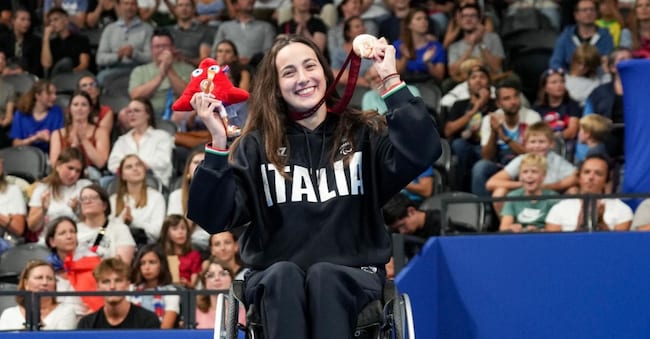
The Paralympic swimming champion is mother to Edward, born a year ago, just before her four medals won in Paris 2024.
by Ilaria Parlanti
 Aggiungi Il Sole 24 Ore
ai preferiti su Google
3' min read
3' min read
When she touched the edge of the pool with her hand, winning bronze in the 400 metres, a race she has always struggled with, Giulia Terzi breathed a sigh of relief. 'Psychologically it was hard, I realised this in the race, when I panicked before entering the pool. The moment I realised I had won bronze, I remember it distinctly: I realised that all the sacrifices I had made so far had not been in vain'.
In order not to miss the Paralympic Games in Paris 2024, where she won a gold and three bronze medals just forty days after giving birth, Giulia Terzi returned to the pool to train as soon as she received the green light from the doctors. "It was a very intense period, but the goal was too important," now recalls the Paralympic swimming champion, who is now looking ahead to her next goal: Los Angeles 2028. "It is three years away, but I am training, although not yet intensively. I am competing, last month I took part in the World Cup in Lignano Sabbiadoro. At the same time, however, I am also taking moments for myself, after the physical exertion of Paris,' explains Terzi, who emphasises: 'I struggled with a strong sense of guilt in leaving Edoardo just a few months old for training and competitions, but I was lucky: my partner and my family made sure that I had the help I needed. And the Paralympics was all about my son: I wanted to be the best athlete I could be, but also the perfect mother for him. On the other hand, partner Stefano Raimondi, who has won five gold and one silver medal and with whom Terzi shares the sporting and family travails, was also in the pool in Paris.
The champion, despite her successes in the pool and in her professional life - two degrees - in Political and Social Sciences and Law as well as an Mba - is not exempt from criticism and criticism, as often happens to mothers: 'Often strangers doubt that I can bring up a child or ask, very insistently, whether Edoardo is really my son. The idea of a mother with disabilities is still not accepted, perhaps because there are few examples. There is still a lot to be done on inclusion and the culture of society, because disability is considered a big limitation, so much so that it becomes inconceivable to be a disabled woman, worker and mother. To all women with disabilities who want to become parents, I tell them to talk to their doctors: if there are no contraindications for themselves and the child, you can face motherhood by organising your life appropriately according to your needs'.
Edward is growing up, but he is too young to understand the disability of his parents, who will deal with him at the appropriate time. "What I hope for my son is that he grows up happy and does not suffer from my disability, from the abilism I struggle with on a daily basis. We will raise him in empathy and respect. Every day he is in contact with disability, but education is not only through the family. For the time being, we are protecting him, choosing environments, such as the nursery, that are completely accessible to me, so that he can live all the experiences that involve us as parents in exactly the same way as other children. Then, I hope he will meet intelligent people, in a society that is more sympathetic to issues of equality and inclusion'.
And what does Giulia Terzi wish for herself? The champion laughs: 'I still have many small and big dreams to realise, day after day. In the meantime, let's think about the next competitions: the world championships in Singapore are approaching, the call-ups will come out after the Italian championships in July. And then being surrounded by the affection of people who love me is the drive that always leads me to improve, as a person and as an athlete'.


