
George Frideric Handel’s *Julius Caesar in Egypt* at the Teatro del Maggio
Directed by Gianluca Capuano and staged by Davide Livermore, the production runs until 25 June

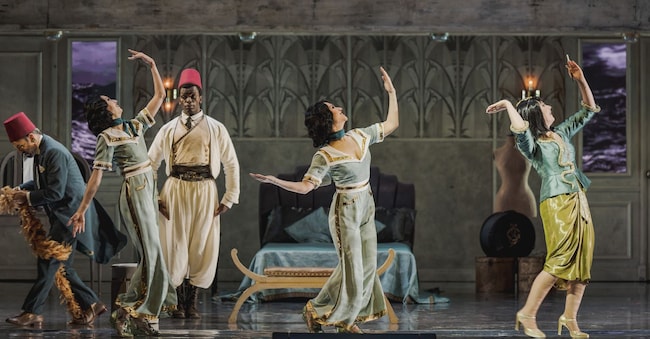
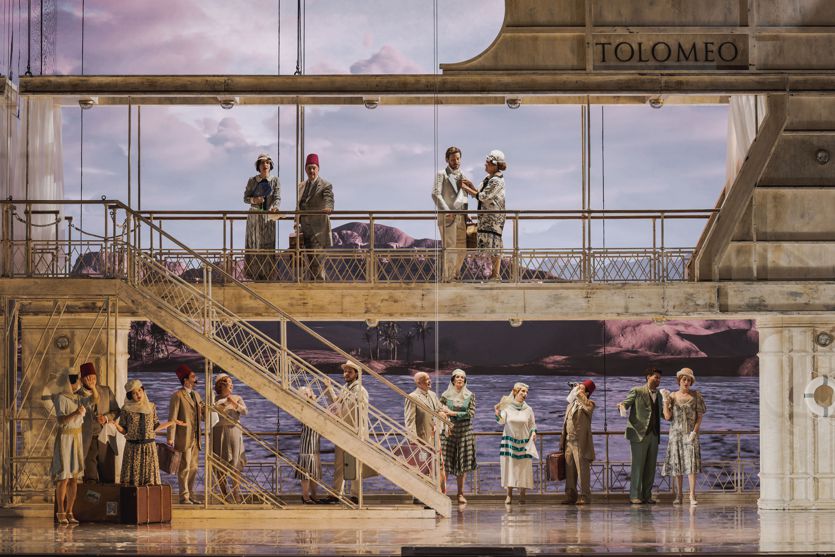
“Julius Caesar in Egypt”, directed by Davide Livermore, becomes a comic thriller; in one of his most successful productions, he reinterprets Handel’s opera by setting it on a luxury steamship named the Ptolemy, cruising along a Nile that takes centre stage. Stormy, lulling or blood-red waters, romantic and otherwise explosive scenes, chic attire and twin-propeller aircraft, in the style of Agatha Christie’s 1930s. First staged in Monte Carlo two years ago and revived in Zurich, this virtual vessel arrives with splendour and merriment at the Maggio Musicale, bringing the Festival’s trio of operas to a glorious conclusion. However, beyond the thunderous gunfire and explosions, it is now the voices on display that stir and ignite: in a contest of expressive intensity, emotional crescendo and infectious virtuosity. The premiere, on Sunday afternoon, becomes a thrilling celebration of voices. Recreating themselves anew with every orchestral entry, every symbolic word, every ‘da capo’.
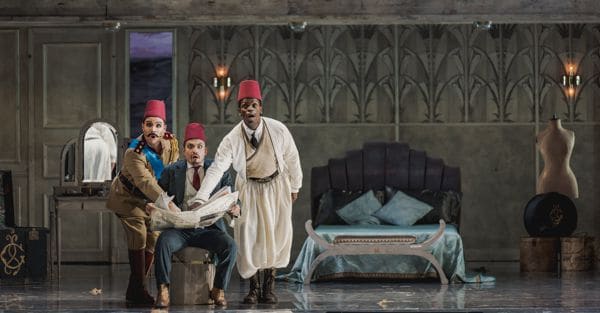
The song takes on a subtle irony
This is thanks to the highly musical direction of Gianluca Capuano, who engages in a close dialogue with a dazzling orchestra—without pretending to be old-fashioned—and with a stellar cast of singers. Leading the way is Giulio Cesare, the unmistakable Raffaele Pe: ever more liberated, ever more of an actor. His singing takes on a subtle air of irony. The chemistry is perfect with Mariangela Sicilia’s Cleopatra, a truly moving prima donna. Hailed with great acclaim, punctuated by thunderous applause following the most beautiful arias – practically all of them, what a display of creativity – the opera had never before been staged in Florence. It is now making its debut – it’s hard to believe.
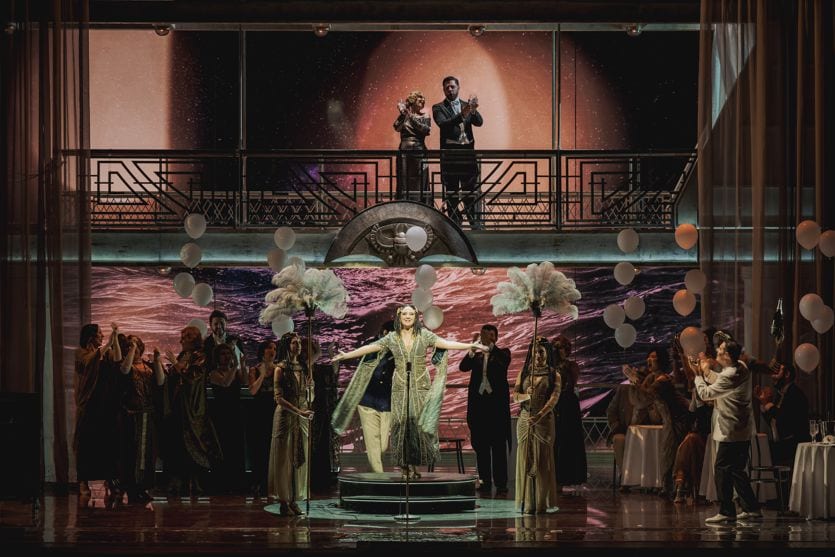
Handel’s ‘Theatre of Emotions’ also wins over the hearts of Livermore and his team, with set design by Giò Forma, video by D-Work and lighting by Antonio Castro. So here he is, in collaboration with the director, constructing a sweeping dramatic arc: it begins light-heartedly, in the carefree atmosphere of a night on a cruise, where the game of mutual pretence between Caesar and Cleopatra masks a cabaret-style romance. Soon the drama unfolds, where colours and gestures embody universal pain. From the abyss we rise again, towards a smiling, utterly charming happy ending. Complete with group photos, flashes and applause. Anyone who thinks of the Baroque as a static parade of fixed numbers without any room for variation needs to think again. The linchpin around which the opera revolves is her aria, ‘Se pietà di me non senti’, a declaration of death delivered with absolute control over phrasing and tone: draped in a long golden gown (Mariana Fracasso’s costumes are truly elegant, straight out of a Hollywood film) Mariangela Sicilia perfectly combines her vocal artistry with her physical presence. Standing alone, she holds the empty space of the stage. In four utterly ordinary octaves, she unfolds a world. A world that also sees her bent to the ground, defeated. But in the finale, with arms raised, as the cloak on her shoulders takes on wings, she soars into flight.
Irony, however, remains the show’s winning feature. It is picked up and carried forward with ease by Raffaele Pe, who has the insight to portray Cesare by drawing on the pompous language of the libretto – laced with academic jargon and subtly comical in a context of love and war. Even for him, however – with his playful voice, smile and carefree dancing – the moment of self-awareness arrives: a medallion of his own, a freeze-frame, ‘Aure, deh, pietà’. Where the opening “a” is held out indefinitely, and not merely as a display of record-breaking breath control. The protagonist’s skill radiates outwards to the other two countertenors on the programme: Sesto is played by the young Nicolò Balducci, with a bright, vibrating, spontaneous timbre, whilst Filippo Mineccia sings Tolomeo, introspective, tormented, contradictory. This theatrical mastery demonstrates the technical quality now achieved by this vocal style – once considered eccentric and at times rather unpleasant, but today a window onto new horizons. Fleur Burron delivers a truly acting performance in the heart-rending role of Cornelia, the utterly loyal and steadfast wife; Valerio Morelli plays Achilla with a beautiful tone. Davide Sodini is Curio, Janekta Hosco is Nireno: even in the supporting roles, the attention to detail is perfect. As in the orchestra, the horn part by Alessio Dainese or the violin on stage, vying in flourishes.
May began with the Klinghoffer. It ends with the ship, now renamed “Cesare”.

