Turin Book Fair

Jumpa Lahiri: 'Raised hybrid, my life is a trespass, my home is translation'

In 'Why Italian', the writer born in London of Bengali parents and living in the United States before settling in Italy reflects on translation ('a violent thing'), self-translation (an even more violent thing) and why she decided to write in Italian

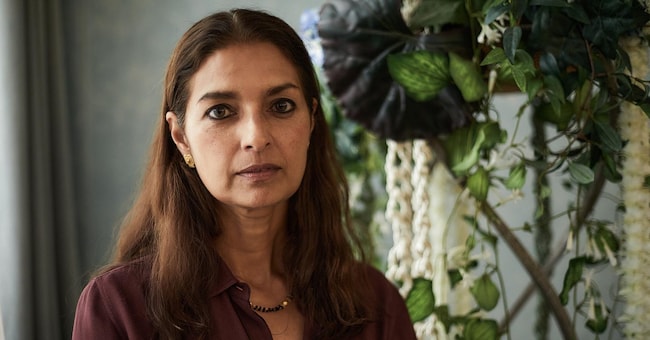
 Jhumpa Lahiri - scrittrice (Mirco Toniolo Errebi / Agf)

8' min read

8' min read

"Traduco dunque sono" writes Jhumpa Lahiri in Perché l'italiano (Einaudi, pp. 228, euro 19, 50, with translations by Tiziana Lo Porto, Fabio Pedone, Stella Sacchini and Domenico Starnone), a collection of essays on translation and self-translation. Born in London to Bengali parents, brought up in the United States, from an early age she faced translation problems between Bengali, her mother's language, and the English she learnt at school. Until, out of love for the Italian language, she decided to live in Rome and even started writing in Italian. This language gave rise to Dove mi trovo, In altre parole, and her first collection of poems Il quaderno di Nerina (all published by Guanda). Lahiri has also started translating other people's books: some of Domenico Starnone's novels, such as Lacci, or Scherzetto, and is now working on a four-handed English translation of Ovid's Metamorphoses.

You write in Why Italian that 'Translation has transformed my relationship with writing'. How?

Loading...

Translation allows a more direct channel with the writing, it really manages to live a text. It is another experience compared to reading, which is more passive. Translation is the recreation of writing, it is writing. Translating is rewriting, you have to choose every word, arrange every sentence. In a nutshell, translating is learning how to write. It is truly extraordinary: you enter other writers' books in a way that you would not have experienced otherwise. Translating some of Domenico Starnone's books into English took me into another world, his world, a semantic, syntactic world. It gave me a direct contact with an elsewhere that gives nourishment to the writer.

Some say that in literature, content is inseparable from form, from writing. What do you think?

In my opinion in poetry this question is more relevant, because really poetry and form are two completely united things. That said, I am translating a great poem by Ovid, The Metamorphoses, which is precisely about form, and I am trying to re-propose a new form for that too. You have to re-propose a new form: translation is not correspondence. Let us imagine that the text is this sofa that we see before us: it is not possible to replicate the same sofa in another language, languages do not have this correspondence. A person could copy this sofa without having drawn it first, without the inspiration, without that idea born out of nothing, with writing, on the other hand, it is not the same thing, because every language is a world. That is why writing is not form. One is somewhat deluded by this idea, an idea that makes one perceive translation as a second-rate work. Instead, after much reflection over these years, through my own work, I really believe that this is not true, that translation is another form of writing. Translation remakes the book. It breaks the form. It doesn't change the characters, the plot, the gestures they make, the descriptions: it doesn't change the roba that you put inside the container, all that doesn't change. But it does change the nature of the text, the rhythm, the momentum, the attitude of the text, in some ways, in the linguistic sense. Language brings another energy, another tonality, language is another instrument. If I hear a musical composition created for piano in another version, a version for another instrument, it is another thing. You can propose another thing.

In your book, you declare yourself surprised by the many 'Italian writers of the last century who have devoted a considerable amount of time and energy to the practice and promotion of the art of translation, not only in search of authoritative guides and influences for themselves, but also to uphold an ethical and political mandate, that of opening cultural frontiers'. Do you count yourself among them? And does translating also have an existential meaning for you?

Existential certainly: translation is able to explain me, and like me so many people, so many hybrid creatures. It gives sense to so many people. As far as the ethical, political sense is concerned, so many Italian authors have opened the way for me, such as Gramsci, whom I talk about in the book, in him we see the importance of translation not only as an intellectual passion, but also in life, as a parent, as a husband. Or even Calvino, who says he can only understand his works through translation, through this filter, through the distances that translation generates. In Perché l'italiano, I did not put a reflection on Pavese, but he is another writer fully dedicated to translation as a political, personal, ethical, existential operation. In these authors, there is really a need for translation, it is impressive. Today this double action of writing and translation typical of 20th century authors seems less strong to me. I seem to see more writers on the one hand, and translators on the other, less writer-translators. Perhaps also because in Pavese's time, under fascism, translation was a 'forbidden' thing, the idea of bringing a work into English had a different scope than today.

Do you think that living in another language than one's mother tongue is an exile?

Already talking about mother tongue for me is problematic. In my case, as for all the children of immigrants, the mother tongue is a language that grows you up to a certain point, then it becomes a bit monotonous because you don't study in that language, you don't make friends in that language. Instead, the mother tongue for other people, for so many people, is a concept of colossal importance: it is a cultural, spiritual reference point, it is the compass of life. When you talk about exile, you have to have a place where you belong, if you don't have it, either there is only exile or there isn't, it is a forced or continuous exile. I feel somehow always in exile, but I don't know from where, because I don't have that point of reference, I don't feel that necessary bond, the whole package: language-culture-place. My mother lived this way, with language-place-culture forming a unicum, this is how many people live. Others, like me, are between languages, places, cultures, like those who translate. Translation always exists between languages, cultures, therefore also between places. Exile interests me a lot, literature has always talked about it....

Ovid, from Tomis...

He has experienced a painful, 'cruel' exile, he has suffered, he feels dead when he is in exile, he no longer lives: without Latin he feels in the afterlife. Yet he continues to write in Latin about this suffering. Writers have always done this, they cling to the language, to the end. I cannot make this return. I miss that point of origin, my activity is always a crossing, a trespassing. Even today I am writing a little in English, but it is not a return for me. After all, we already understood this with Homer: there is no return at all. You return to Ithaca and no one recognises you any more: you are a stranger back home. Return is not possible.

I know he wrote a whole book to answer this question. But I really have to ask him: why Italian? .

I was looking for something else. I was looking for another path, another approach to my writing. In my life there was this desire to reach a new shore, and this shore was a language, a language that I needed to reach. It was really a need, like the need to go to a place. The place for me was the language, before the physical place, that is, Italy. I looked for this place in this language, and then I arrived at the place with the language more or less under control. However, in the meantime I was also looking for another key, another starting point for my writing: these factors in a particular moment of my life combined in a fruitful sense and I began to experiment with Italian as a creative language, and I discovered a new everything, above all a new freedom to express things that I would not have dared to express in English, I would not have dared to even think. This was very strong, then also what Pavese says in his translation of Melville's Moby Dick counted for me, Pavese, in translating it, becomes Melville and writes something like 'I go towards the forbidden sea, that place where I should not go, the other shore'. In my opinion Pavese everything he did was a search for that forbidden sea. He reached it. Italian for me was a way to reach the forbidden sea. Everyone in Italy asks me: why do you abandon your language? Why do you write in our language? These your, our language made me think a lot about things that go beyond language. I have not abandoned my language, I do not have a my language, what does a your language mean? What defines a true linguistic belonging? This aroused other whys within me, because there is any language that can have a label like this: our, your, my... I understand when one says: this is my house, I understand less when one says: this is my language. But it is a recurrent formula in Italian, they use it all the time when they interview me, when they introduce me, when they review my books. . It is already putting a boundary between us if I say that. To say instead Jhuma Lahiri writes in Italian is a more neutral observation.

Few authors translate themselves. You have done it several times, but why is self-translation so problematic?

Self-translation is really an existential crisis! Translation is a rather violent operation, and if it is not, it means that you are not really translating, if you go searching with pliers for correspondences, if you try to 'copy, it is not translation, it is not authentic, it is not a real text. To translate you have to dismantle everything, you have to destroy everything, you have to destroy the text and then reconstruct it, word for word. This is translation, and it is difficult, because often - even in my case with Ovid - if you have a lifelong relationship with a text, a text that seems so sacred to you, so immense, amazing, important, the idea of destroying it does not come to you. Translation already seems taboo for those who work on other people's texts, when you self-translate it is all to the nth power, because it is your text. You are yours. When you write you are your text, the boundary between you and your book is fake. When I see my book I see myself in words and pages instead of blood and bones. So translating is destabilising, tremendously so, it is an earthquake. And it is also very tiring, because in any case you have to get back into an idea, into a text, into a reality on the page that once you have closed you don't necessarily want to process anymore, to go over word by word. And along the way all the problems, all the imperfections come up, you ask yourself: why do I use this word so often? You say to yourself: this repetition was not necessary... I could have written it like this instead.... All this is a torment And there is the risk of radically changing the text, but this is not necessarily a risk, as we learned from Beckett it could instead be a wonderful opportunity. But one has to accept that the so-called source text does not play a primary role, that it was simply a first attempt, one has to accept another mode of literature, that no text is definitive, and there is always another way to propose it to the reader. Translating oneself is an operation that no one wants to undertake to the end, because it is dirty violent, it is a chore. But it is also the joy, the beauty, of rebuilding from the rubble of an earthquake.

Copyright reserved ©
  • Lara Ricci

    Lara Riccivicecaposervizio curatrice delle pagine di letteratura e poesia

    Luogo: Milano e Ginevra

    Lingue parlate: Inglese e francese correntemente, tedesco scolastico

    Argomenti: Letteratura, poesia, scienza, diritti umani

    Premi: Voltolino, Piazzano, Laigueglia, Quasimodo

Loading...

Brand connect

Loading...

Newsletter

Notizie e approfondimenti sugli avvenimenti politici, economici e finanziari.

Iscriviti