Mind the Economy/Justice 76

Justice is in the journey and not in the arrival. Robert Nozick and the 'valid title' theory

by Vittorio Pelligra

8' min read

8' min read

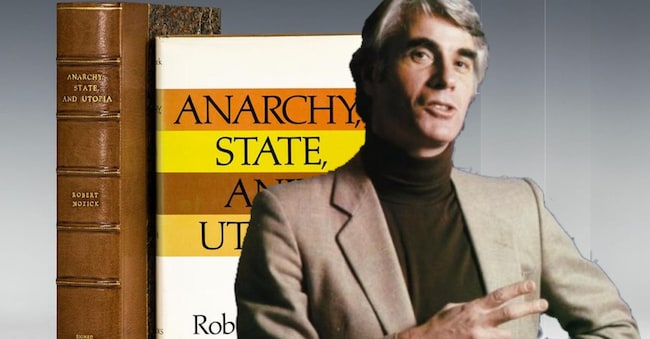
Robert Nozick is the philosopher of the 'minimal state'. While starting from a radical view of natural rights and in particular the inviolability of the right to 'self ownership' he escapes what would seem the natural political consequence of such a perspective - anarchy - by showing, as we saw last week, that a minimalist vision of the state is what individuals in the state of nature would naturally arrive at if they were to begin, first on their own, then in increasingly large and organised groups, to proceed autonomously to enforce their rights and punish those who violate them. The 'minimal state', therefore, is legitimate in that it is only concerned with enforcing natural rights and administering justice. Any other activity would violate the rights of individuals and would therefore be illegitimate, even, for example, an activity to promote a fairer distribution of resources or opportunities. Is there no room, then, in the 'minimum state' for justice? To affirm the inviolability of the "ownership of self" and all other individual rights that flow from it and renounce any idea of promoting social justice, or to assign redistributive functions to the state and renounce the inviolability of rights. This seems to be the dilemma that Nozick addresses in the second part of Anarchy, State and Utopia. A dilemma from which he emerges by proposing his entitlement theory of justice.

In this series of Mind the Economy dedicated to the idea of justice, we have discussed at length various possible solutions to the problem of 'distributive justice', i.e. the problem of how to allocate resources, opportunities and goods in a society so that it is, in the judgement of its citizens, just. The principles that have been developed in even recent history are manifold, of course: one can follow the criterion of needs, of merit, of hard work, of compensation for disadvantages arising from the lottery of birth, or, as Rawls suggests with his 'difference principle', the criterion that leads us toadvantage the disadvantaged. No matter which principle of justice is actually adopted, however, these all presuppose a process of redistribution: we take away from someone to give to someone else. The lack of explicit consent and the non-voluntariness of this redistributive action makes it, in Nozick's eyes, not dissimilar to robbery, and since the resources that are redistributed are the fruit of someone's labour, the redistributive action constitutes not only robbery but also a form of slavery.

Loading...

As one can understand, the judgement is not light. How is it possible, then, precisely in the light of such a radically critical stance towards all forms of redistribution, that Nozick comes up with his own original theory of distributive justice?

A first point of departure is the recognition of the deep connection that must exist between the moment in which goods and wealth are produced and the moment in which the problem of their distribution arises. That is, Nozick begins by questioning the approach of traditional theories of justice whereby it is as if goods and wealth are there ready to be distributed and as if no one has contributed to their creation. Distribution cannot be separated from production, Nozick tells us. This passage allows him to include a criterion of justice in his vision of the 'minimal state', because this idea of justice does not actually involve any form of redistribution (although he discusses this in a section entitled 'distributive justice') and thus no infringement of individual liberties.

"What each person receives," writes Nozick, "he receives from others who give it to him in exchange for something, or as a gift. In a free society, different people control different resources, and new possessions arise from people's voluntary exchanges and actions. There is no more distributive activity or distribution of shares than there is a distribution of partners in a society where people choose whom to marry. The total result is the product of many individual decisions that the different individuals involved are allowed to make' (Anarchy, State and Utopia, 1981, p. 163). The central point, then, is that of the legitimacy of property, of 'possessions' (holdings), as he calls them. This is because his vision of justice is a historical or procedural vision and not, like utilitarianism, for example, a vision based on end-states.

What does this mean? An end-state theory of justice is interested in assessing the properties and nature of a certain distribution and comparing it with possible alternative distributions. Let us imagine two subjects, Alice and Bruno, who own 5 and 10 units of a certain good, respectively. How fair is this distribution? For utilitarians it is fair if it maximises the sum of the utilities of Alice and Bruno. So certainly a distribution in which Alice has 4 and Bruno 9 units will be worse than the former. But what about a third distribution in which Alice has 10 and Bruno 5. This could be just as fair as the initial one where the figures were reversed. The utilitarian does not care who owns what as long as the sum of utilities is maximised. Nor does it matter to the utilitarian how it came about that Alice came into possession of her 10 goods and Bruno of his 5, whether they produced them by their own labour, received them as gifts, found them on the street or bought them. What matters is the distribution, the final state.

Other theories of justice have, on the contrary, a historical or procedural structure, because all these factors have their own relevance. The fact of having produced with one's labour a certain good is not equivalent to possessing it. The fact of deserving something or needing something ties the redistribution process to a dynamic that considers the origin of that possession or right to the good. Nozick's theory of 'valid title' also has a historical structure in the sense that it is fundamentally based on the history of 'possessions'; that is, on the way in which the right of ownership to that particular good was acquired. "The content of justice in possessions," writes the philosopher, "consists of three main arguments. The first is the initial acquisition of possessions, the appropriation of things not possessed. This includes the question of how things without possession can be possessed; the process, or processes, by which things without possession can be possessed (...) We shall refer to the complicated truth on this subject (...) as the principle of justice in acquisitions'. It is, therefore, a question of whether all those who hold possession of a given good have a 'valid title' to do so, because they have acquired it legitimately by producing it or exchanging it. This second aspect, of exchange, falls within the second area of interest of the theory of justice. "The second topic," Nozick writes, "concerns the transfer of possessions from one person to another. By what processes can one person transfer possessions to another? How can one person acquire possession from another who holds it? This topic includes general descriptions of voluntary exchange, gift and (at the other extreme) fraud, as well as reference to special conventions established in a given society. We shall call the complicated truth on this subject (with room provided for special conventions) the principle of justice in transfers' (p. 164). The third principle is the so-called 'principle of rectificatory justice', which we will deal with later.

In a world without fraud, theft or deception, the first two principles, of original acquisition and legitimate transfer, would be sufficient to define justice in 'possessions'. Nozick, in fact, proposes this simple argument in three steps: 1) a person who acquires a possession in accordance with the principle of justice in acquisitions is entitled to that possession; 2) a person who acquires a possession in accordance with the principle of justice in transfers, from someone else who is entitled to that possession, is entitled to the possession; 3) no one is entitled to a possession except by (repeated) applications of 1 and 2.

The central point of Nozick's theory of valid title, therefore, is that a possession is just if its ownership is legitimate, i.e., if it has been acquired or transferred in accordance with the procedures established by the two principles. With regard to the transfer of property, for example, this is only just if it is voluntary. Nozick proposes an example in this regard involving a well-known American basketball player, Wilt Chamberlain. Let us imagine, Nozick suggests, that we start from a situation in which every citizen has exactly the same income. This distribution, let us call it D1, is unanimously considered fair. Now, let us suppose that Chamberlain, by virtue of his great skill and fame, succeeds in extracting a particularly advantageous contract of engagement. The contract specifies that in addition to the fixed remuneration the basketball player will receive twenty-five cents for every ticket sold to attend one of his team's games. 'The season starts,' Nozick continues, 'and people cheerfully go to their team's games, dropping twenty-five cents of the admission price each time into a box with Chamberlain's name on it. They are all very eager to see him play; he is worth the full price of admission to them. Suppose a million people attend his home games in a season, and Wilt Chamberlain ends up with $250,000, a sum far greater than the average income and greater even than anyone else has. Now let's assume that the income of the other citizens has remained more or less the same as the previous year, we should ask ourselves whether the new distribution, let's call it D2, which sees Chamberlain in a position of great advantage over all the other citizens is to be considered fair or not. According to Nozick, if the D1 distribution was fair, then D2, which derives from the former and was obtained from it through totally voluntary, hence legitimate, transfers of 'possessions', cannot not be fair too. "If D1, was a fair distribution," Nozick concludes, "and people move voluntarily from it to D2, transferring part of their allotted shares into D1, will not D2 also be fair?" (p. 174). It is easy to see, then, why the theory of valid title is historical or procedural in nature and how it puts procedures before whatever end state may result. "Anything that results from a just situation by means of just moves is itself just" (p. 165) summarises Nozick. In this framework, any interference with the voluntariness of transactions leads to the emergence of a situation of injustice. From here to stating that 'Taxation of labour earnings is on the same level as forced labour' (p. 181) the step is not long. "To take the earnings from n hours of work," Nozick continues, "is tantamount to taking n hours from the person; it is tantamount to forcing the person to work n hours for the purposes of another" (ivi). He continues, 'To seize the fruits of someone's labour is equivalent to seizing hours from him and having him under your command in the performance of various activities. If people force you to do a certain job, or unpaid work, for a certain period of time, they decide what you should do and what purpose your work should serve, regardless of your decisions. The process by which they make this decision for you makes them co-owners of you; this gives them a property right over you' (p. 184). Through taxation for redistributive purposes, the state becomes your 'co-owner', imposing a true form of slavery in open violation of the right to 'self-ownership'.

From this perspective, therefore, any form of redistribution generates injustice because the principle of 'valid title' states that a distribution can only be considered just if everyone is entitled to the possessions that that distribution provides. And the legitimacy of those possessions, in turn, is specified by the 'principle of justice in transfers' that we discussed above. A forced withdrawal of wealth such as that which occurs with taxation violates justice in transfers and thus generates a situation of injustice. We will analyse in depth, in the coming weeks, the other two fundamental principles of Nozick's theory: the 'principle of justice in acquisitions' which specifies how one can acquire a possession in an original way, and the 'principle of rectificatory justice' which defines the terms of the compensations for which one accrues a title in case one's rights are violated. We will thus continue to search with Robert Nozick for the answer to his fundamental question "If the state did not exist, would it be necessary to invent it?".

Copyright reserved ©

Brand connect

Loading...

Newsletter

Notizie e approfondimenti sugli avvenimenti politici, economici e finanziari.

Iscriviti