Economics and Finance

Kamala, Donald and the others: why fashion is a very political issue in the US

Towards the elections. Strategic looks

by Marta Casadei

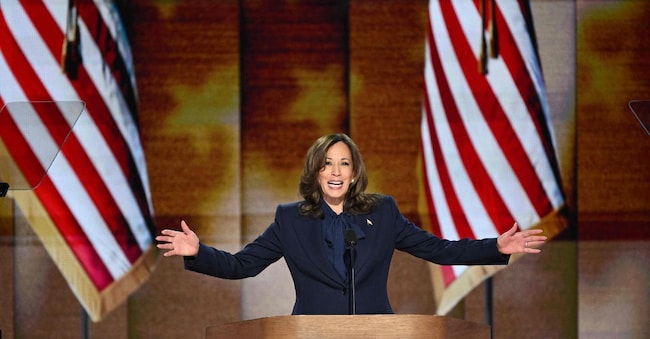
La candidata democratica Kamala Harris. (Mandel NGAN / AFP)

4' min read

4' min read

The pearls that communicate authority, the shirt with the Lavallière collar that evokes autonomy and independence, the 'tan suit' that recalls the non-conformist looks of the most revolutionary tenant that 1600 Pennsylvania Avenue has ever had, at least until today: Barack Obama, the first African-American president in US history.

The link with aesthetics - a concept that obviously goes far beyond style - is something that has always characterised politics, because it influences voters' judgement. At a time when media overexposure amplified by social media reigns, the style choices of the US presidential candidate (who apparently relies on New York stylist Leslie Fremar) convey precise and studied messages. As do those of the Republican candidate, Donald Trump.

Loading...

Between institutional looks and working class garments

Already four years ago, on 8 November 2020, when from Wilmington, Delaware, she delivered her first speech as vice-president (the first woman in history), emphasising that protecting democracy requires effort, Kamala Harris was also telling through her clothes of a 'glass ceiling' that had been broken: she was swaddled in a white trouser suit, historically a symbolic colour of the suffragettes as well as that of the dress worn by Shirley Chisholm, the first African-American woman elected to Congress, and around her neck she sported the first of many 'pussy bow', the Lavallière bow, associated with the idea of women, since the eighteenth century, trying to 'take back space' in a patriarchal society.

On the other hand, Donald Trump - who has made the suit and tie his uniform since the 1980s - has worn reflective blue-collar waistcoats, McDonald's fryer aprons and fireman's helmets during his election campaigns, but always in combination with the dark suit and red tie. A message 'on the contrary': that of the entrepreneur who immerses himself - or tries to immerse himself - in the reality of his constituents, identifying himself with one of them (but always remaining himself: the white shirt, in fact, is never abandoned, not even under the apron).

Da Kamala Harris a Michelle Obama, le scelte di stile che hanno fatto politica

Photogallery24 foto

Returning to the US vice-president's looks, the so-called pussy bow also seems to be a constant in her campaign for the presidency: it also returned on 10 September, on the occasion of the first televised face-to-face with Donald Trump, where Harris wore a black so-called power suit (a suit of power, i.e. a suit with a masculine cut). The power suit Kamala Harris has always made one of her hallmarks (like the already mentioned pearls) even in the last moments of the election campaign where she often opted for an all-blue look, the symbol colour of the Democrats.

If the aesthetic choices speak for themselves, as is often the case with public personalities, who study every look together with specialised teams, in the election campaign Harris presented herself as a woman of the institutions (she is still the second highest office in the state), authoritative, but as a woman and daughter of immigrants, she chose to emphasise that she is a 'revolutionary' figure in her own right. Here is another example: at the end of September 2024, the Democratic candidate attended the gala dinner of the Phoenix Award that the Congressional Black Caucus (CBC) Foundation bestows every year on people who have made a significant contribution to US society. On that occasion Harris - a former Cbc member - wore a black, sequined evening dress by LaQuan Smith, an African-American designer born in Queens and raised with his grandmother, who has made a name for himself internationally in the last decade with his 'manufactured in Long Island City' collections. And therefore strictly made in the USA.

US policy supports American talent

.

The fact that Harris made the aforementioned choice - to support an African-American talent producing in America - in front of an audience of potential voters, is a perfect snapshot of the triple-threaded link that exists in the US between politics and fashion, perhaps more so than in other countries (certainly more so than in Italy, nda). This is demonstrated by the generous fundraisers organised by Anna Wintour, editor-in-chief of Vogue America, for Democratic candidates. Wintour, also in September, paraded through the streets of New York waving a stars and stripes flag. Around her neck was a scarf designed by Thom Browne for the 'Designers for Democracy' collection, which saw 16 creatives working on a collection in support of Harris (as they did for Biden in 2020).

That's not all: the most political fashion choices are undoubtedly those made by Michelle Obama, during her husband Barack's two terms in the White House. And not only that. Michelle Obama has chosen (apart from a passion for Moschino) since the day she took office to support a new generation of American creatives, such as that of Jason Wu - "that dress evoked my family's dream metamorphosis", she wrote in her autobiography "Becoming" - worn for the Neighbourhood Ball. The former first lady continues to promote young American fashion talent through her looks: at the Chicago 2024 Democratic Convention she wore a suit by Monse, a New York duo formed by Laura Kim and Fernando Garcia. The message is clear and to the point: institutions support an important industry.

Loading...
Copyright reserved ©
Loading...

Brand connect

Loading...

Newsletter

Notizie e approfondimenti sugli avvenimenti politici, economici e finanziari.

Iscriviti