Not just dolls

Ken first: at the home of Italy's greatest collector

The release of a book dedicated to Barbie's eternal boyfriend and his looks is an opportunity to retrace the history of men's fashion and its pop icon. Photo by Claudio Moschin

by Angelica Moschin

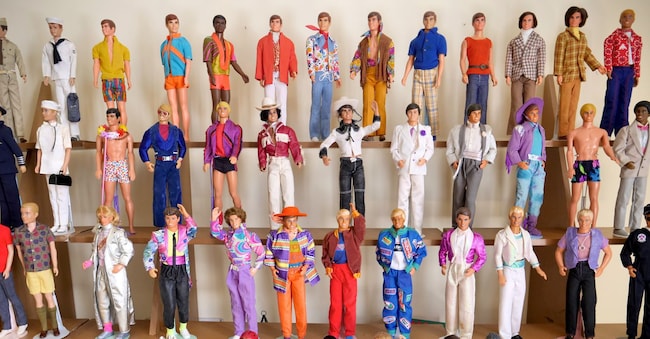
Parte della collezione di Antonio Russo, a Napoli. Per alcuni Ken vintage, iconici e prodotti negli anni Sessanta e Settanta, le quotazioni possono superare i 600 € l’uno, se in perfette condizioni, mentre i prezzi base vanno da 50 a 100 €. Si arriva a 1.000 € per pezzi molto rari (tipo Ken e Barbie nel chiosco Coca-Cola: le varianti a coppia sono tra le più difficili da trovare). Le Barbie sono molto più valutate: nella collezione di Russo si arriva a pezzi da 10.000 €. Ken è stato creato per far sì che Barbie (nata nel 1959) avesse un partner: la storia narra che i due si conobbero nel 1961 su un set.

4' min read

Translated by AI
Versione italiana

4' min read

Translated by AI
Versione italiana

There are those who collect watches, those who collect fine wines, and those who collect vintage cars. And then there is Antonio Russo, a Neapolitan andrologist and surgeon who, with painstaking precision, treats thousands of Barbies and Ken dolls every day as if they were patients in a luxury clinic. 'I don't know why people say 'combing dolls' as a metaphor for wasting time. I assure you that it is an arduous undertaking, to say the least: after thirty combed heads, you cross your fingers and eyes'.

Dr. Russo's meticulous care finds an unexpected celebration this year: Ken takes centre stage with the release of I am Ken. Storia e stile by Massimiliano Capella (24OreCultura, from the end of October, €59), the first book entirely dedicated to Barbie's boyfriend. In this volume, Ken is finally observed not as a simple accessory, but as a lens to narrate sixty years of men's fashion and cultural change. A belated recognition, which finds an exceptional interpreter in the Neapolitan collector.

Loading...

Il libro I am Ken. Storia e stile ripercorre oltre mezzo secolo di tendenze attraverso il ricco guardaroba della fashion doll.

With more than 10,000 examples, Russo is one of the world's biggest collectors of Barbie and Ken. An important part of his collection ended up in 2015 at Mudec in Milan for the exhibition Barbie. The Icon, but his passion has distant roots: "As a child, I was fascinated by a Barbie doll that my cousin had received as a gift. It wasn't like the usual dolls that cried or that had to be changed in nappies. Barbie was independent, autonomous, and above all came with little books that illustrated her thousand outfits and the roles she could play. Even then, it seemed to suggest a multiple life, without the need to invent a destiny for her".

In the 1990s, while giving Barbie to the daughter of friends, the spark exploded again. "It was then that I started to approach Barbie and Ken in a systematic way: books, catalogues, study of variants. It was no longer just a childhood memory, but a scientific research that only a doctor could have transferred to the hair and clothes of thousands of dolls".
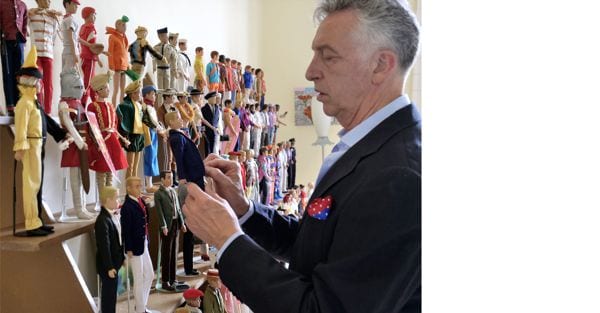
La collezione di Russo conta 500 diversi Ken, che con regolarità vanno controllati uno a uno affinché non si deteriorino o perdano qualche loro accessorio. Il nome Ken fu dato in onore del figlio (Kenneth) della creatrice Ruth Handler. Di cognome, invece, Ken fa Carsone sarebbe originario di Willows, una cittadina immaginaria del Wisconsin.

And while Barbie remains the undisputed protagonist, Ken has always been somewhat neglected: the accessory man, the purse holder ante litteram of a so-called girl boss, a central and influential woman, the one who appears on stage only to complete the picture. In this supporting role, Ken paradoxically (and silently) becomes a precious reflection, in filigree, of male evolution in pop culture.

The very rare Ken Brunette from 1962 proves this: dark brown hair, when the market only provided two variants, blond or black. "He's special because he shouldn't exist. He was born out of a mistake, and yet because of this he has become a myth. A Ken who doesn't conform, and for this reason he has always fascinated me more than the others. He is my absolute favourite.

Then there was the Campus Student, red cardigan and white jumper: quintessential Ivy League style, anticipating the university aesthetic later canonised by Ralph Lauren and photographed by Slim Aarons. The 1970s saw the explosion of Groovy Ken: red and gold brocade, white trousers, a mix of East and West that seemed straight out of Strawberry Fields Forever, suspended between psychedelia and spirituality.

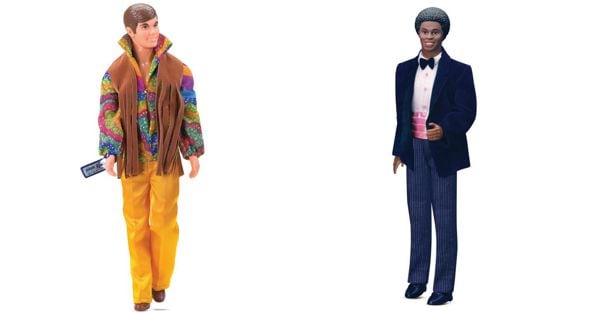
Da sinistra: 1970 Live Action on Stage Ken; 1985 Day-to-Night Ken

The Nineties were the decade of the double discard: the controversial Magic Ken, a lilac jacket and earring, which became a queer icon by chance: "No one could have imagined that a simple earring would trigger such an interpretation. Instead, that accessory turned him into a symbol of transgression and freedom", continues Russo. Then the Totally Hair Ken, a psychedelic shirt that many attributed to Pucci: in reality it was a Versace quoting Pucci. Fashion within fashion, a semiotic short-circuit worthy of Barthes, a game of cross-references that makes quotation an art in itself.

There also came the bearded and tattooed Harley-Davidson Ken, a plastic translation of the cinematic biker; the sophisticated Soda Fountain Ken, with a 1950s Coca-Cola counter made of solid metal, now one of the most sought-after pieces; and the Dressed Box Ken, sold complete with tailored outfits. An absolute rarity for Barbie, whose popularity made dressed boxes extremely difficult to find, while for Ken, less in demand, more of an accessory, it was easier to find intact ones.

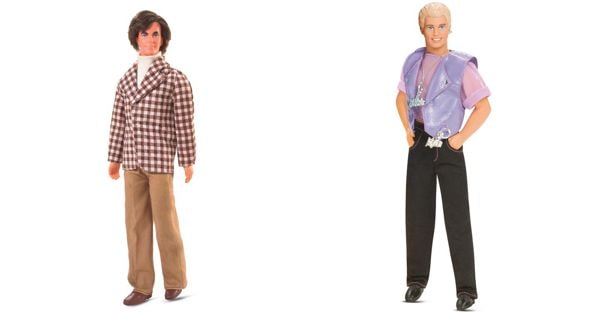
Da sinistra: 1972 Mod Hair Ken; 1992 Earring Magic Ken.

Today, the definitive consecration comes in the pages of I am Ken, which takes up the self-deprecating refrain from Greta Gerwig's film, where Ryan Gosling sings "I'm just Ken" and accepts his marginal role with a performance that has become a cult favourite: "Ken has taken on the part of public ridicule. He has been marginalised, ridiculed, and instead of defending himself he has turned it into character. He has dressed the ridiculous as if it were a stage costume. And therein lies all his nobility.

The final scene is at the Oscars 2024: Gosling in a pink rhinestone-studded Gucci suit, matching gloves, a musical number quoting Marilyn Monroe in Diamonds Are a Girl's Best Friend. Kitsch, as Susan Sontag understood it: exaggerated, histrionic, self-conscious. A glittering, self-deprecating Ken who laughs at his own extravagance, and because of it becomes unbeatable.

'I have always felt more Ken than Barbie, perhaps because we were born in the same year, 1961, and because he represents normality, the common man. And it is by declaring himself common that he becomes extraordinary,' Russo concludes.

Copyright reserved ©
Loading...
Loading...

Newsletter

Notizie e approfondimenti sugli avvenimenti politici, economici e finanziari.

Iscriviti