
Kepler-10c, the mystery of the completely frozen extrasolar planet
International research unravels the mystery of Kepler-10c, a massive but relatively small planet, assuming an icy composition
3' min read
3' min read
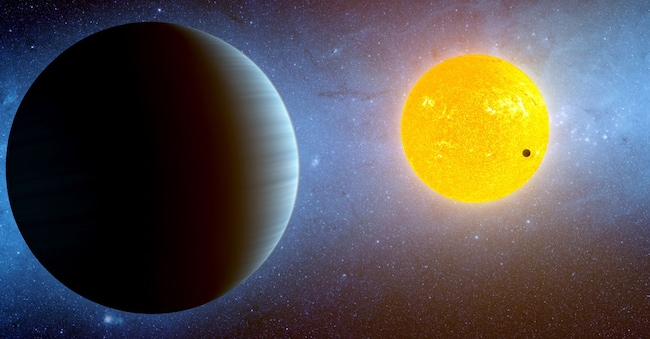
Kepler-10c is an extrasolar planet, revolving around a star other than our Sun, and has been known for more than a decade. Today, thanks to international research led by Italy, we know it to be a completely frozen world.
Using observations made with the TNG, the Galileo National Telescope located in the Canary Islands and specialised in the search for planets revolving around other stars, the enigma that has fascinated scientists since the discovery of Kepler 10c in 2011 has been unravelled: how come it is so massive and at the same time so relatively small.
It lies about 560 light years from Earth, very close in astronomical terms, unreachable for us today, and was initially classified as a 'mega-Earth'.
In fact, it has a mass 17 times that of the Earth but a radius only 2.35 times larger, making it much denser than us. Why such a high density, scholars have been asking themselves for years, and now the recent work by the international group of astrophysicists, led by Aldo Bonomo of Inaf, the National Institute of Astrophysics, published in a leading professional journal in the field, may help us understand why: the planet could be entirely frozen.
Until now, it was thought that the high density of Kepler-10c was due to the fact that it was a rocky planet, like our Earth, but the Italian-led study has led to a reconsideration of the question: it is possible that Kepler-10c is a world composed mainly of a large core of water, solidified in an extreme form, enclosed in a shell of rocky and metallic materials.


