Ukraine

Moscow attacks Kyiv: at least 25 dead. Zelensky: ‘We will certainly respond’

According to the city’s mayor, this is the ‘most intense’ attack by the Russian armed forces on the capital since the start of the war. Seven-year-old girl killed in a raid on Dnipropetrovsk

Aggiornato il 2 luglio 2026

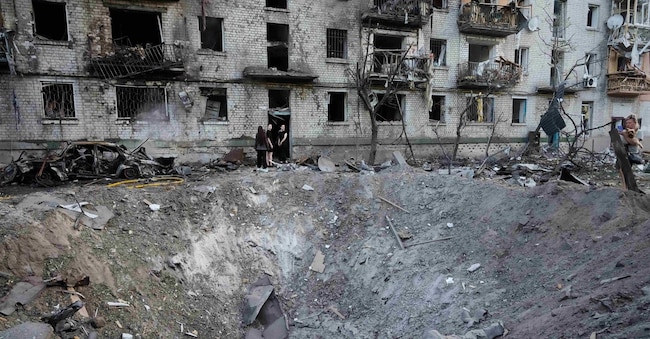
La gente osserva il luogo in cui un missile russo ha colpito un edificio residenziale a Kiev, in Ucraina, giovedì 2 luglio 2026. (Foto AP/Efrem Lukatsky)      Associated Press/LaPresse Solo l'Italia e la Spagna APN

5' min read

Translated by AI
Versione italiana

5' min read

Translated by AI
Versione italiana

The death toll from last night’s Russian air strikes in Kyiv has risen to 25 dead and 85 injured. This was stated by the Ukrainian president Volodymyr Zelensky, who visited the sites of the bombings and pledged to ensure a retaliatory response from Ukraine.

The president also said he hoped for air defence assistance from Western allies at the NATO summit scheduled for next week in Ankara, following the latest massive Russian air strikes on Kyiv. “The issue of air and missile defence must be among the main expected outcomes. Provided, of course, that NATO retains a certain level of importance for the allies,” Zelensky said in his daily address broadcast on social media.

Loading...

The attacks destroyed residential buildings, damaged an A&E department and a hotel in the city centre, and set a multi-storey building alight. At 7.00 local time, damage and destruction had been reported in over 30 neighbourhoods across the Kyiv area. “The enemy is once again targeting residential areas and killing civilians. We have witnessed extremely severe destruction and a significant number of casualties, including children,” said Tymur Tkachenko, head of the military administration of the city of Kyiv.

Ucraina, 1.580° giorno di guerra

Photogallery13 foto

This is the “most intense” attack by the Russian armed forces on the capital since the start of the war, according to the mayor of Kyiv, Vitaliy Klitschko, who has declared Friday a day of city-wide mourning in memory of the victims.

According to the Kyiv Independent, during the offensive, Russia launched dozens of cruise and ballistic missiles at the capital – where ‘powerful explosions’ were reported as early as late on Wednesday evening – as well as launching large-scale drone attacks in various regions.

Una donna reagisce nei pressi di un condominio danneggiato durante un attacco russo con missili e droni, nel contesto dell'offensiva russa contro l'Ucraina, a Kiev, Ucraina, il 2 luglio 2026. REUTERS/Viacheslav Ratynskyi

According to the Ukrainian Air Force – as reported by local media – Russian armed forces launched 570 drones and missiles at Ukraine overnight. There were 74 missiles and 496 drones. The Ukrainian armed forces intercepted a total of 48 missiles and 476 drones.

Zelensky: ‘We will certainly respond to the Russian attack on Kyiv’

Ukraine will ‘certainly’ respond to the massive Russian attack on Kyiv. President Volodymyr Zelenskyy made this promise during a visit to the sites of the bombings. “Russia is targeting civilian sites solely to force Ukraine to renounce its statehood, to drive a wedge between civil society and the army. This is what they have been counting on throughout the war. It will not happen,” he said, adding that Ukraine will “certainly” respond to the attacks.

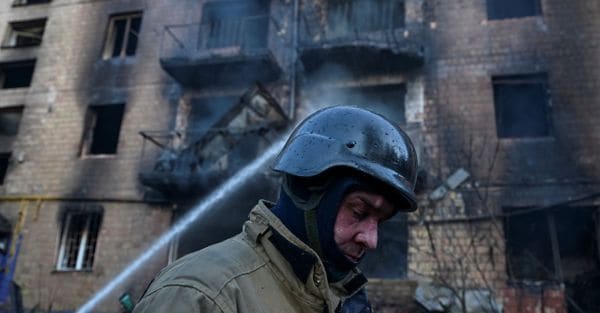
Un pompiere cammina nei pressi di un condominio danneggiato durante un attacco russo con missili e droni, nel contesto dell'offensiva russa contro l'Ucraina, a Kiev, Ucraina, il 2 luglio 2026. REUTERS/Viacheslav Ratynskyi

Kiev authorities: ‘Drones approaching the city from various directions’

On Wednesday evening, Tkachenko had warned via Telegram that drones were approaching the city from ‘various directions’ and that there was ‘the threat of a multi-stage attack’.

Many residents of the Ukrainian capital have taken refuge in the underground stations, and some have pitched tents in anticipation of a long night.

Ucraina: attacchi russi nella notte su Kiev, vittime ed edifici distrutti

Shortly before the explosions began, the Ukrainian Air Force had warned that groups of Russian drones were heading towards Kyiv and other cities, including Mykolaiv, Konotop and Kherson. Just over an hour later, the Air Force reported that further waves of drones were en route to the capital. A few hours earlier, speaking from Dublin, Ukrainian President Volodymyr Zelensky had warned that Russia was preparing ‘a new massive attack’ on Ukraine.

“We have some worrying information” on the matter, said Zelensky, adding that he would be leaving Ireland “shortly” – where he had attended the launch of the Irish EU Presidency – in light of these potential raids.

In the central Ukrainian region of Dnipropetrovsk , a Russian guided bomb attack killed a 7-year-old girl and injured four other people, including an 11-year-old girl, all of whom were members of the same family. This was stated by the regional governor, Oleksandr Hanzha.

EU, Kallas: ‘Words won’t stop Moscow; I will propose new sanctions’

“Words of condemnation alone will not be enough to stop the attacks on Kyiv. Only sustained military support for Ukraine and increased pressure on Moscow can do so. This week, the EU began disbursing €6 billion as part of the €90 billion support loan to strengthen Kyiv’s defences.” EU High Representative Kaja Kallas wrote this on X. “Today I will propose sanctions against further entities that support the Russian military-industrial complex in response to the attacks,” she added.

Loading...

“The more Moscow attacks civilians, the more sanctions must be imposed. We will continue to raise the cost until Russia realises that it cannot win. EU staff in Kyiv are safe. I am deeply grateful to our colleagues on the ground, who are continuing their work with courage and dedication under the most difficult circumstances,” wrote the High Representative.

The Kremlin: ‘We will continue to step up the pressure on Kyiv’

“Russia will continue to step up the pressure on the regime in Kyiv in order to achieve its objectives.” This was stated by the Kremlin spokesperson, Dmitry Peskov, following last night’s massive attacks on Ukraine and in response to comments by the EU’s High Representative, Kaja Kallas, on the need to introduce new sanctions to increase pressure on Moscow. This was reported by the TASS news agency.

Nord Stream sabotage: German prosecutors say Ukraine was behind it

The German public prosecutor’s office has accused the Ukrainian authorities of ordering the sabotage of the Russian-German Nord Stream gas pipelines shortly after Russia’s invasion of Ukraine. The announcement comes the day after the first suspect was charged.

The suspect, identified as Serhii K., “together with other military personnel, drew up – at the request of the Ukrainian authorities – a plan aimed at destroying the Nord Stream 1 and Nord Stream 2 gas pipelines”, the public prosecutor’s office stated in a press release, noting that the undersea pipelines were sabotaged with explosives in September 2022.

The defendant was arrested on 21 August 2025 in Italia and subsequently extradited to Germany in September. Identified at the time as Sergii Kuznietsov, he had stated that, at the time of the events and until 2023, he had been a commander in the Ukrainian army and claimed to have been in Ukraine at the time of the sabotage. According to the prosecution, the suspect and his accomplices (divers, a skipper and a bomb disposal expert) chartered a sailing boat in Germany before heading for the Danish island of Bornholm. From there, the group allegedly placed explosive charges on the gas pipelines, then detonated them, destroying the pipelines.

“The aim was to permanently prevent gas supplies via the pipelines and to ensure that Russia could no longer use the proceeds from the trade in natural gas to finance its war effort,” the public prosecutor’s office emphasised. Nord Stream 2 had not yet become operational. Nord Stream 1, on the other hand, covered “around half of Germany’s annual natural gas requirements” prior to the Russian invasion of Ukraine, the statement noted.

Berlin has been criticised for the Nord Stream project, launched in 2011, because the gas pipelines have increased Europe’s energy dependence on a hostile country. Following the invasion, the European Union was in fact forced to halt most imports of Russian hydrocarbons, leading to a sharp rise in energy costs.

Ukraine has never acknowledged its responsibility for the sabotage, but nor has it concealed its satisfaction, regarding any attack capable of weakening the Kremlin’s ability to fund the war as legitimate.

Copyright reserved ©
Loading...

Brand connect

Loading...

Newsletter

Notizie e approfondimenti sugli avvenimenti politici, economici e finanziari.

Iscriviti