
King Midas Alps (and the Campana brothers) reinvent recycled poplar
Wood waste becomes a laminate equal to an Amazonian fish. Vittorio Alpi: We will still invest in zero-impact logging

3' min read
3' min read
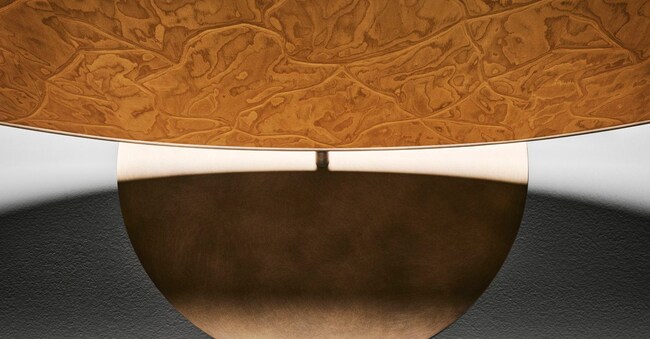
Another virtuosity of the Campana brothers for Alpi. And by Alpi for the Campana brothers. A manifesto in favour of recycling and denouncing the condition of the planet. It is called Agreste. It is wood cladding made from poplar processing waste that reproduces the drought-torn terrain of Caatinga, a region in northern Brazil. It will be in Alpi's catalogue immediately after the Salone del Mobile. It comes almost twenty years after the last Estudio Campana-Alpi creation, Pirarucu, the cladding that reproduces the scaly, spotted back of a fish from the Amazon River, the place of the heart of the two Brazilian designers.
100% recycled material
."This time," says Vittorio Alpi, grandson of the founder and managing director of the family business, "Humberto and Fernando Campana wanted to send a strong message about the condition of the planet. They proposed a drawing of a arid Caatinga sod seen from above, with the gashes in the thirsty earth and the water leaving. We took up the challenge and relaunched by proposing production with one hundred per cent recycled material'.
At Alpi's technical department, every creation proposed by the designers is a technical and engineering challenge. The unique and original procedure adopted at the Modigliano company involves the wood - pioppo, lime, ayus - being laminated, stained, dried, reassembled in logs, cut and re-laminated until it becomes the perfect aesthetic copy of other precious woods or takes on the look and colour created by the imagination of a designer or requested, made to measure, by a company. An interplay of joints, without a final varnish, that proposes surprising effects loved by designers, from Piero Lissoni, who was the company's art director for a long time, to Nendo and Ettore Sottsass, presented again at the Salone . A poor wood that becomes, on the surface, a precious one: from oak to ebony and rosewood. And which is used for furniture panelling, for boiserie, but also for the interiors of ships or planes and in a thousand other applications, even unexpected ones: from pencils to glasses.
"For Agreste," says Vittorio Alpi, "we use poplar lamination residues that are large enough to be reprocessed. The rest we give to panel producers for reuse. A policy in line with the efforts we are making to modernise our plants and reduce emissions'.
Zero Impact Concession Forests
Alpi is planning 16 million investments for the renovation and digitalisation of production lines and the installation of solar panels to reduce emissions. But above all, it is strengthening its policy of zero-impact use of the 350,000 hectares of ayus forest under concession in Cameroon, where the Modigliana-based company has two factories and around 1,200 employees. The forest has been divided into thirty slices of over ten thousand hectares each. Each year a slice of forest is cut down (with an average of 0.8 trees per hectare) and replanted. The following year, the same operation will be carried out on the slice of forest worked thirty years earlier in which the trees have grown back in the meantime. A clockwork, zero-impact system that preserves the forest over time. "Investment in sustainability does not stop despite the market slowdown and fears about US duties," says Vittorio Alpi. "We are not going back on our policy of cutting emissions and compatible production."


