Japan

Koizumi: 'Concerned about China. No rift between the US and Europe'

The Japanese Defence Minister spoke at the Shangri-La Dialogue to defend Tokyo's role and call for unity among democratic countries

from our correspondent Marco Masciaga
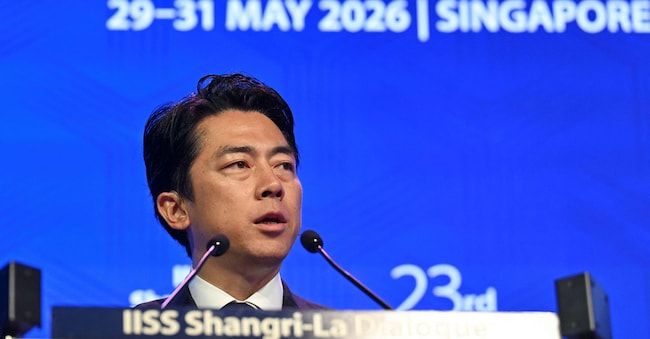
Il ministro della Difesa giapponese Shinjiro Koizumi nel corso del suo intervento di domenica a Singapore REUTERS

4' min read

Translated by AI
Versione italiana

4' min read

Translated by AI
Versione italiana

NEW DELHI - The bitter confrontation that has been going on for months between Tokyo and Beijing was enriched with a new chapter on Sunday when Japan's Defence Minister Shinjiro Koizumi returned to sender the accusations of "new militarism" made in recent weeks by the Chinese leadership and criticised the People's Liberation Army's increasingly massive investments and its growing activities in the region.

"China's approach in its relations with the outside world and its military activities are a matter of serious concern for Japan and, at the same time, for the international community," Koizumi said speaking at the Shangri-La Dialogue in Singapore, 24 hours after US Defence Secretary Pete Hegseth had chosen, for once, the path of institutional prudence in talking about China's growing military assertiveness.

Loading...

Koizumi took the opportunity offered by Asia's leading strategy and defence symposium to dismiss recent criticism from the Chinese Foreign Ministry that Japan is embracing a new militarism.

'Think about it,' Koizumi told the symposium participants, 'there is a country that possesses a huge arsenal of nuclear weapons and strategic bombers. Japan possesses neither such weapons nor such means, and yet its is labelled as 'new militarism'. Isn't that strange?"

Tensions between the two countries

Under the premiership of Sanae Takaichi, relations between China and Japan have rapidly deteriorated. First because of some remarks made by the premier about Taiwan and the active role that Tokyo would in fact be obliged to play in the event of an invasion of the island by China. Then for a series of initiatives by the Japanese government that confirmed how Japan is intent on speeding up its process of emancipation from the pacifist Constitution written by the American occupation forces at the end of World War II.

Last April, the Takaichi government announced that it had relaxed the rules that had prevented Japan from exporting lethal weapons to other countries for decades. This was a crucial decision to make a quantum leap in cooperation with 17 friendly countries, including some of the Asian military powers that have, like Tokyo, a conflictual relationship with Beijing.

Tokyo increasingly a hub for cooperation

The change in the law nominates Japan as a strategic regional hub, crucial for enhancing the cooperation of the countries in the region. "All the Defence Ministers present here agree on the need to rapidly and agilely enhance their defence capabilities," explained the Philippines Defence Secretary, Gilberto Teodoro.

The Minister of Defence of Singapore, Chan Chun Sing, said that in the current international context, 'we should develop flexible partnerships with countries that share our vision, forming coalitions of those who are capable and willing to act'. This would help 'bridge gaps, experiment with new ideas and find paths into new and unexplored territories'.

'We want a region,' echoed both Koizumi, 'that can stand up to intimidation. We want a region that does not allow itself to be misled by disinformation. We want a region that does not give in to pressure. Japan will be even more proactive in cooperation in the area of defence equipment. Our goal is to ensure that each country has the capabilities it needs and to make them available when needed'.

Beijing's response

For the second year running, China did not send its defence minister to Singapore, but a lower-profile delegation. A choice that did not stop the Asian giant from reacting to Koizumi's words.

"I have profound doubts as to whether a country that has not yet completely eliminated the toxic legacy of militarism is qualified to speak so broadly about defence cooperation in international fora, and whether it can earn the trust of the international community, particularly the Asian countries it once invaded," said one of the Chinese delegates, Major General Meng Xiangqing.

Firm tones, but decidedly more composed than those used last year by some Chinese diplomats, both personally towards Takaichi, to whom real threats were addressed, and towards Japan, which is still subject to a tourist and, to a lesser extent, commercial boycott by Beijing.

Shinjiro Koizumi - who is the son of former Premier Junichiro and one of the rising stars of Japanese politics - said he regretted not being able to meet his Chinese counterpart in Singapore, but insisted on his executive's readiness for dialogue with Beijing.

Koizumi's criticism of the US ally

In what appeared to be a response to the worldview based purely on power relations - and not on the shared values of liberal democracies - advocated by Hegseth yesterday, Koizumi emphasised the need to maintain strong coalitions not only regionally, but also globally.

"Divisions weaken deterrence, unity strengthens it. Should rifts emerge between the United States, Europe and their allies and partners who share the same values, there will certainly be forces ready to exploit that opportunity," he said.

In his speech on Saturday, Hegseth lashed out at the rule-based international order, contrasting it with a model driven by national interest. "When our interests coincide," said the US Defence Secretary, "we act together with determination and clarity of purpose. When our interests diverge, we adapt pragmatically, without drama or moralising. I think Western Europe would do well to take note of that'.

Copyright reserved ©
Loading...

Brand connect

Loading...

Newsletter

Notizie e approfondimenti sugli avvenimenti politici, economici e finanziari.

Iscriviti