
Kosovo 18 years later, between the EU dream and tensions with Belgrade
Today the smallest of the Balkan states remembers its independence from Serbia and looks to the future with the newly formed Kurti government

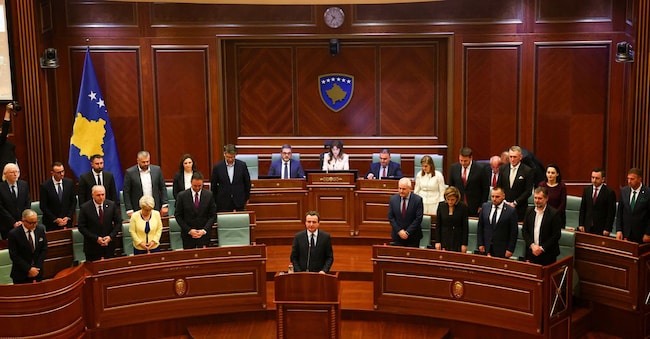
Eighteen years have passed since that 17 February 2008 when Kosovo adopted its declaration of independence from Serbia. And after almost a year of political deadlock, the small Balkan country finally arrives at its anniversary with a government and a stable majority. Five days ago, the parliament in Pristina, which emerged from elections on 28 December, approved a new government led by Albin Kurti and his left-wing nationalist party Vetëvendosje (Self-Determination) with 66 votes in favour and 49 against. The early elections on 28 December had been called after Kurti's party, despite its election victory in February 2025, failed to form a government.
Eighteen years of separation from Serbia and a stable government may not, however, be enough to pave the way for the normalisation of relations between Belgrade and Pristina. A former political prisoner during Serbian rule in Kosovo, Kurti has always taken a tough stance in talks with the government of Serbia. It was with him in government, in 2023, that Albanian mayors were installed in the four municipalities of northern Kosovo despite the opposition of the Serbian majority of the population. A move, in defiance of minorities, that cost Kosovo a series of sanctions from the EU, including the freezing of EUR 882 million in funds allocated under the Growth Plan for the Western Balkans.
Belgrade, for its part, has never wanted to recognise the independence of its southernmost province with an Albanian majority, whose government is still referred to in official documents as the 'Provisional Institutions of Self-Government of Pristina'. Just last weekend, Serbian President Aleksandar Vucic, from the Munich Security Conference, denounced the emerging military alliance between Croatia, Albania and Kosovo, calling it "the biggest threat to Serbia today". Vucic also claims that if peace between Russia and Ukraine ends with Kiev ceding territory, then Serbia will be able to demand that Pristina cede North Kosovo.
Today, 1.6 million Kosovars are well aware that much of their future hinges on joining the European Union. Kosovo's application for membership, submitted in 2022, has in fact never been evaluated. Some say it could be taken up again in the second half of 2026, under the Irish EU presidency. On Pristina's entry chances, however, weigh like boulders the five EU members that still do not recognise Kosovo as a state, on a par with Serbia, Russia and China: they are Spain, Greece, Cyprus, Romania and Slovakia.
The good news is that at least the sanctions decided by the EU in 2023 are over. On 16 December, the European Commission announced their lifting after new regular local elections were held in the Serb-majority municipalities in the north. For Kosovo, this is a financial breath of fresh air: the first EUR 216 million of European aid has already been released and a further EUR 205 million should be made available soon. For a real quality leap in relations with the EU, however, Brussels demands that Pristina change its policy towards Serbia and implement all the agreements made with Belgrade. A step that is anything but simple, as Peter Sørensen, the EU Special Representative for the Belgrade-Pristina dialogue, whose appointment took place just a year ago, explains: "I have arrived at a sensitive political stage in both Belgrade and Pristina. In this context, neither side seemed to have strong incentives to take the political risks that any compromise entails. Consequently, facilitating a meeting at the highest level between the two was unrealistic. For this reason, a high-level dialogue meeting has not yet been held during my tenure'. However, his work has not stopped: 'Despite political constraints, progress has been made,' Sørensen recalls, 'the Joint Commission on Missing Persons has been inaugurated and work on integrated border management has continued. Despite electoral cycles and political uncertainties, in short, we have preserved communication channels. The European future of both Serbia and Kosovo is directly linked to measurable progress in this normalisation process'.


