
Krugman: ‘Europe remains strong. But European unification is failing’
Speech by the Nobel Laureate in Economics at Federico II University in Naples. Prodi was also present: ‘We need a driving force to restore the EU’s role’

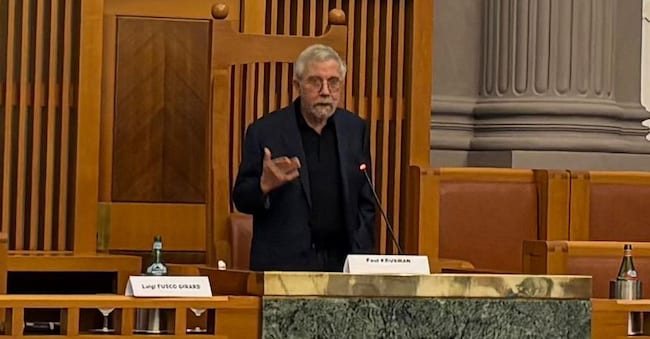
‘Europe as a whole is much stronger than people realise. It is one of the world’s three economic superpowers, alongside the United States and China. Europe is doing much better than most people think, according to some figures I have.’ This was the starting point for the keynote lecture by Paul Krugman, winner of the 2008 Nobel Prize in Economics, who spoke yesterday in Naples at the international conference organised by the Department of Social Sciences at the University of Federico II.
But there is no shortage of problems: for Europe, for Italia, for the United States. For Krugman, the problem does exist, and it is the inequality between regions. In other words, he points the finger at regional disparities. According to the American economist, these exist in the US – between Boston and Alabama – in Italia – between Milan and Naples – and also in Germany, in the former coal-mining region. In the United States, there are large pockets of poverty, caused not only by low per capita income but also by the lack of services and a welfare state. In Italia, says Krugman, ‘the problem is Southern Italy’. This was once considered a specifically Italian issue, but today every developed country has its own equivalent of the Mezzogiorno, and in order to try to revitalise these parts of the world, a great deal of public policy – and a good dose of luck – will be needed. People, he adds, must be supported in terms of mobility, services and employment. In other words, what makes the difference is the welfare state in Europe.
Krugman alternates between positive and optimistic observations and analyses that are decidedly critical. For instance, when, prompted by Romano Prodi – who was attending the event – he dwells on the role of the EU. ‘We are witnessing the failure of European diplomacy. Unless there is economic unification, the process of European unification will have failed. The Draghi Report had already identified this as an urgent objective, but no progress has been made.’ These observations are echoed by those of the former Prime Minister and former President of the European Commission, Romano Prodi: “In twenty years, Europe has lost power and influence – a balancing role,” he observes, “both politically and economically. Today we are unable to establish a common policy. Europe,’ adds Prodi, ‘moved forward as long as France and Germany were good partners. Today they are no longer so; therefore, we need a new driving force, something strong – first and foremost, the heart.’
Krugman, prompted by questions from the audience, speaks of populism (‘often fuelled by a sluggish economy, though not always’), the manufacturing sector (‘it will not return to what it once was’), technology and artificial intelligence (‘in which Europe is not lagging behind’). He adds, ‘We need to invest in sustainability and envisage a Europe that is less dependent on gas from other countries’, but admits: ‘It will be difficult to give up fossil fuels.’ He rejects protectionist measures. His attention then turns back to the United States, and when asked what will happen after Trump, he replies: ‘It would be foolish to think that after 2029 we’ll be able to turn back the clock. American citizens do not approve of the current government’s policies. But we shouldn’t be too trusting: we’ve already elected him twice. We’ve already elected him twice.’


