
Kukum, the novel of the forest and the river
When Almanda falls in love with a young Indian, she also falls in love with an unspoilt world that welcomes her and that she will later see disappear. Innu writer Michel Jean puts on paper the beauty of a disappearing people and environment and the terrible violence suffered by native Canadian children
by Lara Ricci
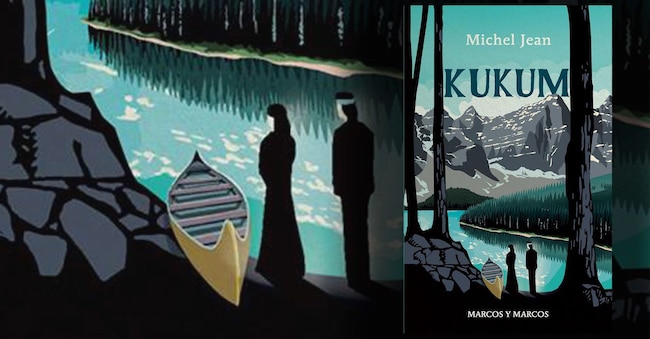
"Living on the farm is a form of priesthood. Farmers are convinced that the land protects them from barbarism. In reality it enslaves them'. Orphaned when she was very young, Almanda grew up with a couple of 'uncles' who tirelessly worked and re-worked the land wrested from the forest in a settlers' village on the shores of Lake Pekuakami, in the Labrador Peninsula (eastern Canada): 'a sea among the trees. Water as far as the eye can see, grey or blue depending on the mood of the sky, crossed by icy currents. The lake is both beautiful and terrible. Boundless. And life there is as fragile as it is burning. She is fifteen years old and milking cows when she sees a young Native American man descending the river in a canoe. Their eyes meet, that evening and then some. Almanda falls in love with what is for her "a kind of wind-carried vagabond": Thomas. "I was young, I know it well. Surrounded by beings who were prisoners of their own lands, I discovered that someone was free'. She asks Thomas to take her with him to the winter hunting grounds, to the mountains beyond which 'the white plains of the Great North stretched as far as the eye could see'.
With the canoe, they paddled up the lake and then the Péribonka River: "to the right, water. On the left, a line of sand and rocks stood out in front of the forest. It was for me the passage between two worlds, immersed in an intoxication I had never experienced before'. She will learn that the human being is not superior to any other; that fear paralyses, while awe invites caution; that learning constancy is a long way; she will learn to hunt and respect the prey: it is she who decides to give herself. 'By offering her own life mush (the moose, ndr ) allows the hunter to live. You have to thank him,' Thomas explains to her.
Thus the innu, hunters, fishermen, nomadic gatherers, restore dignity to the animal, making voluntary what is inevitable. They learn Innu-aimun, which has only eight consonants, seven vowels and fifteen distinct sounds. A language in which there is no feminine or masculine, it distinguishes between the animate and the inanimate. He learns how to make snow food: a maple-flavoured treacle that the natives knew how to cook from tree resin, ensuring sugary food in the dead of winter. The narrative voice of Kukum, a novel by the Innu writer and journalist Michel Jean, is that of Almanda, his great-grandmother. Now old, she remembers her youth. And what begins as a tale of love for Thomas gradually turns into a tale of love also for the forest, the river, the lake, "the air laden with the smell of pine trees", "the thousands of hearts of different sizes and shapes" that beat in unison around her and for the time that passes between them, triggering the circular change. It is the Innu people and the sumptuous sub-Arctic nature that are the real protagonists of the book, which then turns again, this time into an elegy. If Thomas's father had known the world before the arrival of the whites, his children will have to adapt to an alien life. Deforestation becomes intensive. Almanda recounts that 'when he saw a clear cut Thomas would be furious: "It's not enough for them to cut down the trees," he would shout, "they have to destroy everything, the birds, the animals, they cut down the very spirit of the forest!"' The woman observes that this is the reasoning of an innu who knows he always returns to the same places. "The woodcutter, on the other hand, walks straight ahead, never looking back. He pursues progress."
The tale becomes dramatic and moving when, summer over, Almanda's family climbs into their canoes to return to their winter hunting grounds and is soon hit by a nauseating smell. They see before them thousands of cut logs floating on Lake Pekuakami: 'an immense, dark, undulating mass'. Impossible to ascend the river: 'before us, the Péribonka, choked by the weight of the logs, vomited the forest into the lake'. The paper mills devour the forests, the dams create 'a kind of Innu Atlantis', the natives can no longer go about: now the land belongs to the 'company'. But the tents are not suitable for wintering on the windswept lake shores, and there is not enough game in the reserve for everyone. The government distributes subsidies. The natives go from a life on the move to a sedentary existence, from autonomy to dependence: 'we never left'. After the land, they also take away their children. All children between the ages of six and 15 are deported to boarding schools ('Try to imagine a village without children').
Here it is also forbidden to speak one's own language. "The priests punished those who dared to do so. Another bridge cut between generations. They believed they were making whites out of them by depriving them of their language. But an Innu who speaks French is still an Innu. With an extra wound'. Undernourished and abused, often abused by priests, many children die. Those who return home no longer know who they are (the extent of this tragedy only came to light in 2021, two years after the book was published, when thousands of mass graves where tens of thousands of native children had been dumped were reviewed). Some lose themselves in alcohol, others kill themselves. Still others resist, like Jean, who has reconstructed the world of her ancestors, even for us, in words, filling in the gaps of lost memories with imagination.


