The draft

The 14-point US-Iran agreement, reported by the media in Tehran but disputed by Trump

A draft memorandum is said to outline the path towards an agreement on nuclear issues, sanctions and regional security. This is according to Iranian media sources close to Tehran’s negotiating team, who note that the text is still being reviewed by the relevant authorities
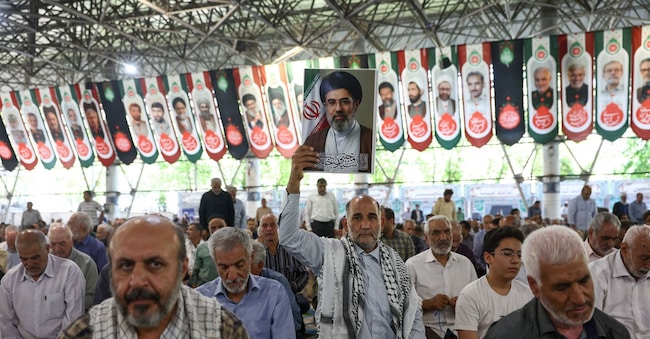
Un uomo tiene in mano una foto della Guida Suprema dell'Iran, Mojtaba Khamenei, durante la preghiera del venerdì a Teheran, in Iran, il 12 giugno 2026. Majid Asgaripour/WANA (West Asia News Agency) via REUTERS    via REUTERS

3' min read

Translated by AI
Versione italiana

3' min read

Translated by AI
Versione italiana

A draft 14-point memorandum between the United States and Iran is said to outline the path towards an agreement on nuclear issues, sanctions and regional security. This was reported by Iranian media outlets close to Tehran’s negotiating team, who noted that the text is still being reviewed by the relevant authorities. Subsequently, President Trump stated that the terms of the agreement leaked by Iran do not correspond to those agreed upon.

According to the Iranian news agency Mehr, however, the agreement is said to provide for an immediate ceasefire on various regional fronts, including Lebanon, a commitment by the United States not to interfere in Iran’s internal affairs, and the withdrawal of US forces from areas near Iran.

Loading...

Key points include the reopening of the Strait of Hormuz within 30 days under Iranian control, the suspension of sanctions on oil and petrochemicals, and the release of Iranian funds frozen abroad, amounting to $24 billion, half of which would be made available before the start of final negotiations. The draft would also provide for 60 days of talks to reach a final agreement on the nuclear programme and the lifting of US and UN sanctions. Tehran would reaffirm its commitment not to develop nuclear weapons under the Non-Proliferation Treaty (NPT).

According to reports, Iran’s ballistic missile programme and its support for regional armed groups would be excluded from the negotiations. The plan would also include proposals for the economic reconstruction of Iran, amounting to at least $300 billion, to be provided by the United States and its allies.

According to Iranian media, the final round of negotiations will not begin until some of the oil sanctions have been lifted, maritime trade has resumed and the first tranche of frozen funds has been released.

Below are the main points of the proposal, as reported by the Iranian news agency Mehr.

1. IMMEDIATE CEASEFIRE ON ALL FRONTS - A permanent and immediate ceasefire is to be implemented on all fronts, including Lebanon.

2. US NON-INTERFERENCE IN IRANIAN AFFAIRS - Washington would undertake not to interfere in Iran’s internal affairs and to respect its sovereignty.

3. LIFTING OF THE NAVAL BLOCKADE WITHIN 30 DAYS - The draft provides for the complete lifting of naval restrictions against Tehran within a month.

4. WITHDRAWAL OF US FORCES FROM THE REGION SURROUNDING IRAN - The United States should reduce or withdraw its military presence from areas considered sensitive by Tehran.

5. REOPENING OF THE STRAIT OF HORMUZ - The strategic energy chokepoint is set to reopen within 30 days, according to agreements reached with Iran.

6. SUSPENSION OF ENERGY SANCTIONS AGAINST IRAN - Sanctions on Iranian exports of oil, petrochemicals and derivatives would be lifted, with Tehran gaining full access to the financial proceeds.

7. $300 BILLION RECONSTRUCTION PLAN FOR IRAN - The US and its allies are expected to present plans for the economic reconstruction of Iran worth at least $300 billion.

8. SIXTY DAYS OF NUCLEAR NEGOTIATIONS - A two-month period is set aside to reach a final agreement on Iran’s nuclear programme and the complete lifting of sanctions imposed by the US, the UN and the International Atomic Energy Agency.

9. IRAN’S COMMITMENT AGAINST NUCLEAR WEAPONS - Tehran is set to formally confirm its compliance with the Nuclear Non-Proliferation Treaty (NPT), reiterating that it has no intention of developing nuclear weapons.

10. NO FURTHER ESCALATION DURING THE TALKS - The US would undertake not to increase troop numbers in the region and not to impose new sanctions during the negotiations.

11. UNFREEZING OF $24 BILLION IN IRANIAN FUNDS - During the negotiation period, $24 billion in Iranian funds frozen abroad would be released, half of which would be available before the start of the final talks.

12. ESTABLISHMENT OF A MECHANISM TO MONITOR THE AGREEMENT - The proposal includes the creation of a monitoring system to verify the implementation of mutual commitments.

13. UN RATIFICATION OF THE FINAL AGREEMENT - Any final agreement would need to be approved by a resolution of the United Nations Security Council.

14. NEGOTIATION CLAUSES AND THE EXCLUSION OF BALLISTIC MISSILES AND SUPPORT FOR PROXIES - Final negotiations will not begin until half of Iran’s frozen funds have been released, oil sanctions against Iran have been suspended and the naval blockade has been lifted.

The final phase of the negotiations would focus solely on Iran’s nuclear programme, sanctions and economic recovery. Iran’s missile programme and its support for so-called “regional resistance” groups would remain off the table.

Copyright reserved ©
Loading...

Brand connect

Loading...

Newsletter

Notizie e approfondimenti sugli avvenimenti politici, economici e finanziari.

Iscriviti