
The Amerigo Vespucci. Pedagogy of the sea between history, form and future
A photo story for 'the most beautiful ship in the world', symbol and national pride
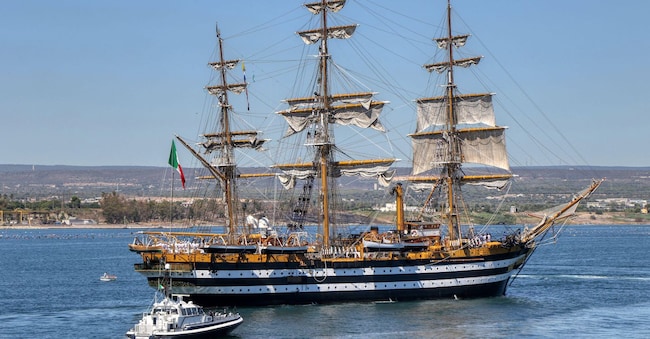
There is a ship that crosses the 20th century and the new millennium without losing its identity, function and symbolic power. The Amerigo Vespucci is not only the Italian Navy's most famous sailing ship, but a complex cultural instrument, a synthesis of naval history, training and international representation.
The book, published by Scripta Maneant, whose text was written and edited by Squadron Admiral (r) Cristiano Bettini, is not just a photographic book but an editorial project that combines photography and text, in Italian and English, to convey the unique experience of a ship that is a symbol of the Italian Navy and of Italia. Produced in collaboration with the Italian Navy and by concession of DIFESA SERVIZI S.p.A., on the occasion of the sailing ship's second round-the-world voyage in 2023, the publication accompanies the bridges, masts and sails, through a carefully crafted visual narrative in which the symbolic significance of the Vespucci, which represents Italia and its identity in international ports, is evident.
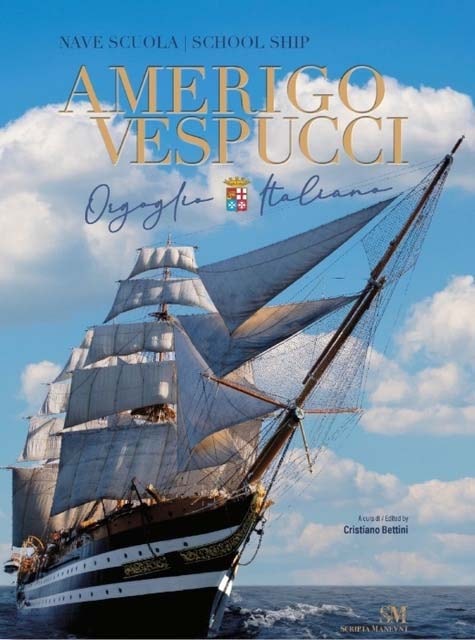
Today, the Amerigo Vespucci ship is undoubtedly Italy's pride of the past and, at the same time, of the future, traced by the many activities it performs and its systems that, as part of the Navy's institutional tasks, it applies to environmental protection and the preservation of the marine ecosystem. On its new round-the-world voyage, the training ship continues to travel over forty thousand nautical miles, touching dozens of countries and cultures, while its most significant voyage remains its inner journey, accompanying generations of officer trainees in the transition from training to responsibility, demonstrating that the sea, even today, remains one of the most effective places in which to educate a sense of limits, community and service.
The Story
Launched in 1931 and conceived as a training ship, the Vespucci was born in a context of renewed attention to the Italian fleet, at a time when Italia, between the two world wars, was redefining its maritime role also in the light of international agreements on naval tonnage. Together with her sister ship Cristoforo Colombo, later ceded to the Soviet Union after World War II, the Vespucci represents the highest outcome of a precise design choice: to train naval officers through sailing, entrusting the complexity of the sea with an educational task that no technology can replace. The design, entrusted in 1926 to engineer Francesco Rotundi, consciously looks to the past. The hull lines were inspired by the great vessels of the eighteenth and nineteenth centuries, particularly the tradition of the French school of naval architecture, from Jacques-Noël Sané onwards, filtered through Mediterranean experiences such as that of the Kingdom of the Two Sicilies.
Aesthetics and Value
The design of the sailboat, therefore, is not a mere exercise in style but a functional choice in which balance, stability and sailing behaviour become training tools before becoming technical requirements. The result is a ship that, although equipped with modern apparatuses, retains an absolute centrality of manual manoeuvre. Climbing the spars, steering the sails, reading the wind and sea are practices that require discipline, cooperation, foresight and adaptation. It is in this direct relationship with the elements that sailing shows its irreplaceable educational value: it teaches limits, imposes respect for natural forces, builds a sense of collective responsibility. Sailing means learning to balance - between opposing forces, between commanding and listening, between deciding and waiting - and to develop that flexibility which, at sea as in leadership, proves decisive. It is the principle of flectar, non frangar, bending without breaking, adapting without giving up the course. Over the decades, the Vespucci has passed through crucial moments in national history, from 8 September 1943 to international representation missions, gradually becoming a shared symbol. In foreign ports, the ship is an ambassador of an idea of Italia that goes beyond formal diplomacy: that of a country that entrusts its image in the world to competence, tradition and silent work. It is not surprising that for many Italians abroad boarding means entering, even legally, a fragment of their homeland. The aesthetics of the Vespucci, therefore, are the coherent result of a form born of function in which proportions, livery, friezes and materials combine to construct an image of sober monumentality, capable of communicating authority without ostentation. A beauty that derives from harmony, not excess.

