Competitiveness

Artificial intelligence enters the lives of eleven companies. Here are the applications

The project developed by Liuc University with the contribution of Confindustria Varese

5' min read

5' min read

How can artificial intelligence be applied in business activities? And what improvements can they guarantee? Answering these questions is the aim of the project developed by the Liuc University with the contribution of Confindustria Varese.

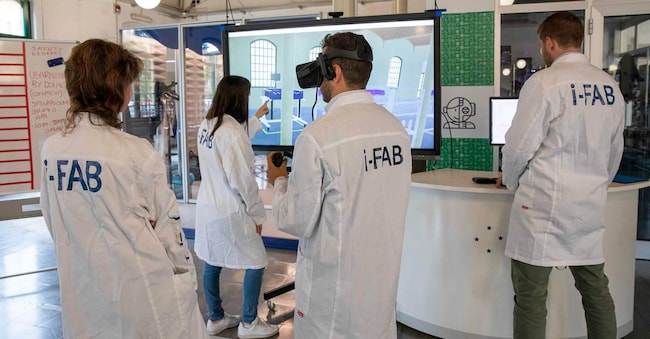
"The project,' says Tommaso Rossi, director of the Liuc School of Industrial Engineering and i-FAB, 'involved specific training of managers on the subject of Artificial Intelligence and, above all, the development in each company of a prototype application based on AI that would allow them to experience the benefits that this technology can bring within business processes. To reduce the AI divide between large companies and SMEs, the development of these applications was carried out using hardware that was as cheap and off the shelf as possible.

Loading...

It was precisely the i-Fab, the simulated factory created within the University, that played a central role in the project, which was also an opportunity to illustrate the role of the Italian Institute of Artificial Intelligence for Industry (AI4Industry Foundation), set up by the government in 2024, and to explore the uses of robotics that Artificial Intelligence enables (or will enable) and that are being researched by the Scuola Superiore Sant'Anna.

Eleven companies from the province of Varese, both SMEs and large companies, are involved in the initiative: in the computer vision sphere they are Carl Zeiss Vision, BDG-El, Prealpi, ACSA Steel Forgings; in the field of agents, Fiamma, Eurojersey,Fogliani and Carl Zeiss X-Ray participated; finally, in the field of Data Mining, Simplas, Slimpa-Kone, LATI Industria Termoplastici Spa.

'In the technological development of Artificial Intelligence,' explains Luca Donelli, Vice-President of Confindustria Varese, 'Europe must find its own role. One aspect that will be increasingly strategic is the application of such AI technologies in industrial production, in research and development, in the rethinking of products and processes to support people's work. This is what we need to invest in. Both as companies and, even more so, as manufacturing production chains. We have all the skills and capabilities. Also on the ground. Our commitment is to support the innovation and competitiveness of companies of all sectors and sizes, including through financing instruments aimed at the adoption of advanced technologies. We want to help companies seize every opportunity. As was the case recently with Servizi Confindustria Varese, which, together with Liuc, through a Fondirigenti grant, has supported eleven companies in the area, helping them to innovate in these areas'.

Tommaso Rossi emphasises that 'the project does not stop here, but remains an 'open worksite': i-FAB wants to continue mapping the needs of companies, both local and not, and offer support to implement these solutions. Furthermore, we will continue to monitor the developments of what is already in place in order to measure the effectiveness of the tools introduced over time'.

All in-house experiments

.

Carl Zeiss Vision. Above the robot that inserts and seals the sachets with the lenses is a video camera that takes photos of the closed sachets and passes them to a raspberry on which an artificial intelligence (AI) algorithm works. The algorithm recognises whether the photo depicts properly sealed sachets or not. In the second case, the raspberry sends a signal to the robot that does not move the sachets towards the conveyor belt.

BDG-El. The operator controls two rotary tables equipped with six vibrators each that assemble clamps for refrigerator compressor buffers. At the end of the vibrator, the cases can get stuck, no longer feeding the buffer. At the point where jamming can occur, a video camera is inserted that takes photos and passes them to a raspberry on which an Artificial Intelligence algorithm works to recognise whether the photo depicts a jamming or not. In the first case, the raspberry sends a signal to a blower that activates and causes the jammed cases to fall into the vibrator, eliminating the problem.

Prealpi. The boxes of cheese are moved on conveyor belts that serve the packaging machines. Again, a camera positioned at a strategic point takes photos and passes them to a raspberry on which an object detection algorithm works. The algorithm recognises the private label logo on the box and, if it is incorrect, sends a signal to an extractor that removes the box from the belt.

ACSA Steel Forgings. 100% of the parts coming out of the forge are checked with a magnetoscope for defects such as cracks, burns, missing parts, etc. Using a camera, photos are taken and sent to the raspberry on which a recognition algorithm, trained to recognise good parts, works. In the event of errors, a signal is sent to an LED located on the magnetoscope that lights up, calling the operator to perform the check.

Fiamma. The motorhome carry-ons that the company produces are made by cutting aluminium bars to size and assembling the pieces from the cut. The company pursues efficiency by optimising cutting batches and minimising scrap. An agent has been created that allows the user to call up a nesting algorithm in natural language, consult the stock database, parameterise the algorithm, start it and present the result given by the optimised cutting plan in tabular form.

Eurojersey. The company makes sensitive fabric and has a huge amount of data collected in the field (e.g. dye bath temperature, degree of colour, number of defects). An agent was created that, based on natural language requests from users, analyses the data and transforms it into information.

Fogliani. The agent, by accessing the company database, answers technical questions from customers about the products of a particular line and triggers an update of the database itself by the operator (with consequent feedback to the user) if the answer is not present in the current version.

Carl Zeiss X-Ray. The company designs and manufactures machines for non-destructive testing using X-rays. The production process is characterised by numerous assembly steps, and the machines must be accompanied by a significant amount of manuals. An agent was developed that independently creates standard work, maintenance procedures, manuals, etc. from videos.

Simplas. Based on historical data regarding the extrusion heads designed and manufactured by the company, a clustering was carried out in order to identify the different technological groups into which the heads can be divided. Following this, a classification algorithm was developed to identify, when faced with a new customer order, which technological group the required extrusion head will belong to.

Slimpa-Kone. In this case, the focus of the project is on lift pushbutton panels: a classification algorithm was developed to identify which technology group each pushbutton panel will belong to.

LATI Industria Termoplastici Spa. A key element in LATI's production process is temperature management in the extruder, which has a significant impact on energy consumption. The desired temperatures are achieved and maintained by means of electric heaters for heating and solenoid valves for cooling. An Anomaly Detection algorithm has been developed that can identify irregular operating trends, such as degradation of thermal performance and energy efficiency. This tool supports predictive maintenance, preventing failures and improving the process.

Copyright reserved ©
Loading...

Brand connect

Loading...

Newsletter

Notizie e approfondimenti sugli avvenimenti politici, economici e finanziari.

Iscriviti