The event

Mothers' call for peace: Palestinian and Israeli activists together for a better future

On 24 March in Rome the Israeli-Palestinian initiative 'Barefoot Walk: Mothers' call for peace' to promote inclusive negotiations and overcome decades of diplomatic failures

3' min read

Translated by AI
Versione italiana

3' min read

Translated by AI
Versione italiana

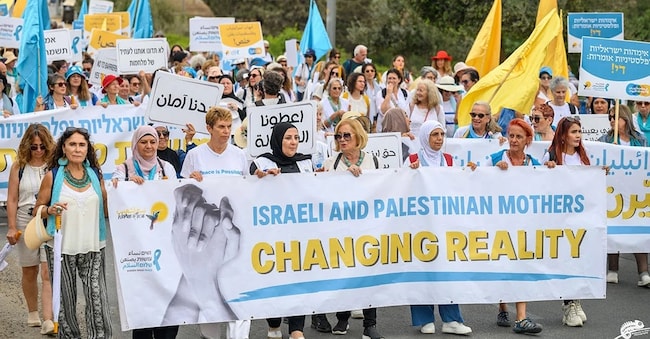
A silent, barefoot march through the streets of Rome. One step after another to move forward after decades of failed dialogues. On 24 March, the "Barefoot Walk: Mothers' call for peace" initiative arrives in the capital to launch an appeal for peace.

The event is a collaboration between the Palestinian Women of the Sun and Israeli Women Wage Peace movements, founded by Reem al-Hajajreh and Yael Admi respectively. The two activists, who have been campaigning for years for a peaceful solution to the Israeli-Palestinian conflict, were named Women of the Year by Time Magazine in 2024 and nominated for the Nobel Peace Prize.

Loading...

"Walking barefoot is both vulnerable and courageous. - yael Admi explains - It symbolises direct contact with the soil of a land that has absorbed so much pain, but also a conscious choice to move forward with honesty and hope'. To convey this message, the choice of Rome is not random: a diplomatic and cultural crossroads that is also home to the Vatican, one of the most authoritative voices against the war. The aim is to build a global civic movement that supports inclusive negotiations and the participation of women in peace processes.

It is precisely this that is one of the main claims of the Mothers' Call for Peace initiative: if up to now, in a male-dominated context, negotiations have always failed, to give peace a real chance it is necessary to involve women as well. "When women participate in negotiations, agreements are more durable and more in line with the needs of society," emphasises the founder of Women Wage Peace.

The figure of the mother is also an indispensable element of the march's message. Here, the idea of motherhood is understood in a broader sense than the biological one and reflects a sense of responsibility. In this sense, being a mother becomes a moral stance and a source of civic courage: it means caring for the future of the societies in which we live beyond particular interests.

Reem al-Hajajreh, fondatrice del movimento palestinese Women of the Sun (a sinistra) e Yael Admi, fondatrice del movimento israeliano Women Wage Peace (a destra)

This mission seems even more difficult today. With the outbreak of the open conflict between the United States, Israel and Iran, the space devoted to Palestine in the media immediately shrank, obscuring a political and humanitarian crisis still in the midst of it.

"While the focus is on the war with Iran, rebuilding Gaza and saving lives is no longer a priority," says Reem al-Hajajreh, voice of the Women of the Sun movement. "Settlers are violating the rights of Palestinians in the West Bank with killings, house demolitions, land confiscation, torture of prisoners and the collapse of the Palestinian economy."

A context that once again seems to reinforce the conditions that have never allowed a real peace process. 'Negotiations were not really decisive or urgent; they were secondary, and their absence led to the failure of the peace process,' explains al-Hajajreh, who emphasises how the lack of a moderate component and the exclusion of women and civil society contributed to the sinking of the dialogue.

Then there is another obstacle that threatens to undermine the possibility of coexistence between Israelis and Palestinians in the long run. As of 7 October 2023, opportunities to meet have been almost completely eliminated. The spaces are increasingly separated, even physically, and the border crossing between Israel and the Palestinian territories has become much more complicated.

"The danger of distrust, distance, and the presence of walls and barriers of separation have fuelled hatred, resentment, and aggression," al-Hajajreh says. 'The belief that there is no partner has become very strong in both societies and physical separation reinforces this perception. - yael Admi echoes her - Our partnership directly challenges this narrative: Israeli and Palestinian women meet, talk and work together through structured cross-border initiatives."

What is certain is that right now talking about peace seems more difficult than ever. The international order based on shared rules seems a distant mirage, but even in the face of a Middle East in flames, from Iran to the Gulf countries to Lebanon, the commitment to dialogue refuses to stop. 'For us, peace activism is not naive idealism,' Admi explains, 'it means insisting on political solutions even when the environment becomes more polarised and more militarised. It means creating civic pressure for diplomacy and refusing to accept that violence is the only language available'.

Copyright reserved ©
Loading...

Brand connect

Loading...

Newsletter

Notizie e approfondimenti sugli avvenimenti politici, economici e finanziari.

Iscriviti