
The canonical atelier and the physiognomy of the Italians
The summer tour to discover small and unexpected museums or special objects starts with Elisabetta Rasy (Strega Prize finalist) who takes us to the Pietro Canonica Museum, one of the less frequented places in Villa Borghese. Full of surprises and memories

5' min read
5' min read
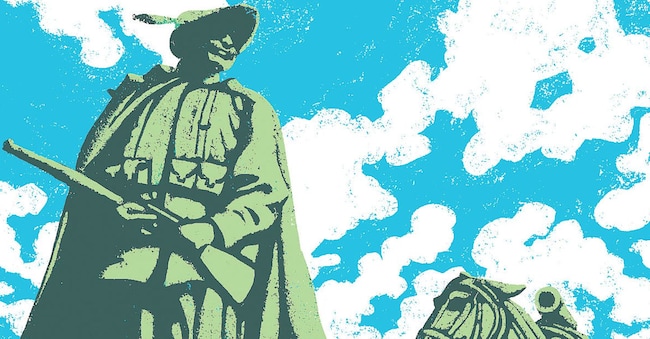
Every time I arrived in Rome to pay her a visit, my grandmother would take me to greet a strange stone animal with the same enthusiasm as if it had been a puppy. And that fatigued-looking donkey, laden with gibbets and machine guns, a stunned puppy it really looked, next to its companion, an equally stony alpine who should have looked heroic and instead was as lost as the animal. These are the two life-size sculptures that welcome the visitor to one of the most evocative but less frequented places in Villa Borghese: the Pietro Canonica Museum in the avenue of the same name from which one also accesses the Giardino del Lago. Now this part of the park is mainly the territory of cyclists large and small and joggers - except on Sundays it turns into the festive place par excellence for Romans with families - but it has a long and complex history behind it.
At the origin of the park is Cardinal Scipione Borghese, an art lover and protector of artists, who in the 17th century had had a small villa built in a wild and wooded area on the edge of the city centre to house his collection of works of art, which later became the famous Galleria. But it was one of his enterprising nephews, Prince Marcantonio, with the help of Italian and northern European architects, who at the end of the 18th century had imagined an area where a daring interweaving of works and buildings would make it difficult to distinguish the ancient from the modern, such as the fascinating 'capriccio' that is the Classical temple of Faustina or the one dedicated to Aesculapius on a small island in the centre of the small lake. Nearby, meanwhile, a building was falling into disrepair, which in Cardinal Scipione's time was called the 'Gallinaro' because ostriches, ducks and even peacocks for the Borghese family's hunting parties were bred there. The architect Antonio Asprucci, who had already been responsible for designing the garden with the lake and its modern antiquities in the centre, enlisted the help of the sculptor Felice Giani to restore the dilapidated farmhouse and transformed it into a somewhat Disneyesque medieval fortress, a low building surrounded by a scalloped wall, which was henceforth known as the Fortezzuola. But even this new version of the old building did not have a fortunate fate: used as an administrative office after the unification of Italy and the transfer of the capital to Rome, it was destroyed in a fire, and would have remained a ruin if the ordinary citizen, in a gesture in which it is difficult to distinguish generosity from interest, had not donated it in 1926 to Pietro Canonica, who offered to restore it to make it his studio and home.
But who was Pietro Canonica, of whom few now remember? Born in 1869 in Moncalieri, he had been one of the most appreciated sculptors of the belle époque not only in Italy, only to enter, after much success, even before his death in 1959, the grey paradise of the once famous and then forgotten artists. Only Canonica had been far-sighted enough to guarantee himself a place in posterity anyway, and to do so thanks to the shabby building whose costly restoration he undertook. The vast proportions of the stables convinced him that this was the right place to entrust his works to the future, and if there was money to be spent, he could afford it because, especially at the turn of the 19th and 20th century, as a young sculptor in the young Italian nation, his activity had not stopped and the number of his works was very substantial, as was the size of some of them.
The artist's career was studded with one commission after another. In Italy, aristocrats eager to hand down their features to posterity blindly trusted not only Canonica's technical expertise but also his empathetic feeling for the beautiful and important of noble birth. The new physiognomy of the Italians had to be built between rich and poor, and the latter also had to be given a moralising civic identity. Canonica's world is akin to that of the almost contemporary (1886) book Cuore (Heart) by Edmondo De Amicis, but the sculptor never had the socialist sympathies of the writer and in addition to Italian aristocrats, he devoted himself to immortalising the greats of Europe with commissions ranging from Buckingham Palace to the palaces of the Russian imperial family in St. Petersburg.
The First World War changed the situation, however, Canonica did not stop working, and the patriotic one became his main vein: many war memorials that stand in the squares of Italian municipalities are his, while he also devoted himself to (rare) religious works, and quietly continued his work as a portrait painter during the Fascist period, later becoming, a year before his death, a senator for life by appointment of Luigi Einaudi.

