
Road haulage calls for biofuels
The EU Parliament and Council approved the regulation cutting CO2 emissions from heavy-duty vehicles: the pro-electric-only forces imposed their vision but had to accept a review of the text in 2027. And now Italy hopes

3' min read
3' min read
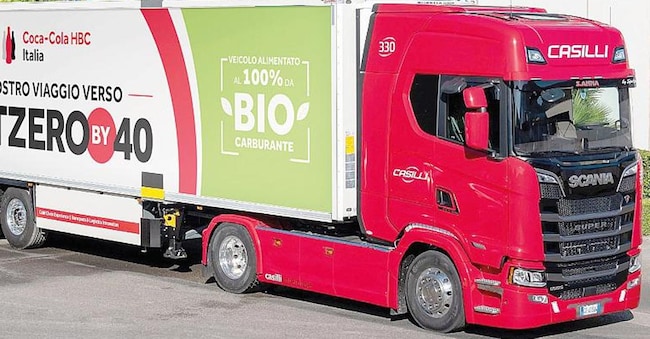
One question is nagging at Italian road haulage companies: to ensure less polluting road shipments, as Europe is demanding, is there only electric or can trucks also run on other types of fuel, helping to clean up the environment and halt climate change? And the answer, the Italian haulage industry has repeatedly indicated: to decarbonise heavy transport it is necessary to focus decisively on biofuels (Hvo diesel and biomethane), a sector in which Italy is at the forefront in the world. Now it is a matter of making Europe understand this too.
Last April, before dissolving for the five-year term of office, the EU Parliament finally approved the regulation introducing drastic and progressive cuts in CO2 emissions for heavy duty vehicles (HGVs) up to 2040: -90% compared to the standards set in 2019. The regulation was also approved by the EU Council on 13 May. A decision that came down like a boulder on a reality composed of about 100,000 companies and 4 million vehicles, with an average age of over 14 years, more than 90% of which are powered by diesel (gas oil), while electric vehicles represent 0.3% of the total number of trucks in circulation. After the EU's decision, the road seems marked: in 16 years' time, manufacturers will practically no longer be able to build heavy vehicles with combustion engines and, while waiting for the time to come for hydrogen-powered ones, all new vehicles will have to have electric traction, which, however, has a very modest diffusion in Italy. In this scenario, Italian hauliers, among whom there are thousands of 'padroncini', i.e. companies with only one vehicle, will have to choose between renewing their fleets by purchasing vehicles costing more than twice as much as traditional combustion vehicles (diesel, petrol) or continuing to drive their old trucks for as long as they are allowed.
In fact, the final ratification by the European institutions comes at the end of a tormented path, with controversial votes that showed the growing doubts within the Assembly about the solution that was on the horizon, with frequent majority reversals. In the end, the forces most sensitive to an electric-only environmentalism imposed their overall vision, but had to accept that the effectiveness and impact of the regulation on heavy vehicle emissions would be reviewed by the Commission in 2027.
And it is in this scenario, with the verification expected in three years' time, that Italy and Germany, albeit with different visions, are counting on playing their cards to promote alternative fuels to the electric motor. This is explained in the new edition of 'Cento numeri per capire l'autotrasporto - Tutte le spine della sostenibilità', published by Federservice (Federtrasporti Group) and produced by the editorial team of Uomini e Trasporti, which was presented last May during Transpotec at the Milan Trade Fair.
In summary: the positions of Rome and Berlin are emblematic and parallel. Berlin defends e-fuels (synthetic fuels, i.e. fuels produced in the laboratory through electrolysis) to protect its own automotive industry which has invested heavily in this solution. The same reasons move Italy in the battle waged within the EU institutions to obtain a green light for biofuels, which has not yet matured. Behind the positions of our government are in fact the substantial investments of the two leading national companies in the energy sector: Eni and Snam. Eni (of which Snam was a rib until 2010) is producing and distributing in 600 stations throughout Italy a renewable liquid biofuel - Hvo (Hydroteated Vegetable Oil) - derived from vegetable or animal waste, residues from the agro-food industry and a residual part of vegetable oils, which reduces carbon emissions by up to 90% and can be safely used in the latest generation Euro 6 engines. Hvo is already widespread in various countries around the world, especially in the United States. Eni has invested in this type of fuel, producing it in two biorefineries in Venice (since 2014) and Gela (from 2019), but also (for the past three years) in Kenya, where it has set up an agro-hub for the production of vegetable oils, which will be followed by similar installations in Congo, Ivory Coast, Mozambique and Angola.


