
The hi-tech umbrella to defend against extreme weather events
by Barbara Ganz
3' min read
Key points
3' min read
"Our peculiarity on the national scene is being able to provide companies, organisations and institutions, our customers, with historical and forecast data on weather events for Italy with an accuracy of one square kilometre". Weather Data Scientist Tullio Degiacomi explains in this way the role of Hypermeteo, a company based in Progetto Manifattura, the green pole of Trentino Sviluppo in Rovereto.
Start up
.The start-up was born within the Radarmeteo company (which develops platforms and services for meteo-climatic monitoring to support operational activities, decision-making processes and risk analysis), and specialises in the analysis of high-resolution meteo-climatic data. The context is that of a country where heat waves, droughts, torrential rains, violent hailstorms, tornadoes and floods are frequent. Increasingly unpredictable weather causes an average of 6.8 billion in damage every year in Italy (according to the European Environment Agency, 135 billion from 1980 to 2024) and things are not going to get any better: according to Legambiente, in 2024, 351 extreme weather events were recorded in our country, an increase of 485% compared to 2015.
A scenario in which help is needed for companies that are increasingly exposed to uncertainty, especially in the face of the recently introduced legal obligations to take out insurance policies to cover damages resulting from catastrophic events and natural disasters.
The method
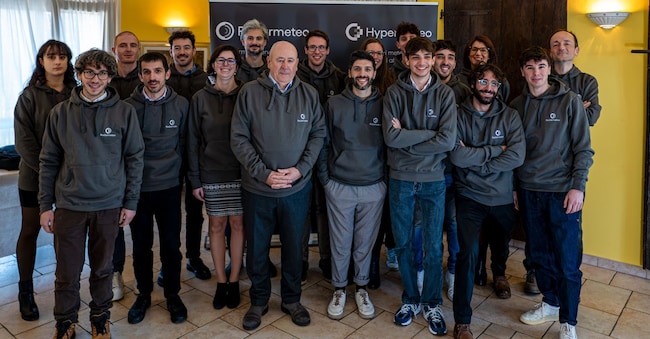
.Hypermeteo - with a team of under-35 specialists including meteorologists, data scientists, computer engineers, AI specialists and graduates in atmospheric physics or environmental sciences - is able to provide absolute precision in weather forecasting: "To make a forecast, we usually start with a three-dimensional description of the initial atmospheric state, defined by parameters such as pressure, temperature, humidity and wind, obtained from satellite measurements and meteorological stations scattered across the territory. This initial state is processed with numerical models, which simulate the weather evolution by solving the equations of fluid dynamics that describe air movements and atmospheric processes,' Degiacomi further explains.
But according to Hypermeteo, in order to make these simulations increasingly accurate and reliable, it is essential to integrate real-time observations and possess accurate historical data: "Our strength is to have done important work on observational data: we have managed to collect the largest possible number of observations from stations, satellite and radiometric measurements over the entire Italian territory over a period of time dating back to the 1990s. This has allowed us to reconstruct historical weather data up to 30 years ago with the resolution of one square kilometre, an element that becomes the fundamental key to refine, through proprietary algorithms, the forecasting chains and thus make much more accurate forecasts over the territory'.

