
Home staging cuts sales time
Rearranging spaces on the market to enhance rooms, enrich them with harmonies, colours and brightness is a consolidated practice in the USA but also growing in Italia. In Rome the average transfer time can go from 4.5 months to 48 days
by Real Estate Editor
 Aggiungi Il Sole 24 Ore
ai preferiti su Google
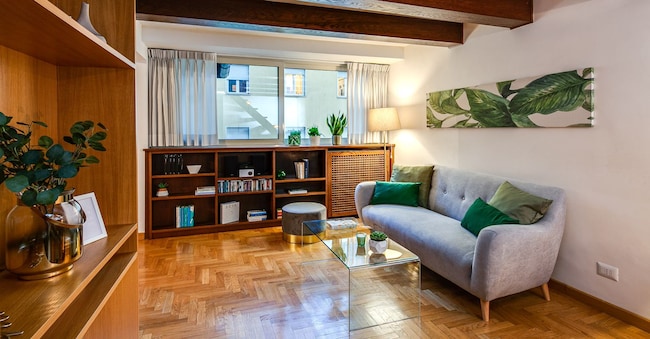
Home staging as the first act of a sales strategy, cutting negotiation time not only in the US but also in Italia. Between 2023 and 2025 Mari Team Immobiliare analysed more than 150 professional home staging operations carried out in the capital. On this basis, the data measured by the agency converges with the American statistical picture and translates the evidence to the local market.
On the Roman market, a second-hand home remains on sale for an average of 4.6 months, while properties enhanced with home staging register an average stay of 48 days - around one third of the market benchmark. On the price front, at the beginning of 2026, purchases and sales brokered by the agency in the central and semi-central areas of the capital closed on average (+0.32%) higher than commission prices, with peaks of up to +10% in cases of greater competition among buyers. However, the impact of staging is also measured by property type. For properties with low light levels (thanks to targeted interventions on light management between natural/artificial mixes, soft palettes, reflective surfaces), positive responses on first visits increased by over 70%. Positive evaluations on dated houses by revising furniture arrangements, more personal elements and restoring more harmonious proportions increase by 68%.
In the US, the latest edition of the International Association of Realtors' Profile of Home Staging highlighted how staging affects the buyer's ability to project themselves into the property, the value offered, and the length of time the listing stays on the market. 83% of agents who assist buyers say that the staged house makes it easier for buyers to imagine it as their future home. 26% say that staging influences the perception of most buyers; a further 60% recognise the effect on buyers at closing. Only 12% consider it irrelevant.
"The American data," emphasised Gianluca Mari, CEO and founder of Mari Team Immobiliare, "confirm what we observe every day on the market in Rome: the presentation of a property is no longer a cosmetic detail, it is the first lever on the final price. When the perceived value is consistent with the real value, competition between buyers is activated and results in upward bids. Staging, today, is a positioning tool, not a decoration tool'.
"The market," added Sanja Radovanovic, co-founder of Mari Team Immobiliare and global president of Gaphs - Global association of professional home stagers - "rewards consistency, starting with the price: a property should be priced realistically and placed in the correct market bracket. No staging makes up for an error in pricing. But consistency does not stop at the number: it means choosing the right furnishings for the right buyer. Study of the floor plan, study of the neighbourhood target, neutral furniture calibrated to the income bracket and lifestyle of the person who will actually live in that house. As Mari Team we have chosen to invest in our own furniture warehouse: each property receives furniture calibrated to the neighbourhood target and deliberately neutral because the staging must be the palette, not the picture. It is in the space we leave that the buyer projects himself. Staging is less manned as a professional category, less statistically measured, less told. This leaves room for evolution, but also exposes the market to a frequent simplification: reducing staging to aesthetic 'posing', or improperly entrusting it to virtual staging alone with the risk of building an expectation that the real visit then belies.
Brand connect


Newsletter RealEstate+
La newsletter premium dedicata al mondo del mercato immobiliare con inchieste esclusive, notizie, analisi ed approfondimenti
Abbonati