
The illusion of an apparently clear death
L'Amore non lo vede nessuno, directed by Piero Maccarinelli, with Stefania Rocca, Giorgio Crippa and Franca Penone, at the Teatro Quirino Roma, until 8 February

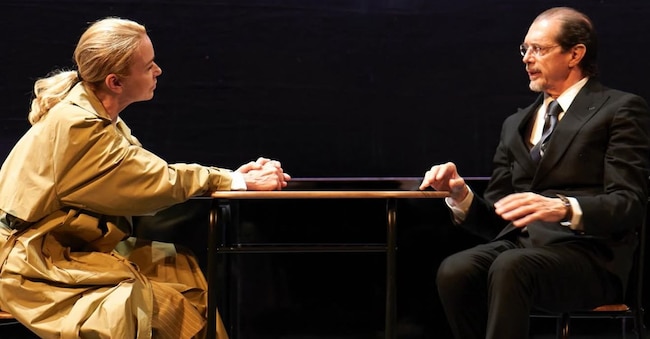
The love of the title cannot be seen because it does not ask to be believed. It does not need witnesses, it does not claim definitions, nor does it allow itself to be nailed down to a cause or a fault. In L'amore non lo vede nessuno, staged at the Teatro Quirino in Rome, it is what remains when words stop explaining and begin, finally, to hurt. The story, based on the book of the same name by Giovanni Grasso, directed by Piero Maccarinelli, begins with an apparently clear death, that of Federica, a victim of a car accident. Clarity is an illusion that the text patiently dismantles, choosing a structure made up of rejects, expectations and partial confessions.
Silvia (Stefania Rocca), the sister, does not seek the truth in the designated places - minutes, investigations and archives - but in an improper space: a suburban bar, anonymous and slightly equivocal, where every Tuesday she meets a stranger, Paolo (Giorgio Crippa) seen only once before, at a funeral. A pact is born between the two that has the rigour of an ancient rite: he will tell everything that has linked him to Federica, she will renounce knowing who he really is. It is in this suspension that the text finds its strength.
The question here is not "what happened?" but "how much are we willing to believe the other?". And again: how much are we willing to believe in ourselves? Trust, suggests Grasso, is not a moral act but an emotional necessity, often blind, sometimes desperate. Alongside Silvia moves Eugenia (Franca Penone), the friend, a figure of apparent balance, the bearer of a doubt that does not save, but warns, creating new ones. It is she who reminds us that storytelling can be a form of power, that the word, if accepted without defence, can rewrite memories and deform feelings, but Silvia proceeds anyway, attracted not so much by the man in front of her as by the possibility of recomposing an image of her sister that has always eluded her. Federica thus emerges as an ambiguous presence, never pacified, capable of absolute love and subtle cruelty, of radical dedication and secret calculations. She is not an enigma to be solved, but an irreducible figure, as the people we have loved most often are.
Maccarinelli's direction
Maccarinelli's direction accompanies this inner movement without overloading it in the two spaces - Silvia's petit-bourgeois house and the bar with the luminous green and yellow 'Totocalcio' sign - which are not mere environments, but states of the soul that coexist, reflect and contaminate each other. The music by Antonio Di Pofi are short sonic fissures that mark passages, falls and returns. The performers entrust to pauses and glances what the text deliberately leaves in the shadows. All three evolve and change (not just clothes) on stage and even when something seems 'phoned in', it really is not at all and the surprise will be all in the finale, after a game of revelations and reticence, where God does not appear as an answer, but as a further question, as a threshold, because it is the name we give to what we do not understand when pain exceeds our categories. Love, then, is neither consolation nor redemption, but an opaque force that traverses lives without guaranteeing salvation, imposing a choice anyway: to remain locked in one's own version of the facts or to accept that the other - dead or alive - continues to elude us.
Love is not seen by anyone is a text that looks at existence without indulgence or complacency, reminding us that forgiveness, when it comes, is not a magnanimous gesture, but rather an act of luminous exhaustion, the moment when we stop demanding a definitive truth and learn, perhaps, to live with what we will never know.

