
The narrative irony of Kerry James Marshall
The exhibition 'The Histories' is on view until 18 January at 'The Royal Academy' in London

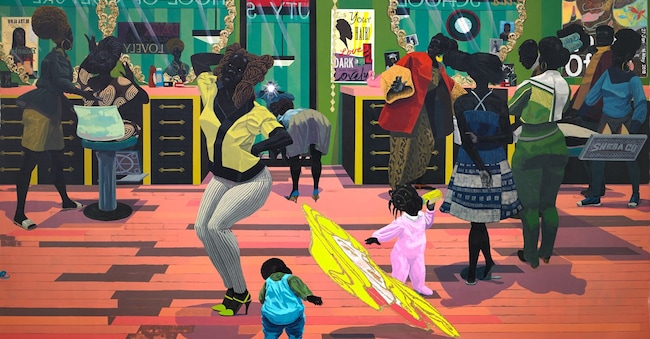
Kerry James Marshall was born an artist: at the age of four, he had already decided what he was going to do with his life and at ten, he was copying his favourite paintings (two allegories by Veronese) seen in the Los Angeles museum. As soon as he was able, he went to visit museums in New York and in particular to see Picasso's Guernica, a work he still considers an inspiration.
The American artist's respect and admiration for the European artistic tradition is visible in every painting in The Histories exhibition at the Royal Academy, the first major retrospective devoted to Marshall on this side of the Atlantic on the occasion of his 70th birthday. However, there is no trace of emulation or apocryphal imitation: Marshall's greatness lies precisely in the way he created his own completely original and unique narrative painting, painting pictures populated only by blacks in today's America, but tracing the origins of his art to the common roots of European art.
Turning the page to create something new does not mean despising history, according to Marshall, because the art of the past informs, inspires and nourishes the painter of today. With this choice, consistent and maintained over time, the artist as a young man distanced himself from the Black Arts Movement, which wanted to break with the 'white' past in order to devote itself solely to works of social protest.
The first two works in the exhibition depict a woman and a man, both black, holding a huge palette and a paintbrush, gazing into the eyes of the beholder, as if to emphasise that yes, black people paint too.
"Invisible man", 1986
Equally clear is the message of the painting 'Invisible man', from 1986, part of a series depicting a black man against a black background, with white eyes and teeth in evidence, as an ironic reminder of how black people have always been invisible in Western art. These paintings, as well as 'Self-Portrait of the Artist as Shadow of Himself', 1980, are made with egg tempera, a painting technique that dates back to the Sienese school of Duccio.

