The urban hyperuranium of Mauro Reggio
In the exhibition 'Ultraphysics' at Palazzo Merulana (until 2 November) the architecture of Rome recreated in paintings that are ideal images of the city

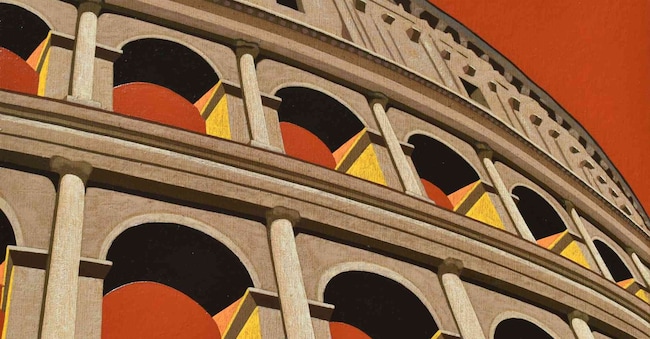
Symbols of Romanity, almost two thousand years apart, dialogue beyond time: the Flavian Amphitheatre, deprived of its marble covering, and the Palazzo della Civiltà Italiana at EUR, built in modern times and covered in travertine. It is this invisible bond that makes the two coliseums "twins" and unites all the architecture depicted in the paintings by Mauro Reggio (Rome, 1971) on show at Palazzo Merulana until 2 November with the title "Ultraphysics" (curated by Valeria Rufini Ferranti).
His paintings depict well-known elements of the capital - from the inner vault of the Pantheon (the 'oculus') to the aqueducts - suspended in a timeless space, where skies of synthetic colours generate an almost dreamlike atmosphere. During the visit, one has the feeling of walking through a familiar but hardly recognisable city. Some elements, such as the Capital She-wolf, are familiar but escape precise chronological placement. A disorienting effect, especially for those who believe they know Rome and its symbols inside out.
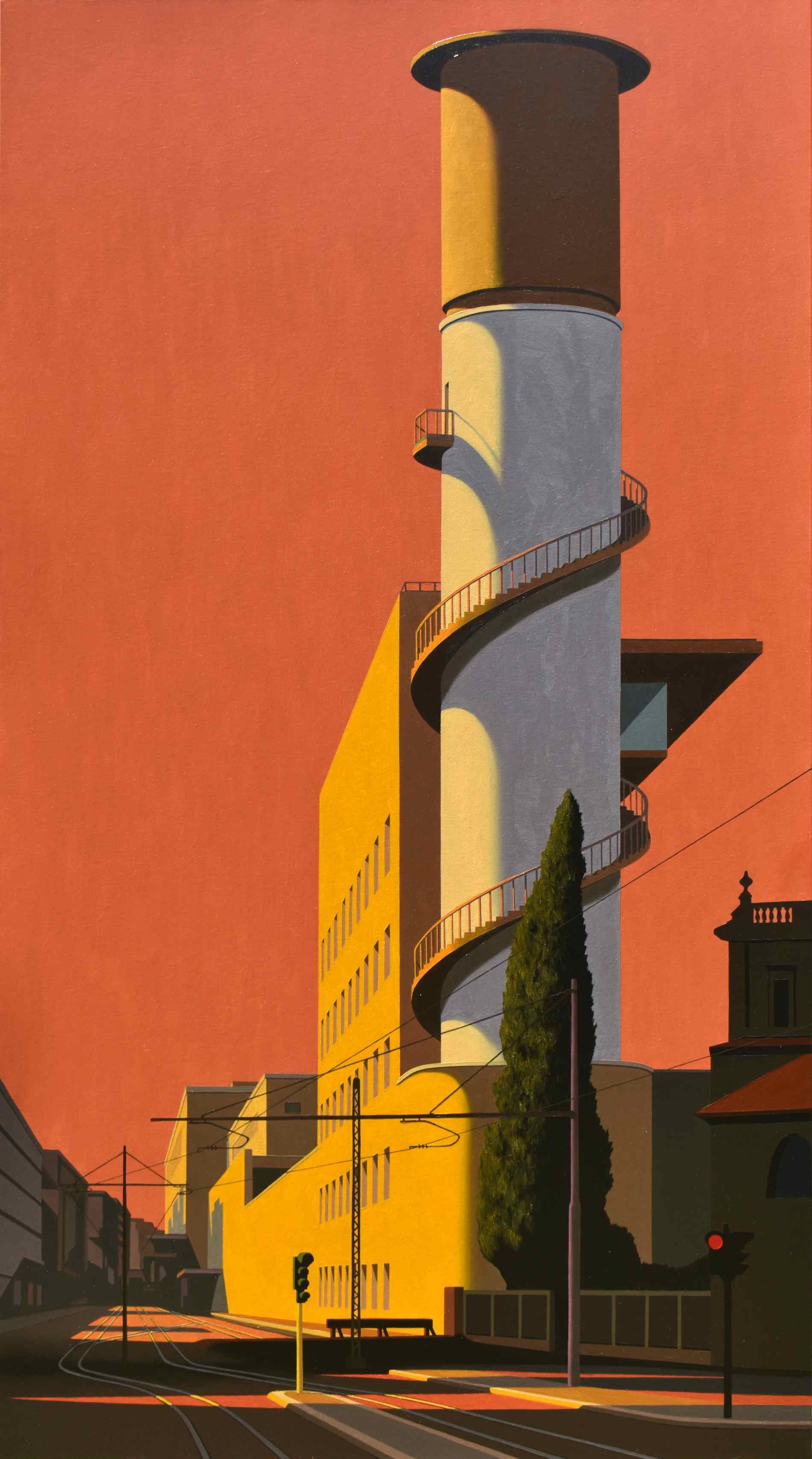
Having overcome this initial confusion, we are guided by Reggio into an "ideal city", where the urban landscape is recomposed with coherence and harmony, devoid of visual contrasts and "cleaned up" of signs, writing and human presence. An invitation to walk through spaces where there are no other spectators, bewitched by warm colours and essential surfaces that restore a feeling of balance. Even in usually chaotic areas, such as the area around Termini station. In Reggio's urban hyperuranium, the large cylindrical tank on via Giolitti, enveloped by its helicoidal staircase, becomes a perfect model that coexists in harmony with the small and precious church of Santa Bibiana, brutalised in its "copy" of reality.
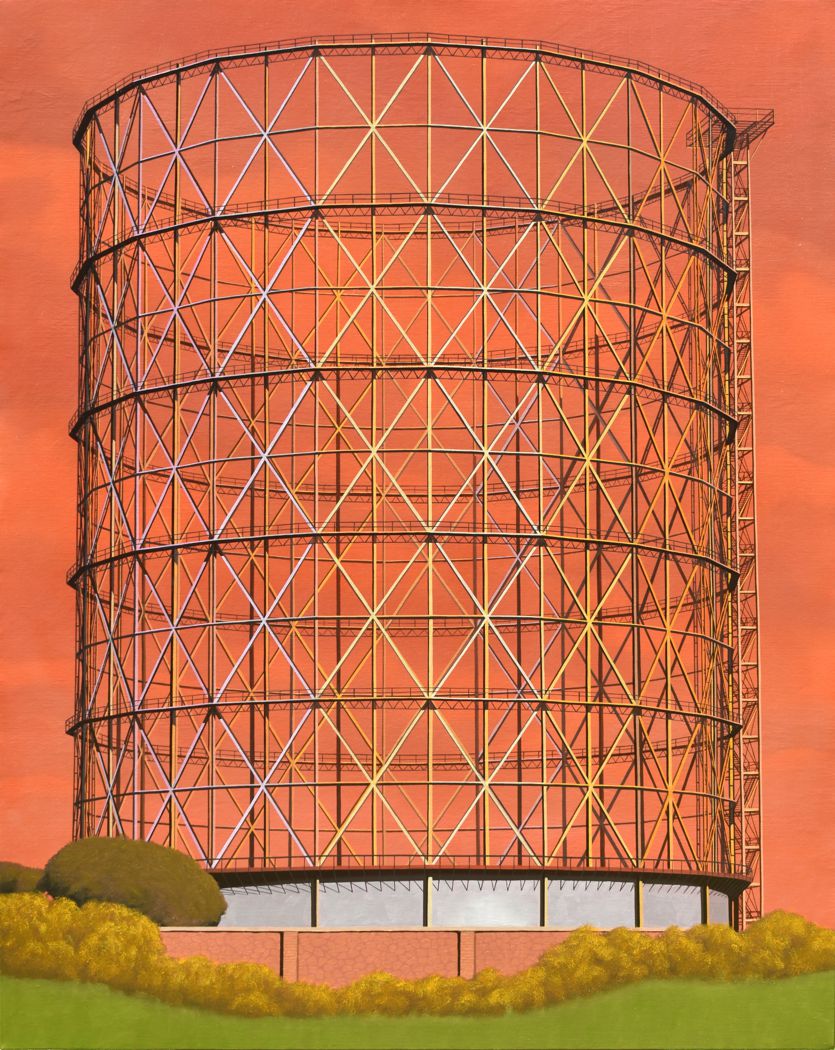
Looking at the works (the exhibition also includes non-Roman subjects such as the Duomo di Milano shot with a Flemish painting frontal), one can better understand what Reggio means when he says that "one falls in love with the things one sees every day". An observation that certainly applies to the aerial photograph of the Cinecittà district. But it is also the fascination exerted by another cylinder, this time empty like the Gazometro. An image already used in a completely different way by Renzo Vespignani in his line drawings and also taken up by the cinema, one of Reggio's first sources of inspiration.
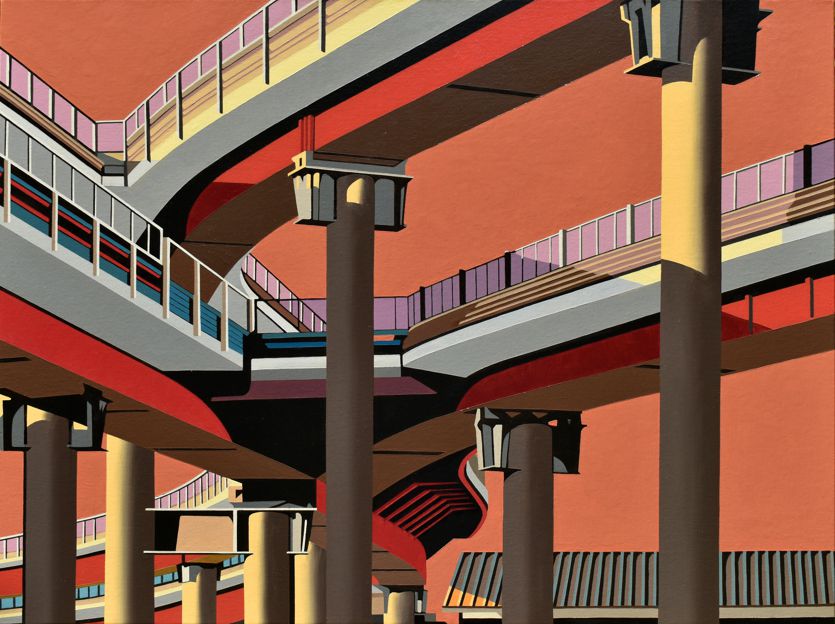
The most surprising treatment, however, is reserved for the East Ring Road, a recurring subject in the exhibition (as many as four canvases). A little-loved structure - not even the famous scene in Fantozzi (1975) in which the "accountant Ugo" catches the bus on the fly, throwing himself off the balcony of his house overlooking the viaduct, had managed to "humanise" it - and at risk of being demolished. The Veltroni junta voted for its demolition in 2002, right in the section of the San Lorenzo slipway: the same section that Reggio is now focusing on. If the project had been realised, we would still have seen its lanes at different heights, the curvilinear trend of the steel beams and the circular pillars with a large capital: everything rethought by Reggio as in an epiphany.