The September meeting

The ECB has raised interest rates by 25 basis points, with the deposit rate rising to 2.50 per cent. Lagarde: “There are upside risks to inflation and downside risks to growth”

ECB President on the digital euro: ‘We need legislation as soon as possible’

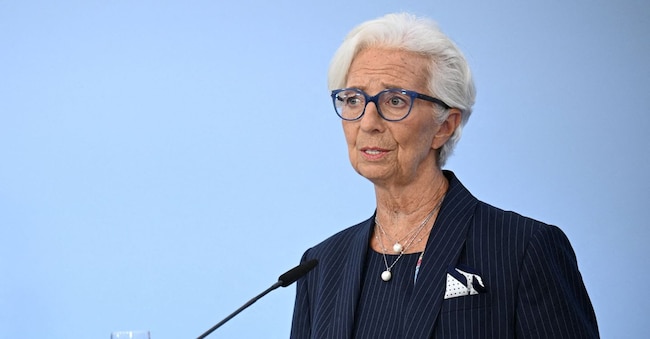
European Central Bank President Christine Lagarde and President of Deutsche Bundesbank Joachim Nagel take part in a press conference following a ECB Governing Council meeting at the guest house of the Deutsche Bundesbank in Berlin, Germany, August 10, 2026. REUTERS/Annegret Hilse REUTERS

5' min read

Translated by AI
Versione italiana

5' min read

Translated by AI
Versione italiana

The ECB Governing Council decided today, as expected, to raise, interest rates by 25 basis points and warned that ‘the conflict in the Middle East continues to exert inflationary pressures, which are expected to remain well above the target for a prolonged period’.

“Today’s decision – as emphasised in the post-meeting statement – underlines the Governing Council’s commitment to setting monetary policy in such a way as to ensure that inflation converges towards the 2 per cent target in the medium term.” “The outlook remains highly uncertain, with upside risks to inflation and downside risks to economic growth. With regard to the energy shock, the new scenarios drawn up by our experts illustrate the wide range of possible outcomes for growth and inflation, based on different assumptions regarding the intensity and duration of the shock, as well as its indirect and second-round effects. With today’s decision, the Governing Council remains well-positioned to address the uncertainty caused by the conflict.” To determine the appropriate monetary policy stance, the ECB “will follow a data-driven approach, whereby decisions are taken on a case-by-case basis at each meeting.”

Loading...

Lagarde: ‘Risks of inflation rising and economic growth falling’

“The outlook remains highly uncertain, with upside risks to inflation. Risks to growth remain skewed to the downside, particularly due to the war in the Middle East and Russia’s aggression against Ukraine. This is likely to keep headline inflation well above target until the first half of 2027.” This was stated by ECB President Christine Lagarde at a press conference in Berlin, following the announcement of the rate rise.

Specifically, Lagarde emphasised that inflation is expected to remain at levels ‘well above’ the ECB’s 2 per cent target: according to forecasts, it will be 3 per cent in 2026, 2.5 per cent in 2027 and 2.1 per cent in 2028, whilst inflation excluding energy and food is projected to stand at 2.5 per cent in 2026, 2.6 per cent in 2027 and 2.3 per cent in 2028. The outlook remains unchanged from June for 2026, but ‘is rising for 2027 and 2028’.

The economy proved resilient in the second quarter, despite the difficulties caused by the energy shock,” Lagarde went on to say. “Growth was widespread across countries and sectors,” and “this trend is likely to have continued into the third quarter,” she added.

“The manufacturing sector continues to show strong performance, whilst governments are increasing spending on defence and infrastructure.” Consumer confidence has also “rebounded from previous lows”, contributing to the recovery in services following the initial impact of the energy shock. “The rise in activities related to Artificial Intelligence is evident in digital services, business investment and exports,” Lagarde concluded.

A sharp rise in interest rates across all three scenarios

The ECB’s decision to raise interest rates by 25 basis points “is robust across all three scenarios”, stated Christine Lagarde, referring to the scenarios drawn up by the institution’s experts on the evolution of the energy shock. “We are once again producing a favourable scenario, an adverse scenario and a severe scenario”, she explained. The scenarios, she added, are drawn up by varying the assumptions regarding the trend of the main driver of the shock, “which is the price of energy”. Lagarde emphasised that the new scenarios will be published “tomorrow or in the coming days” and will show how they have evolved between June and September.

“The creation of a capital markets union is a key element. We need legislation on the digital euro as soon as possible”

“The creation of the Capital Markets Union is a key element,” Lagarde added at a press conference in Berlin. Furthermore, the digital euro is necessary to preserve European sovereignty and maintain control over the infrastructure through which payments are made. “With the transition to a world of digital payments, including by private operators, we believe it is important that the central bank’s currency takes on a digital form,” she stated. The digital euro also concerns “our ability to retain control over our currency and the channels through which digital payments flow”. “The payments infrastructure is part of our sovereignty. Anyone who does not control their own payments infrastructure is potentially vulnerable”, emphasised Lagarde, who expressed confidence that the legislation currently under negotiation between the European institutions would be approved as soon as possible, urging the Parliament and the Council to speed up the discussions. “I really hope,” she concluded, “that all this will be finalised quickly, so that we can begin the trial phase as soon as possible.”

‘Debt cancellation breaches the Treaties and is financially dangerous’

The write-off of the debt held by the central bank “makes no sense from a legal, technical or financial point of view” and would constitute a breach of the European Treaties, Lagarde stated in Berlin in response to a question about a proposal that has entered the French political debate. “It is not by repeating something that makes no sense—legally, technically or financially—that you make it valid,” Lagarde said. Debt cancellation, she pointed out, is governed by Article 123 of the Treaty on the Functioning of the European Union, which represents ‘one of the pillars of stability’ and has been approved by all Member States.

“Any initiative that were to interfere in this way with debt financing would constitute a plain and simple breach of the Treaty,” she emphasised. On a technical level, Lagarde referred to the views of the IMF’s former chief economist, Olivier Blanchard: “You don’t actually write off a debt by shifting money from one pocket to another. It isn’t written off.” The proposal would also be “financially dangerous”, because behind every loan there is a creditor. If a borrower announces that they will not repay what they have received, the lender will not be willing to grant them further credit, or will do so only at significantly higher interest rates. “From a legal, technical and financial point of view,” he concluded, “it really isn’t a good idea and is a huge waste of time, however popular it may be in any eurozone Member State.”

Loading...

‘The euro has never been so popular’

The euro has never been so popular in Europe and, in particular, in the eurozone,” Lagarde added, responding to a question about the rise of political parties opposed to the European Union and the single currency. “I believe that support for and a favourable view of our currency stand at 82 per cent,” Lagarde stated. “Of course, 82 per cent is not 100 per cent, and there will always be people who are dissatisfied, but it is the highest level we have ever recorded,” she emphasised.

‘We did not discuss the possible future path of interest rates’

We did not discuss any possible future path for interest rates at all, nor the likelihood of one decision or another,” said Lagarde, responding to a question about market expectations. “The entire discussion we had today focused on today’s decision,” Lagarde emphasised. In the current circumstances, she explained, the ECB must also analyse the shock, “primarily on the supply side”, assessing its intensity, duration and spread. “The markets do what they have to do and we do what we have to do,” said Lagarde. The ECB’s task remains to ensure price stability, as defined by the 2 per cent inflation target in the medium term. The President added that she believes these guidance on the policy framework help the markets to form their own assessments of the possible path of interest rates. “But they do their job and we do ours.”

“There’s nothing to say about my future; when the time comes, you’ll hear it from me”

“When there is something to report about me personally, you will be the first to know after my grandchildren. And there is nothing to report,” said ECB President Christine Lagarde in response to a question about the possibility of her stepping down as ECB President before the end of her term to take up the leadership of the World Economic Forum.


Copyright reserved ©
Loading...

Brand connect

Loading...

Newsletter

Notizie e approfondimenti sugli avvenimenti politici, economici e finanziari.

Iscriviti