
'La BD à tous les étages', the Centre Pompidou celebrates comics in Paris
With the term Bande Dessinée denoting the Franco-Belgian comic strip tradition, the 'Beaubourg' celebrates in all its spaces what the French critic Claude Beylie called the ninth art
4' min read
4' min read
In collaboration with the Fonds Hélène & Édouard Leclerc, the Parisian institution organised the series of events entitled "La BD à tous les étages", which will end on 4 November 2024. At the centre is the diversity and richness of this genre investigated in all its aspects. The path of the curatorial project unfolds through several sections, each of which aims to explore the different facets and periods of this artistic genre.
The main body is the exhibition 'Bande dessinée, 1964-2024', which offers a historical and thematic journey through sixty years of comics, comparing three important traditions: European creation, Asian manga and American comics. One of the pivotal focuses investigates key moments in the history of comics, from the counterculture of the 1960s, with works such as those of Robert Crumb, to the more contemporary and experimental outcomes. The exhibition is accompanied by a series of collateral activities such as workshops, laboratories, talks also for the very young.
The exhibition sections
Twelve are the sections into which the exhibition is divided, each retracing a significant historical moment for comics as the Contre - culture that corresponds to the 1960s and refers to comics as a form of entertainment for young people. With the birth of the first user associations, this genre is finally legitimised in the cultural sphere, publishing initiatives flourish with a focus on an adult audience. In France, the humour magazine Hara-Kiri, defined as 'silly and naughty', which inaugurated humour in a graphic key, became popular. Jean- Claude Forest published the famous albums dedicated to Barbarella, while in 1964 the avant-garde monthly Garo appeared in Japan, declining the authorial concept of comics. In 1968 in America, Robert Crumb with Zap Comix became the leader of the underground movement. This was followed by a section devoted to comic strips and caricature; a genre published in the satirical newspapers of the Belle époque. Humour expressed in short forms ranged from parody to satire. It continued with horror comics. The occult was developed as a theme in the 1940s in America before it was censored in 1954. This genre was hugely successful in Japan mainly due to the figure of Kazuo Umezo. Still the dream element in comics has the same importance as the real one. Especially In Winsor McCay's Little Nemo in Slumberland, parallel universes inspired by the currents of surrealism with psychedelic elements are depicted. Contemporary artists such as Julie Doucet and David B. draw on "the nocturnal manifestations of the unconscious, with the dream appearing as a gateway to the self".
For a long time, comics have emphasised the dimension of travel in its exotic sense. Contemporary production, on the contrary, proposes more contemplative, introspective reading experiences, immovable as a metaphor for narrating the intimate component of the characters. Chris Ware, for instance, dissects the everyday life of ordinary people living in the same building ("Building Stories"). Taniguchi follows the steps of a 'Walking Man', while McGuire traces the history of a corner of deep America ('Here'). Autobiography as a theme appeared in the late 1960s in Japan, early 1970s in the US. The genre, which has become very popular especially for narrating the female universe in the ninth art, is dealt with through childhood stories, chronicles of professional life, intimate confessions, autofiction, diaries, notebooks.
Black and white
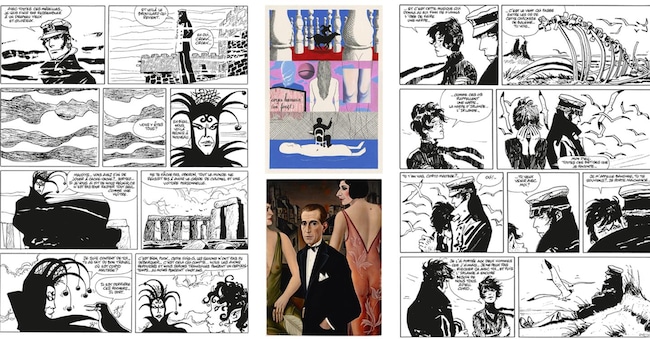
An entire section is devoted to black and white, in some cases the choice to use these two colours is linked to economic constraints, and addresses an autonomous expressive power. Many illustrators set their aesthetics on chiaroscuro based on techniques ranging from scratchboard to shadow drawing, from line to stain, each artist imposing their own technique that shows the pictorial derivation of drawing. Another theme explored is the tragic events of the 20th century, such as the First and Second World Wars. Among the exhibited plates are those by Spiegelman, Nakazawa and Guibert.

