
The hand of God makes the Croisette rejoice
A documentary by Juan Cabral and Santiago Franco reconstructs the Argentina-England match at the 1986 World Cup with the protagonists of the time
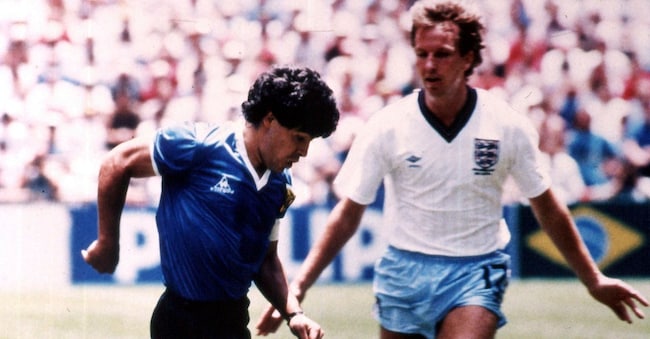
Ninety-one minutes is the exact duration of The match by Juan Cabral and his co-director Santiago Franco, as that of the historic Argentina-England match in the 1986 World Cup quarter-finals in Mexico City. Ninety minutes of play, one minute of added time, played forty years ago between the national football teams of Argentina and England. It was a memorable match not only because of Diego Armando Maradona's goals, but also because the two states were meeting for the first time on an official occasion after the war that had cost so much in casualties for the Malvinas (if you look at it from the Argentine side) or the Falklands (if you look at it from the English side).
History and players
The protagonist of the documentary, presented at Cannes Première, is of course the archive material of the match and the historical context that prepared the 73-day war with losses mainly among Argentine soldiers and ended with the victory of the United Kingdom. In addition to this, there are the players placed in front of a giant video to spy on their reaction as the images of the match roll by: Gary Lineker, John Barnes, Jorge Burruchaga, Jorge Valdano, Oscar Ruggeri, Peter Shilton, Ricardo Giusti, Giulio Olorarioechea.
The Aesthetics of Documentary
The documentary begins with the players filmed as if they were the stars of a great modern-day sports show: sculpted in black and white like gladiators. It was they, in fact, who suffered the culmination of more than two centuries of tension and conflict between the two nations. Back then, football was pervasive in people's lives, the players were supermen, Maradona a god: commentators called him Diegoool, you couldn't get the ball off his foot. But the other protagonists were no less singular: Argentina's coach Carlos Bilardo tackled the team with extremely difficult mathematical schemes, but he was also a slave to the superstitions he imposed on everyone. On the other side, there was Gary Lineker, the World Cup's top scorer, and Peter Shilton, the player who played the most matches. They were all signed separately, in a neutral place, then found themselves in the same room, each speaking their own language, but understanding each other, especially in their admiration for Maradona.
La mano de Dios
The documentary painstakingly reconstructs the most controversial goal in football history, scored by Maradona minutes before he scored the 'most beautiful' goal in football history. The reconstruction is done with images, replays, photographs, comments from teammates and even an explanation of how that memorable phrase, 'Mano de Dios' attributed to a reporter and attributed to Maradona who had only nodded. But everyone remembers that prodigy with a smile on their face.
At half-time, a white dove enters the stadium and lands on a door. Andrés Burgo, the author of the book on which the documentary is based, drew inspiration from this image, and the filmmakers rushed to retrieve it as a good omen for our times as well.


