
The first encyclical of Leo XIV: centrality of the person before the challenge of AI
'Magnifica humanitas' is the manifesto of the American Pope's pontificate: an ideal continuation of Leo XIII's Rerum Novarum of 1891

Key points
Centrality and dignity of the human person. Faced with the serious (and new) problems of our times, the dignity of work, truth, but also justice and peace must be promoted, cultivating a healthy realism with a long-term vision, promoting the culture of encounter. The first encyclical of Leo XIV, Magnifica humanitas, is certainly the 'manifesto' of his pontificate, with the urgency of having a human approach, precisely, towards artificial intelligence, one of the main challenges of the contemporary age.
The first presentation with a pontiff
The first lines give a glimpse of the papal thought: 'The magnificent humanity created by God is today faced with a decisive choice: erect a new tower of Babel or build the city where God and humanity dwell together'. The document, which confirms the centrality of the Social Doctrine of the Church, was signed by Robert Prevost on 15 May last, on the 135th anniversary of the promulgation of the Rerum Novarum of Leo XIII, the pontiff from whom it is inspired, who faced the challenges and contradictions of the industrial revolution.
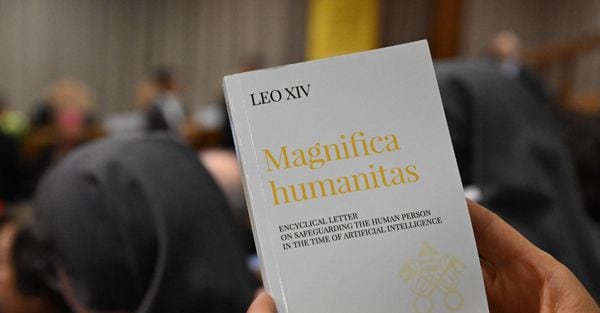
The encyclical was presented on 25 May by the Pontiff himself, a unique case to date, and among others also by Cristopher Olah, co-founder of Anthopic, an AI giant that in recent years has promoted development models geared towards transparency and reducing the social risks of new technologies, and which under the Trump administration has come into conflict with the Pentagon.
"Disarming" artificial intelligence
"Disarming' AI means removing it from the logic of armed competition, which today is no longer just military but economic and cognitive. This is the starting point for understanding the encyclical's path: 'Technology,' writes Leo, 'can heal, connect, educate, guard the Common Home; but it can also divide, discard, generate new injustices. In the abstract, it is not in itself a solution to humanity's problems, just as it is not in itself an evil; but, concretely, it is not neutral, because it takes on the face of those who think it up, finance it, regulate it, use it. The issue today for the American pope is 'disarming' AI, which 'means removing it from the logic of armed competition, which today is no longer just military but economic and cognitive. It is the race for the best performing algorithm and the largest database, in order to consolidate a geopolitical or commercial advantage over all others. Disarming means breaking this equivalence between technical power and the right to rule. Disarming does not mean giving up technology, but preventing it from dominating the human. It means taking it away from monopolies, making it debatable, contestable, and therefore inhabitable, returning it to the plurality of human cultures and forms of life. The task today is not only ethical or technical: it is ecological in the most radical sense, because it calls into question a new dimension of our common home. AI is already an environment in which we are immersed and a power with which we must come to terms. For this, it is not enough to regulate it: it must be disarmed and made hospitable'.


