
Puglia facing the challenge of reconversion
by Giuseppe Coco, Claudio De Vincenti and Raffaele Lagravinese
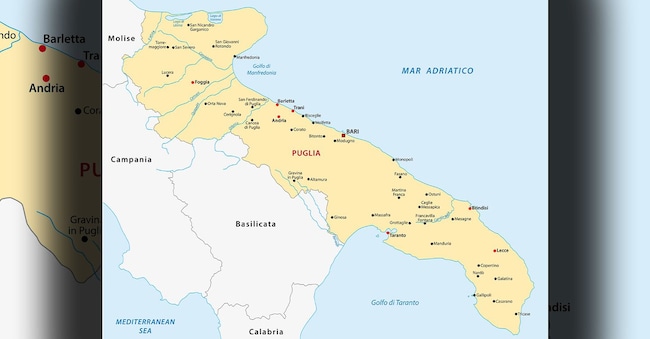
The approach of the regional elections suggests conducting an analysis of the transformations and criticalities of the Apulian economy, proposing an agenda of priorities for the future. This is what we propose in the Manifesto per la Crescita della Puglia (the next Policy Brief by the Merita Foundation in collaboration with the European University Institute), a summary of which is provided in this note (as anticipated by Buti and De Vincenti in Il Sole 24 Ore on 18 September).
Apulia emerges from the double shock of the financial crisis and the pandemic with significant economic growth: from 2015 to 2023, per capita GDP increases by almost 13%, more than the national and Mezzogiorno averages, while the unemployment and Neet rates are substantially reduced.
However, this macroeconomic dynamic rests on fragile foundations: labour productivity is stagnant and employment growth is concentrated in low value-added sectors, such as tourism, trade and catering, to the detriment of manufacturing.
The value added per hour worked in the regional economy as a whole remains close to the levels of the beginning of the century and has lost in comparison with Italy and also the southern distribution, despite the strong recovery in recent years. This is a gap that opened up in the three-year period 2005-2008 and has never been closed since. The causes of this comparative deterioration in productivity lie mainly in the change in the region's production structure.
Since 2004, trade and tourism have gained six percentage points in share of regional added value, while industry in the narrow sense has lost three points. Gross fixed investments, while satisfactory in aggregate, are still below the levels of twenty-five years ago in the industrial sector, despite a recent partial recovery. Exports are growing less than in the rest of the country and the Mezzogiorno, with a worrying contraction in 2024-25. The weakening of the productive structure and the insufficiency of industrial investments are reflected in wages, which for the Apulian economy as a whole will lose about 10% in real terms from 2010 to 2023. At the same time, human capital remains a serious weakness even compared to the average for the South: only one young person in four (24.4%) between the ages of 25 and 34 has a university degree, and the student migration balance is strongly negative.

