Sustainable development

The restoration of the lakes is giving Gujarat a new lease of life

A project by the Dholakia Foundation has restored water to the Indian region, bringing benefits to agriculture and the environment

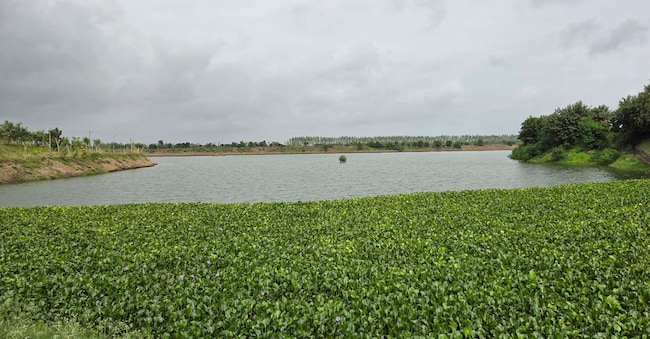
Uno dei 169 laghi creati dalla Dholakia Foundation nell’ambito del progetto Mission River nello Stato del Gujarat

4' min read

Translated by AI
Versione italiana

4' min read

Translated by AI
Versione italiana

DUDHALA (GUJARAT) – In this remote corner of western India, the distance between a precarious existence – spent farming some of the least fertile land on the subcontinent – and a life comfortable enough to send a child to study in Germany is measured in feet. In the case of Ghanshyam Khunt, a 58-year-old farmer, it is exactly 25 feet – the distance needed to fetch water from a well.

“Over the years,” he explains, “the water level had dropped to as low as 90 feet.” Then, between 2018 and 2019, things began to change. The water returned, “and by irrigating the land more effectively, the cotton yield rose from 7 to 21 quintals per hectare. This, together with the possibility of growing pulses during the winter, has increased my income fivefold,” explains Khunt.

Loading...

Behind the small economic miracle that is changing this family’s fortunes lies the vision of one of India’s 1,000 richest men. Savji Dholakia is the best-known entrepreneur in Surat, the tough and ambitious city where around 90 per cent of the world’s traded diamonds are processed, but he spent his childhood in these villages, swimming in a river that no longer exists.

Now, thanks to the work of the Dholakia Foundation, in place of that watercourse which had silted up until it disappeared, there are some of the 169 lakes that have been restored as part of the Mission River project.
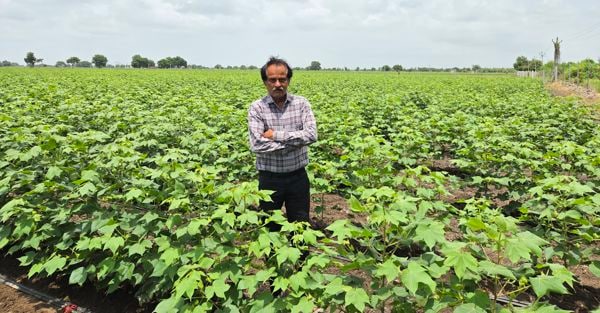
Ghanshyam Khunt, 58 anni, agricoltore

Water returned just in time to hold together a community that was falling apart, to swell the ranks of what – for want of a harsher term that better reflects the reality of the country – we might call the urban underclass.

“I didn’t want to be remembered solely for the wealth I’ve amassed,” says Dholakia at the end of a lunch which, as is customary in Gujarat, is strictly vegetarian. “What better sector than water, on which life depends – not just for us humans, but for all creatures?”

The author attempts to highlight an area that is even more crucial for India’s future: education. But Dholakia, who is 63 years old and has ancestral ties to this land, views the world through the lens of his sense of belonging. ‘I,’ he explains, ‘am not a highly educated person, and I know that I can only be effective if I focus on what I really know.’

The issue of water is so pervasive in India today that you don’t need to have spent your childhood by a river to realise how important it is. All you need to do is live in a city like Delhi, where more than four in ten homes are not connected to the sewerage system and where nearly 5,200 million litres of untreated water are discharged into the Yamuna every day.

The problems downstream of the metropolis are no less serious than those upstream. Every household in the Indian capital receives water for a couple of hours a day, during which those who can afford pumps and cisterns draw as much as possible, whilst the rest fill their buckets and wait resignedly to be fleeced by the water tankers controlled by the ‘water mafia’. This is a problem that is perhaps more acute in Delhi than elsewhere, but one shared by many of the country’s major cities.

“In 1910, there were well over a thousand lakes in Bangalore. Today, around 300 remain. Houses, stadiums and stations have been built on top of the others,” says Anand Malligavad, an engineer who left his job in 2019 to set up a foundation specialising in restoring the lakes of India’s IT capital. “We saved the first lake from unauthorised development, rubbish and industrial waste in 45 days, spending less than 90,000 euros. A fraction of the costs and time estimated by the government.”

Loading...

Today, the Malligavad Foundation has revitalised 52 lakes, despite resistance from the public sector (“we don’t pay bribes”). “But,” explains its founder, “if we were to adopt European best practices, we could return to where we were in 1996, when we used to drink tap water in Bangalore without filtering it. Today, I don’t know anyone who would even dream of doing that.”

It is surprising that the need to protect water resources has not yet been recognised by all the components that make up the vast mosaic of Indian public administration, because the figures leave little room for doubt. ‘Fifty years ago, annual water availability stood at 5,144 cubic metres per person. Today, we fluctuate between 1,200 and 1,300, with some estimates placing us below the 1,000 mark,’ explains Anshuman, an alumnus of the prestigious Indian Institute of Technology, Delhi, who has renounced his surname in protest against its caste-based connotations and who now heads the Water Resources Division at TERI (The Energy and Resources Institute).

A deficit that fuels increasingly unsustainable trends, such as those in Gurgaon, the most modern and attractive of Delhi’s satellite towns, where, over the course of a year, 300 per cent of the water that returns to the aquifer via rainfall is extracted from it.

However reprehensible it may be, the indifference with which the wealthy classes appropriate shared resources is only a small part of the problem. The efficiency rate of the Indian water system – collection, storage, transport and use – fluctuates between 35 and 38 per cent. The rest is lost.

Not to mention that the agricultural sector – responsible for 80 per cent of water consumption – continues to be governed by a system of incentives which, in order to ensure food security and reward an influential electoral constituency, promote crops that require large quantities of water, even in regions that are not naturally suited to the cultivation of rice and sugar cane.

These are policy choices which, far from being reconsidered, are being repeated in the age of artificial intelligence. Data centres use large quantities of water for their cooling systems. According to Rystad Energy, Jamnagar in Gujarat – an arid state, yet close to the centres of government and to the tycoons most aligned with the executive – is among the cities worldwide most at risk due to the water consumption associated with their operations.

Copyright reserved ©
Loading...

Brand connect

Loading...

Newsletter

Notizie e approfondimenti sugli avvenimenti politici, economici e finanziari.

Iscriviti