
Lancia in motorsport: the roots and the long-awaited return with the Ypsilon Rally4 HF
The Turin-based manufacturer made thousands of fans around the world dream when it was the brand to beat and now it is ready to return with a Rally4 car.

4' min read
Key points
4' min read
For two decades, Fiat, together with the Lancia brand, made its mark globally by winning fourteen world rally titles. From 1972, when there was still talk of an international title, the Lancia Fulvia Coupé HF won the championship, up to the undisputed domination of the Lancia Delta Integrale in the 1980s and early 1990s, passing through the golden years of the Lancia Stratos, the legendary Fiat 131 Abarth and the Lancia 037, the latter also the last two-wheel drive car to win in the world championship.
Four, the models of history
.There were four winning models in the group: Lancia Fulvia Coupé HF, Fiat 131 Abarth, Lancia 037 and Lancia Delta HF. But from 1969 to 1986, a car was produced that was a great school for the drivers who went on to the world championships, it was the legendary Autobianchi A112 Abarth.The Turin-based manufacturer's commitment was realised with participation in the first thirteen world rally championships, from 1970 to 1982. It then returned with the Lancia brand, purchased in 1969 until its definitive retirement in 1992.The first satisfactions came in 1972 with the Lancia Fulvia Coupé HF, in the 1,600 version that debuted at the 1965 Tour de Corse, a few months after its presentation at the Turin Motor Show.This car, after numerous successes, won the world championship for makes in 1972, which would become the current world constructors' championship the following year.Then came the time for another car. For three years in a row, from 1974 to 1976, Lancia conquered the top of the constructors' rally world championship with the legendary Stratos. A car with a very special design (designed by the Bertone coachbuilder) that still shows only limited signs of time today. This was the first car built specifically for rallying. Both the engine and transmission were those of the Ferrari Dino 246: a 2.4-litre 6-cylinder V-engine. These were combined with a central steel monocoque chassis, features that made the Stratos a very competitive sports car. Slow production at the Bertone factory in Grugnisco forced the Stratos to compete as a Group 5 (limited edition car) until the required number of units for Group 4 homologation was reached, which was 400.Although the Stratos continued to be a winning car, with no major rivals, the Fiat group stopped using it as an official World Rally car in 1977 to replace it with the Fiat 131 Abarth: an obviously commercial choice to promote the image of Mirafiori's new family-friendly model.The '31' was powered by a 2-litre 4-cylinder inline 16-valve engine with two camshafts coupled to a five-speed manual gearbox with a self-locking differential. Drive was obviously rear-wheel drive.
The Delta and the (temporary) end of Lancia in rallying
After the 037, Lancia (Audi had already developed it) also started to adopt all-wheel drive. First with the famous Group Bs, extremely high-performance cars with 600 hp engines and a mass of 900 kg. Numerous accidents occurred with these cars (such as the Lancia S4), mainly due to the extreme power of the cars and to chassis and tyres that were not able to guarantee sufficient stability and safety at the time. The farewell came in 1986, after only four seasons. Beginning with the 1987 World Rally Championship, the FIA (International Automobile Federation) introduced new technical regulations for the cars, which led to the exclusion of the previous Group B cars in favour of the less sophisticated and safer Group A. To cope with this change in regulations, Lancia produced the Lancia Delta 4WD. A car that proved competitive right from its debut, winning both the constructors' and drivers' titles in 1987. Its story was short-lived, however, because during the 1988 season it was replaced by the Lancia Delta Integrale. This was an update of its predecessor, fitted with a 2-litre turbocharged engine equipped with an intercooler and renewed electronics management. Year after year it was updated with a few developments and this constant work brought it to the top of the world for five consecutive years, from 1988 to 1992.Then a market choice: the Fiat Group could not keep two brands like Lancia and Alfa Romeo in competition and the choice was to favour the Biscione brand.
Lancia's return to rallying with the Ypsilon Rally4 HF
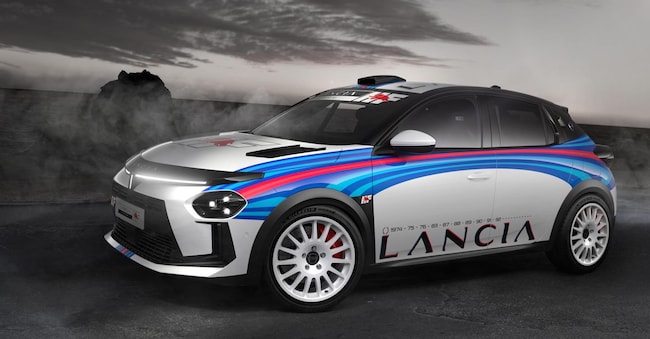
27 May 2024 is a historic date because it is the day of the announcement of Lancia's return to competition. The brand, now part of the Italo-French Stellantis group, is ready to return to rallying with the Ypsilon HF Rally4, a car that, like its road version, shares many details with the Peugeot 208 and Opel Corsa. Indeed, a return to competition by Lancia has been rumoured for some time, a strategy that could also bring prestige to the group given the high value and international recognition that the Turin-based brand has enjoyed over the years. The Lancia Ypsilon Rally4 HF is powered by a 1.2-litre turbo 3-cylinder, 4-valve per cylinder engine developing 212 hp. Equipped with front-wheel drive with 5-speed mechanical transmission and mechanical self-locking differential, the high-performance model is an ideal solution for the enjoyment of all rally enthusiasts, but also a serious contender for drivers who aspire to victory in the R4 category and two-wheel drive championships.The rally debut is set for the 2025 season.

